
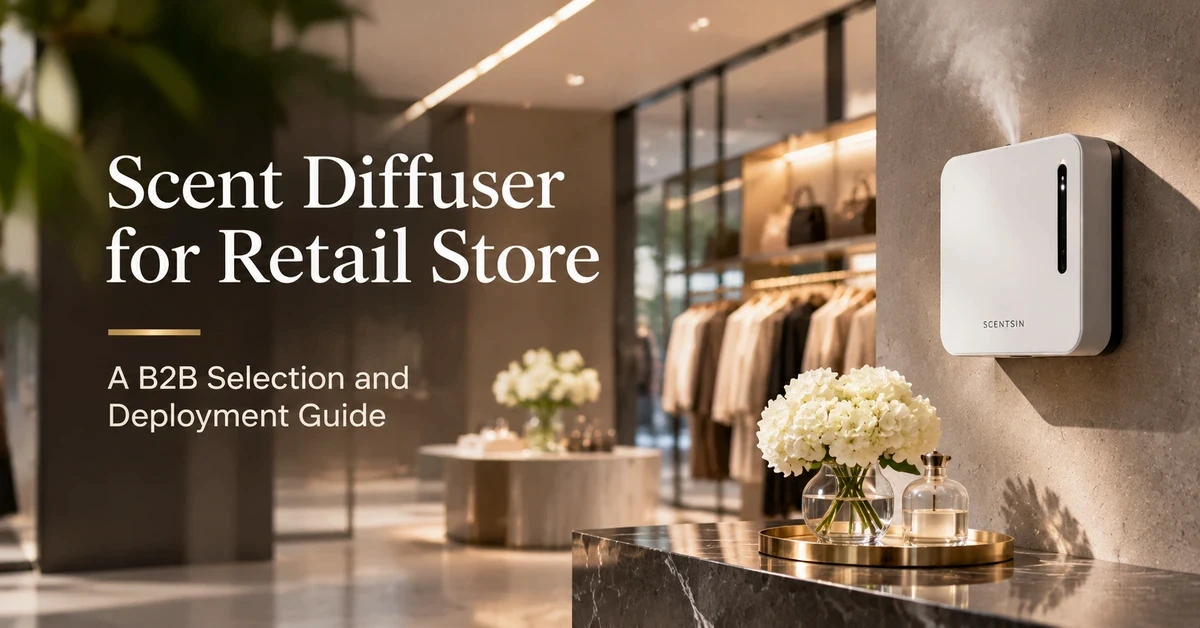
Short answer: the best scent diffuser for a retail store is the one that delivers a controlled fragrance in the customer zone without creating an excessive plume at the entrance, distracting noise, difficult refills, or an oil bill that the store cannot sustain. Select it from the store volume, HVAC pattern, opening hours, visitor path, placement restrictions, fragrance format, and service plan. Use the published coverage of a machine to build a shortlist, then verify the actual result with a site trial.
Review the S600plus Retail Options
What Does a Retail Store Scent Diffuser Need to Do?
A retail scent diffuser should support a defined customer journey. It may create a recognizable atmosphere at the entrance, make a showroom feel more considered, support a premium product category, or provide a consistent brand cue across several branches. The machine is only one part of the system. The fragrance, bottle, atomizer, controls, placement, ventilation, schedule and service routine all influence the result.
Before comparing models, write the brief in operational language:
- Store volume: floor area, average ceiling height, open connections, partitions, fitting rooms and back-of-house areas.
- Air movement: supply and return vents, doors, escalators, fans, open storefronts, exhaust paths and seasonal HVAC changes.
- Customer path: entrance, queue, display wall, consultation area, checkout and the places where visitors normally pause.
- Opening schedule: pre-opening preparation, customer hours, cleaning windows, late-night security and campaign events.
- People constraints: staff sensitivity, fragrance policies, visitor feedback process and the location of the nearest occupied workstation.
- Service model: who refills the machine, where oil is stored, how faults are reported and how multiple stores will use the same settings.
This brief makes the supplier answer a testable question: for example, a quiet wall unit for a 320 m3 boutique, open ten hours per day, with a defined outlet position and monthly refill visit.
How to Size a Scent Diffuser for a Retail Store
Start with approximate volume by multiplying usable floor area by average ceiling height. Then mark the air supply, air return, doors and open connections. Two stores with the same floor area can need different machines because one has a low ceiling and stable air while the other has a high ceiling, a frequently opened door and a strong exhaust path. Coverage is therefore a screening value, not the final design.
Use published coverage as a selection ladder
The Scentsin S600plus family publishes four configurations that help a buyer compare scale: S600 at 600 m3, S1500 at 1,500 m3, S3000 at 3,000 m3 and S6000 at 6,000 m3. The same page lists 150 ml, 500 ml, 1,000 ml and 1,000 ml capacities, with reference oil consumption from 1.8 ml/h to 10 ml/h. It also shows different power and noise thresholds. These figures are useful for creating a shortlist, but they do not describe how evenly fragrance will reach a retail floor.
| Configuration | Published coverage | Capacity | Reference consumption | Retail buying question |
|---|---|---|---|---|
| S600 | 600 m3 | 150 ml | 1.8 ml/h | Can it cover the defined sales zone without placing the machine beside staff? |
| S1500 | 1,500 m3 | 500 ml | 3.2 ml/h | Does the larger reservoir reduce service visits without creating excessive output? |
| S3000 | 3,000 m3 | 1,000 ml | 6 ml/h | Is the store open enough to justify this output and refill size? |
| S6000 | 6,000 m3 | 1,000 ml | 10 ml/h | Will sound, oil cost and fragrance intensity remain acceptable near occupied retail areas? |
A simple arithmetic check can expose an unrealistic refill plan. At the published S600 reference of 1.8 ml/h, ten hours per day for 26 days is about 468 ml before duty-cycle adjustment; S3000 at 6 ml/h would be about 1,560 ml. These are planning calculations, not promises. Actual use changes with output, pauses, formula, temperature and usable fill level.
When one store needs more than one zone
A department store, connected showroom or large lifestyle shop may have a front entrance, a central sales floor and a consultation zone with different airflow. One high-output machine can create a strong point source while leaving another area weak. Two lower-output units with separate schedules may be easier to balance and service. Ask the supplier to evaluate zones rather than simply multiplying the largest coverage number.
For an HVAC-connected project, the decision is different again. The C400 product information uses HVAC scent diffuser language and lists a 150 ml capacity, 8 W power, 12 V input and metal construction. Those details identify a product direction, not proof that it fits every duct, fan, filter or building-control system. Request injection-point drawings, airflow and pressure requirements, access details, oil compatibility and commissioning responsibility before specifying HVAC integration.
Choose the Diffuser Format by Retail Store Scenario
Retail buyers usually compare four formats: compact wall/tabletop, larger commercial wall, floor-standing display, or HVAC-connected. The right choice depends on customer area, visual merchandising and service access.
| Retail scenario | Starting format | Why it may fit | Approval gate |
|---|---|---|---|
| Small boutique, reception or consultation room | S600, C400 or a compact 150 ml class | Lower reservoir and smaller footprint can suit a defined zone. | Confirm noise, output range, refill access and outlet position. |
| Medium fashion, beauty or lifestyle store | S1500 or S3000 | Larger capacity and remote-control options can support opening-hour schedules. | Run a visitor-path trial and compare oil cost with staff comfort. |
| Large showroom, department-store area or flagship | AS3000S, S3000TF or multi-zone S600plus | Higher capacity, visible floor-standing options or zone control can support a larger footprint. | Require site plan, security, sound, refill route and service approval. |
| Store connected to building HVAC | C400 HVAC direction or custom system review | Air-handling distribution may reduce visible equipment in the sales area. | Obtain duct drawings, airflow data, injection point and commissioning scope. |
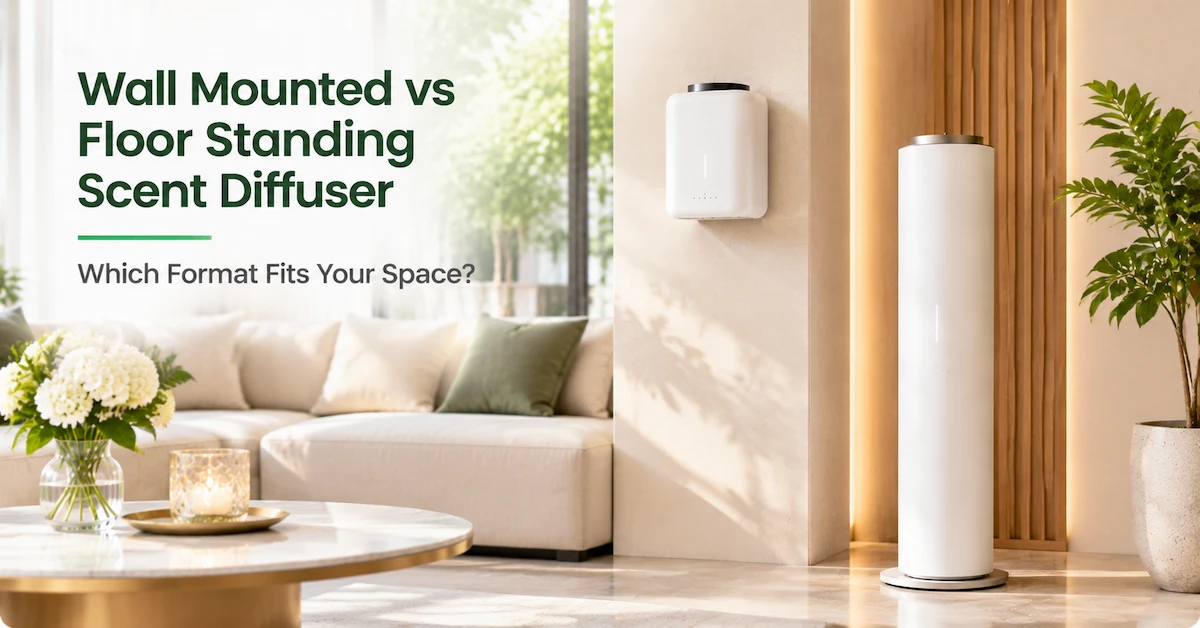
Wall-mounted or concealed placement
A wall-mounted diffuser can keep the machine away from display tables and protect the refill bottle from customer contact. It also makes cable routing and service access important. Mount it where the outlet can discharge into the moving air without pointing directly at a staff desk, fitting-room queue or a sensitive product. Leave the clearance required by the manufacturer, and do not hide the machine behind a display panel that blocks the outlet or prevents a refill inspection.
Floor-standing or visible display placement
A floor-standing unit can become part of a flagship store's visual environment, but the base must not narrow a walkway and the bottle should not be reachable by customers. The S3000TF direction includes floor-standing design, app remote control and a magnetic security lock; confirm the current configuration and dimensions before planning the fixture.
HVAC placement
HVAC distribution can create a cleaner retail floor, but commissioning must be treated as an engineering task. A scent injection point near a return may pull fragrance away before it reaches customers. A filter, damper or pressure change can alter output. Request the connection method, permitted oil, access panel location and shutdown procedure before ordering equipment.
Review a Large-Format Retail Machine
Plan Retail Placement Around the Customer Journey
Placement determines whether the shopper experiences a smooth brand cue or a strong cloud at the door. Start with the path customers actually take, not the location where the power outlet happens to be. Mark the entrance, first pause, central aisle, consultation area, checkout, staff zone and HVAC supply and return points on the floor plan.
- Keep the entrance gentle: an open door creates rapid air exchange. A diffuser immediately beside the doorway may waste oil outside or create a sharp first impression.
- Use a circulation path: place the outlet where normal air movement carries scent toward the customer zone, not straight into an exhaust.
- Protect staff: avoid placing the unit beside a fixed workstation, cash desk or fitting-room attendant who cannot move away from the source.
- Protect merchandise: keep liquid bottles and outlets away from delicate textiles, paper, electronics, painted surfaces and direct heat.
- Keep service practical: staff must be able to inspect the bottle, clean the unit and replace oil without closing a display or blocking customers.
- Record the position: photograph the approved location and add it to the store guide so the next team does not move the diffuser to a more convenient but ineffective corner.
Do not judge the location from one quiet morning. Observe the store after opening, during a busy period and during the HVAC cycle change. Doors, crowds, escalators and seasonal heating or cooling can change the direction and speed of air. The goal is not maximum scent near the machine; it is a comfortable, recognizable experience along the shopping path.
Set Output and Schedule for Retail Hours
Retail scenting should follow the store calendar. A machine can run a short pre-opening cycle, maintain a lower daytime setting, reduce output during cleaning and stop after closing. The exact schedule depends on the machine, fragrance and local policy, but the operating brief should be written in hours, intensity and duty cycle rather than “strong” or “long-lasting.”
Opening and closing routines
Use a short pre-opening cycle, a lower daytime setting and a reduced or stopped setting after closing. A programmable unit may reduce waste; a local timer may be enough for one boutique. Confirm the exact Wi-Fi, Bluetooth or 4G functions and the local fallback if connectivity drops.
Staff comfort and fragrance fatigue
Employees experience the same fragrance for many hours. A setting that feels impressive during a short visit may become tiring after a full shift. Ask staff separately from customers and improve placement before increasing output.
Seasonal and campaign changes
Temperature, humidity, doors and HVAC mode affect perception and oil use. Keep the model and operating profile stable where possible, change one variable at a time, and record the oil batch, schedule and placement for each campaign.
Match the Oil to the Diffuser
Retail buyers often focus on scent names, but the liquid is part of the machine specification. A commercial cold-air diffuser needs an approved formula, bottle, seal and atomizer combination. Do not put a reed diffuser liquid, candle fragrance, cooking oil or unlabeled decant into a commercial atomizer simply because the smell is attractive. Flow behavior, carrier, volatility, residue and material compatibility can affect output and maintenance.
Scentsin's Wood Series page states suitability for commercial diffusers and presents custom fragrance capability. That is useful public evidence, but it is not a blanket approval for every machine or every retail store. Ask the supplier to identify the exact oil SKU, bottle, atomizer, output setting, cleaning method and sample record. Keep the approved oil batch linked to the store rollout.
For a chain, define the reference scent, acceptable variation, storage, shelf life, refill label and change control. If a carrier or fragrance component changes under the same name, require a review. The waterless diffuser oil compatibility guide provides a deeper test framework.
What Scentsin Product Evidence Can Confirm
CNUS TECH (GUANGDONG) CO., LTD. is identified on Scentsin pages as a Guangzhou, Guangdong, China manufacturer integrating R&D, production and wholesale. The AS3000S product information lists a metal body, 1,000 ml capacity, 5,000 cbm coverage, 15 W power, 12 V input, hotel/commercial/household applications, CE and RoHS, and a one-year warranty. The same page describes more than ten years of R&D and production experience, SGS factory inspection, ISO9001 quality-management information and OEM/ODM solutions.
The AS3000S information also shows product design, material cutting, sheet-metal bending, opening, welding, grinding and polishing. These production stages help a buyer understand the manufacturer behind the model, but do not replace a trial or quotation.
| Model or family | Public evidence | Retail project question |
|---|---|---|
| S600plus family | 600 to 6,000 m3 configurations, 150 ml to 1,000 ml capacities, 1.8 to 10 ml/h reference consumption and aluminum, PP or PP-plus-aluminum atomizer options. | Which exact capacity, atomizer and output setting matches the store's air movement and refill plan? |
| S600 plus | 150 ml, 600 cbm, 8 W, 12 V and remote-control support are listed for hotel, commercial and household use. | Is remote scheduling available in the selected market, and who will manage the account? |
| AS3000S | 1,000 ml, 5,000 cbm, 15 W, 12 V, metal body, CE/RoHS and one-year warranty are published. | Can the store secure the floor or display position and provide a practical refill route? |
| S3000TF | Floor-standing format, 1,000 ml class, app remote control and magnetic security-lock direction are shown in the product information. | Will the visible machine work with the store's visual merchandising and customer-safety plan? |
| C400 direction | HVAC scent diffuser language, 150 ml capacity, 8 W, 12 V and metal construction are listed. | What duct, airflow, injection and access information is required before installation? |
Run a Retail Store Site Trial Before Ordering in Volume
A site trial should answer a purchasing question. Define pass criteria before installation: fragrance reaches the entrance and checkout, staff accept the intensity, oil use fits budget, noise is acceptable, and the operator can refill without moving merchandise.
Trial method
- Map the zone: record floor area, ceiling height, doors, HVAC supply and return, fitting rooms, checkout and staff positions.
- Lock the test configuration: identify model, capacity, atomizer, bottle, oil SKU, batch, output schedule and mounting or stand.
- Run normal hours: include pre-opening, customer traffic, cleaning and closing rather than testing only in an empty store.
- Walk fixed points: check fragrance at the entrance, central aisle, display zone, checkout and staff area at the same times each day.
- Record operating data: measure oil use, refill access, sound, residue, leakage, start-up, stop behavior and connectivity.
- Collect separate feedback: ask staff and customers different questions, and record comments without prompting them toward “strong” or “weak.”
- Change one variable: adjust placement or schedule before changing the machine and oil together. This keeps the result interpretable.
- Approve the profile: record model, oil, placement, output, schedule, cleaning and refill trigger as the store standard.
Do not confuse intensity at the machine with coverage. If scent is sharp at one display but absent near the entrance, move the source or review airflow before raising output. For a chain, repeat the trial in small, medium and large locations.
Retail Scent Diffuser Procurement Checklist
| RFQ field | What to request | Why it protects the rollout |
|---|---|---|
| Exact machine | Model, configuration, dimensions, material, capacity, coverage and control. | Prevents a family name from hiding different outputs or interfaces. |
| Store conditions | Area, ceiling, HVAC, doors, occupancy, operating hours and placement. | Makes the recommendation about the real retail zone, not a headline number. |
| Oil and compatibility | Approved oil, bottle, atomizer, cleaning method, storage and batch record. | Reduces leakage, residue, blocked atomizer and inconsistent scent risk. |
| Controls | Timer, Bluetooth, Wi-Fi, 4G, app, local fallback and account ownership. | Avoids a remote-control feature that the store cannot operate or support. |
| Commercial terms | Sample fee and lead time, MOQ, bulk lead time, warranty, inspection and spare parts. | Converts a successful trial into a realistic purchasing plan. |
| Packaging and delivery | Retail box, carton quantity, dimensions, drop protection, labels and pallet plan. | Retail displays and multi-site shipments need more than product photos. |
| Multi-store support | Installation guide, store standard, service contact, change control and training. | Keeps the approved experience consistent after the first installation. |
Current Scentsin FAQs state that samples are welcome, sample production can be approximately 3-5 days and bulk timing depends on quantity. Treat these as process references, not fixed promises. Ask for the project quotation and keep it with the sample approval.
Calculate Total Cost, Not Just Machine Price
Compare machine price, approved fragrance, measured consumption, refill labor, replacement parts, electricity, connectivity, shipping, breakage and site visits. A larger tank may reduce visits but cost more if it needs higher output or costly oil. Measure consumption in the trial, and ask whether MOQ applies per model, fragrance, logo method, bottle and carton; no universal MOQ is published.
Common Retail Scenting Mistakes
- Choosing from floor area only: airflow, ceiling, doors and visitor path can matter more than the square-meter figure.
- Installing beside the entrance: open doors can push fragrance outside or create an intense first impression.
- Placing the machine beside staff: fixed employees experience the fragrance for longer than shoppers do.
- Using a retail oil in the wrong machine: reed liquid, candle fragrance and water-based formulas are not automatic substitutes.
- Copying one setting to every branch: a flagship store, kiosk and shopping-center unit have different airflow and occupancy.
- Approving a sample without a record: a product photo does not preserve the oil batch, schedule, placement or test conditions.
- Ignoring service access: a machine hidden behind a display may look clean but become difficult to refill and clean.
- Promising uniform fragrance: use “published coverage” as a reference and describe the need for commissioning.
Frequently Asked Questions
What is the best scent diffuser for a retail store?
There is no single best model without the store volume, airflow, opening hours, visitor path, placement and oil budget. S600plus configurations are a useful starting ladder for commercial spaces, while AS3000S and S3000TF are relevant large-format pages to investigate. Approve the final choice through a site trial.
How do I size a scent diffuser for a retail store?
Calculate approximate room volume, then review ceiling height, doors, HVAC supply and return, open storefronts and the target customer zone. Use published coverage to shortlist models. Confirm fragrance distribution, consumption and staff comfort during normal store hours before ordering in volume.
Should a retail diffuser be near the entrance?
Not automatically. An open entrance can carry fragrance outdoors or create a strong plume at the first step. Test a position that lets normal air movement carry fragrance into the shopping path while keeping the source away from staff, heat and merchandise.
What is the difference between a 150 ml and 1,000 ml commercial diffuser?
Capacity changes refill workload, but it does not determine scent quality by itself. The S600plus family pairs 150 ml and 1,000 ml options with different coverage, output, power and reference consumption. Select capacity together with operating hours, oil cost and service access.
Can I use any essential oil in a retail scent machine?
No. Compatibility depends on the exact formula, viscosity, carrier, bottle, seal, atomizer and cleaning procedure. Use a supplier-approved oil or document a model-level sample test. Do not substitute reed diffuser liquid, candle fragrance or an unlabeled oil without written approval.
Is HVAC scenting better than a stand-alone machine for a store?
HVAC scenting can reduce visible equipment and distribute fragrance through an air system, but it requires duct, pressure, injection-point and commissioning information. A stand-alone unit is easier to trial in a defined zone. Choose based on the building and service capability rather than assuming one format is always better.
How can a retail chain keep scent consistent?
Standardize the model, oil SKU, bottle, output, schedule, placement, refill trigger and cleaning method. Keep a reference sample and batch record. Test at least a small, medium and large store before applying one operating profile across all branches.
Does Scentsin provide samples and OEM support?
Relevant Scentsin product pages state that samples are welcome, sample production can be approximately 3-5 days, bulk timing depends on quantity and OEM/ODM support is available. Confirm the exact sample fee, MOQ, packaging, lead time, certification scope and project customization in the quotation.
What should I send when requesting a retail diffuser quote?
Send store area and height, HVAC and door conditions, opening hours, customer path, preferred placement, target intensity, number of stores, fragrance direction, oil requirement, control preference, sample quantity and launch date. The Scentsin contact page is the correct place to request a project-specific recommendation.
Where can I compare commercial diffuser models?
Start with the Scentsin product catalogue, then review the S600plus family, AS3000S and the relevant HVAC or floor-standing page. For broader selection logic, read the existing commercial scent diffuser selection guide.
Conclusion
The best scent diffuser for a retail store is not the unit with the largest advertised coverage. It is the system that matches the store volume, HVAC, customer path, opening schedule, staff comfort, fragrance formula, refill route and service budget. Start with a commercial configuration that fits the zone, place it where air can carry fragrance into the shopping path, and verify the experience during real operating hours.
Scentsin's evidence gives buyers a starting point: S600plus spans 600 to 6,000 m3, AS3000S lists 1,000 ml and 5,000 cbm, S600 plus lists 150 ml and 600 cbm with remote control, and C400 provides an HVAC direction requiring engineering confirmation. Request the exact configuration, oil, test conditions, packaging, MOQ, lead time and service scope before a multi-store order.