
Quick answer: Choose a wall mounted scent diffuser when floor space is limited, the unit needs protection from knocks, and a fixed refill point is practical. Choose a floor standing scent diffuser when the room needs a visible, movable feature, a larger oil capacity, easier access for service, or a machine that can sit in a defined zone without drilling into a wall. For a home, the decision is usually about furniture, cable routing, noise, and refill convenience. For a hotel, retail store, showroom, or lobby, it also includes visitor safety, security, service access, coverage planning, and how the machine fits the site's operating routine.
The search for wall mounted vs floor standing scent diffuser usually starts with an installation question, but the real decision is broader. A wall mounted unit can look tidy and keep equipment away from a busy walkway. A floor standing unit can be easier to move, refill, demonstrate, and replace without opening a wall. Neither format is automatically more powerful, quieter, or more economical. The better choice depends on where people walk, where air moves, who maintains the machine, and whether the fragrance source should be discreet or visible.
Wall Mounted vs Floor Standing Scent Diffuser: The Decision in One View
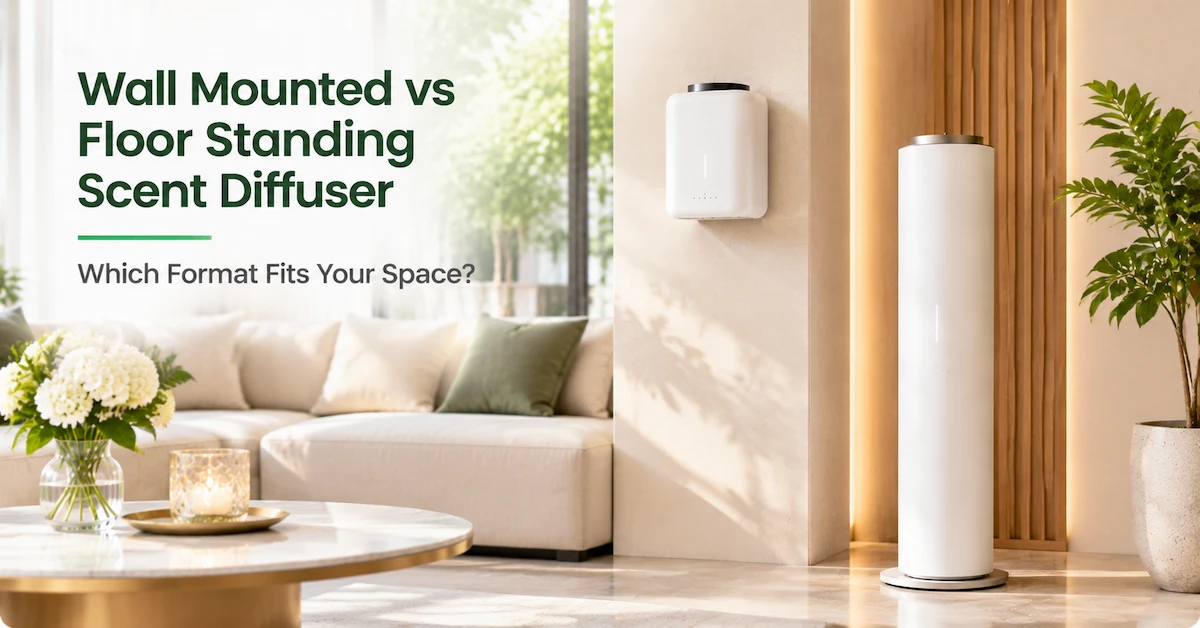
A wall mounted diffuser attaches to a vertical surface and keeps the machine above the floor or furniture level. A floor standing diffuser uses its own base or cabinet and remains movable within the installation zone. The difference sounds simple, but it changes almost every routine around the product.
| Decision factor | Wall mounted format | Floor standing format |
|---|---|---|
| Best starting scenario | Small rooms, corridors, reception walls, compact retail zones, or homes where tabletop space is limited. | Large rooms, lobbies, showrooms, open retail areas, demonstrations, or spaces that may be rearranged. |
| Installation | Requires a suitable wall, fixing method, cable route, and access for refill and service. | Requires a stable, level floor position and a safe power route; no drilling is normally needed. |
| Protection from knocks | Generally less exposed to carts, feet, children, pets, and cleaning equipment when mounted correctly. | More exposed to contact, but can be protected with a controlled zone or security feature. |
| Moving the unit | Slow and disruptive if the wall position or cable route changes. | Simple to reposition after a trial, room change, or seasonal layout adjustment. |
| Refill access | Can be awkward if the machine is mounted too high, behind furniture, or above a reception counter. | Usually easier to reach, inspect, and refill, provided the service side remains clear. |
| Visual role | Can remain discreet and preserve floor space. | Can become part of the room design, a branded feature, or a visible scenting station. |
| Main risk | Poor wall choice, hidden leaks, difficult service access, or vibration transferred through the wall. | Trip risk, accidental impact, unauthorized access, or a footprint that conflicts with the visitor path. |
The table is a screening tool, not a universal ranking. A wall mounted device can be the wrong choice when the wall is hollow, the outlet is inaccessible, or the machine must be tested in several positions. A floor standing device can be the wrong choice when the only available location is beside a doorway or in a narrow passage. Start with the room and service routine, then compare the model.
What Wall Mounting Solves, and What It Adds
Wall mounting is attractive because it removes the diffuser from a crowded surface or a vulnerable floor zone. In a home office, it can keep a machine away from papers and cable clutter. In a retail store, it can preserve a display table. In a hotel corridor or reception area, it can reduce the chance that a guest or cleaning trolley will move the unit.
It protects valuable floor and counter space
The most practical benefit is often not fragrance performance but space management. A wall mounted unit can sit above a console, beside a reception desk, or on a service wall while leaving the usable surface clear. That matters in smaller apartments and stores where every counter area already has a payment device, signage, product display, or charging cable.
It adds an installation dependency
The wall becomes part of the product system. Before drilling, confirm whether the surface is concrete, brick, wood, drywall, tile, or a partition with hidden services. Check the fixing hardware, the machine weight, the bottle access angle, and the distance from the nearest outlet. A wall mounted diffuser that looks tidy but cannot be reached without a ladder is not a convenient consumer product.
It can transmit vibration
A wall can amplify or transmit a low hum differently from a table or a floor. This is especially relevant in bedrooms, treatment rooms, quiet offices, and hotel guest areas. The public specification for the CNUS X2mini lists a noise level below 38 dB, but the specification does not describe a common acoustic method across all models. The actual experience still depends on the wall, bracket, output mode, oil path, and the listener's position. Test the mounted configuration rather than assuming a number means silent in every room.
What Floor Standing Scenting Solves, and What It Adds
Floor standing machines are useful when the diffuser needs to be visible, movable, accessible, or capable of serving a larger defined zone. They are common in spaces where the scenting equipment is part of the room plan rather than hidden infrastructure. A floor standing unit can also be easier to sample because the supplier or operator can move it between test positions without repairing a wall.
It makes trials and layout changes easier
When a buyer does not yet know the best position, mobility is valuable. A hotel can test a machine near the entrance, then compare it with a lounge position. A retailer can move the diffuser after changing a display. A homeowner can test the living room, dining area, and home office before committing to one location. A wall mounted format turns each trial into an installation task; a floor standing format keeps the test reversible.
It improves refill and inspection access
A floor standing diffuser can be designed around a service side that staff can reach at standing height. That makes it easier to check the oil level, wipe the housing, inspect the bottle connection, and record a refill. The convenience disappears if the machine is placed behind a sofa, inside a locked display, or against a wall with no clearance. A floor standing unit still needs a deliberate service zone.
It can carry a larger visual and functional presence
A tower or cabinet format may hold a larger bottle, a control system, or a security feature. The CNUS S3000TF product page describes a floor-standing scent diffuser with faster diffusion, app remote control, aluminum and acrylic construction, and a magnetic security lock. Those are useful product directions for a public area, but they do not prove that the machine fits every floor plan. Confirm the footprint, operating instructions, oil compatibility, and maintenance route for the exact configuration.
It needs floor and visitor planning
Floor standing does not mean “place it anywhere.” Keep the unit out of emergency routes, door swings, wheelchair paths, stair landings, and areas where a vacuum cleaner or trolley will hit it. The base must remain stable on the actual floor surface. In a commercial location, decide who can access the machine and whether a lock, barrier, or staff-only position is needed.
Installation, Airflow, and the Fragrance Result
Mounting format influences where the fragrance source can sit, but neither format controls the room's air by itself. Supply outlets, return grilles, exhaust fans, open doors, ceiling height, furniture, and visitor movement all affect distribution. A wall mounted diffuser can sit at a useful height but still release into a return-air path. A floor standing unit can sit in the centre of a room but still send fragrance toward an open entrance.
ASHRAE room-air-distribution guidance identifies supply and return locations, airflow rates, furniture, obstructions, and heat sources as factors that shape air movement. Apply that principle to scenting: choose a route into the occupied zone, not simply a visually central location. It explains why two installations with the same machine can feel different.
Wall mounted placement and air path
A wall mounted diffuser often works best on a wall that faces or borders the occupied zone, with clear space around the outlet. Avoid placing it directly beside a return grille, above a strong supply jet, behind a curtain, or in a corner where furniture blocks the first part of the plume. If the wall is near an open entrance, check whether the scent is being pulled into the corridor rather than across the room.
Floor standing placement and air path
A floor standing diffuser can be moved to find a better path, but its height and surrounding furniture still matter. A tall cabinet may release fragrance above seated occupants; a low unit may be shielded by a sofa or display. Test the machine at the height and position it will actually use. Do not judge a floor standing format from a test in an empty room if the finished space will contain shelving, queues, curtains, or large furniture.
Ventilation is a comfort requirement, not a problem to defeat
The U.S. Environmental Protection Agency recommends managing indoor air quality through source control, ventilation, and filtration. Necessary ventilation should not be reduced simply to preserve fragrance. If windows, kitchen exhaust, or outdoor-air systems are running strongly, fragrance may dilute or leave the room faster. Adjust the schedule and placement first; do not compensate automatically by increasing output.
Wall Mounted vs Floor Standing: Home and Commercial Scenarios
The same format can be right for one customer and inconvenient for another. The most reliable choice comes from the user's routine rather than a generic claim that one format is “premium” or “professional.”
| Scenario | Likely starting format | Why | Check before ordering |
|---|---|---|---|
| Small apartment living room | Wall mounted or compact desktop/wall model | Preserves table and floor space and can keep the machine away from pets or children. | Wall type, cable route, refill access, noise at the sofa, and whether the coverage reference suits the connected space. |
| Large open-plan home | Floor standing or larger home unit | Allows trial placement and may provide a larger capacity or more visible control zone. | Room volume, doors, HVAC, walking routes, oil compatibility, and whether one machine can realistically serve every zone. |
| Hotel reception or lobby | Floor standing for a movable trial; wall mounted after the zone is proven | A floor unit makes commissioning easier, while a fixed wall position can protect space once the air path is known. | Visitor route, cleaning equipment, security, refill access, noise, and documented operating schedule. |
| Retail store with changing displays | Floor standing | Displays, queues, and seasonal layouts change; mobility has operational value. | Trip clearance, base stability, power cable, customer contact, and the effect of doors opening throughout the day. |
| Clinic, salon, or quiet treatment room | Wall mounted or compact fixed unit | Reduces floor clutter and can keep equipment away from chairs and cleaning paths. | Noise at the client position, fragrance sensitivity, wall vibration, ventilation, and staff refill access. |
| Showroom or branded experience zone | Floor standing feature unit | The machine can support a visible design story and be moved as the visitor path changes. | Brand presentation, tamper control, sample testing, footprint, and whether the unit becomes a visual obstruction. |
For B2C buyers, a wall mounted format is rarely a good impulse purchase if the wall and power route have not been checked. For B2B buyers, a floor standing format is rarely a complete project solution if nobody has defined the service owner, refill interval, cleaning record, and visitor safety boundary. The format is only one line in the site brief.
Capacity, Refill Work, and Total Operating Cost
Mounting position does not determine oil consumption, but it changes how easy consumption is to monitor and how expensive a refill visit becomes. A compact wall mounted unit may have a smaller bottle and a convenient low-output routine. A floor standing machine may carry more oil and reduce refill frequency, but the larger capacity does not eliminate maintenance or make a poor airflow path perform well.
Capacity is a service interval, not a coverage guarantee
The CNUS X2mini page lists 130 ml capacity, 400 m³ coverage, 5 W power, DC 5 V input, a noise level below 38 dB, composite PP construction, and oil consumption of 0.6 ml/h ±5%. The CNUS Stream2 page lists 150 ml, 400 m³, 5 W, DC 12 V, aluminum construction, Bluetooth control, and noise below 32 dB. These numbers help compare a compact wall-oriented format with a larger home-style unit, but they do not prove identical scent distribution or equal refill life in every room.
For a commercial project, record the actual setting, operating hours, oil formula, and refill dates. A published consumption figure may be tied to a particular output condition. The monthly quantity should be calculated from the approved schedule, then verified during a site trial rather than promised from capacity alone.
Wall mounted costs can hide in installation
A wall unit may look less expensive because it occupies no floor area, but the complete setup can include anchors, brackets, cable concealment, an electrician or installer, access equipment, wall repair, and a second visit if the first position is wrong. These costs matter more across multiple stores or hotel floors. Ask whether the quoted product includes the mounting hardware and whether the installation method is documented.
Floor standing costs can hide in footprint and protection
A floor standing unit may avoid drilling but require a larger protected zone, a security lock, a barrier, or staff training. If a machine is moved during cleaning or knocked by a trolley, the cost is not just cosmetic. It can include a missed scenting period, damaged oil, a service call, or a replacement base. Budget for the operating environment, not only the machine price.
Maintenance, Safety, and Service Access
Maintenance is where format preferences become real. A scent diffuser needs compatible fragrance, an intact bottle and connector, a clear atomizer or oil path, a stable power connection, and a safe position. The machine should be stopped and handled according to the exact model instructions before cleaning or changing oil.
Wall mounted maintenance checklist
- Can the operator reach the bottle without a chair or ladder?
- Can the wall behind the unit be inspected for oil marks, loose screws, or vibration?
- Is the power cable secured without being pinched or routed across a wet area?
- Can the outlet and refill connection be seen clearly during a routine check?
- Would a leak run toward a socket, display, bedding, or a wall cavity?
Floor standing maintenance checklist
- Is there enough clearance to open the service panel or remove the bottle?
- Can cleaners vacuum and mop around the base without moving the machine?
- Is the unit stable on the actual floor, including carpet, tile, or a raised platform?
- Can visitors touch the controls or oil bottle, and does the site need a lock?
- Is the cable protected from feet, carts, and door movement?
Do not treat a wall mounted or floor standing label as proof of safety for every oil. Viscosity, ingredients, seals, tubing, and atomizer materials are part of the compatibility question. The Scentsin waterless diffuser oil guide provides a separate checklist for matching oil and machine. If a newly installed or refilled unit sputters, leaks, or becomes louder, stop and inspect the approved bottle and oil path before increasing output.
Noise and Vibration: The Format Changes the Room
Noise is not determined by mounting format alone. It comes from the atomizer, pump, fan, adapter, control cycle, bottle connection, and vibration transferred into the surrounding structure. A wall can transmit vibration into an adjacent room; a hollow floor or cabinet can amplify a floor unit. A published dB number is useful as a starting point, but the test condition matters.
For example, the Stream2 product page lists below 32 dB and describes quiet working. The X2mini page lists below 38 dB. These values are model-specific and the public pages do not establish one shared measurement distance, oil formula, output setting, or background-noise condition. A buyer who needs a quiet bedroom, clinic, or hotel guest area should test the exact unit in the exact position, including the intended bottle and schedule.
Listen for the sound that people actually notice: start-up pulses, a relay click, a low hum, a loose bracket, a rattling bottle, or a cable touching the wall. Run the device at its planned output, not only at the lowest setting. For B2B approvals, record the location, surface, oil, power supply, output, and sample revision. For B2C use, a simple evening test at the sofa or bed is more useful than relying on a generic “silent” label.
Product Examples: What the Current Scentsin Pages Support
Product examples are included to make the format comparison concrete. They are not universal recommendations, and the public pages should be rechecked for the exact version, price, availability, accessories, and instructions before purchase.
| Model | Published information | Format relevance | What still needs confirmation |
|---|---|---|---|
| CNUS X2mini | 400 m³ coverage, 130 ml, 5 W, DC 5 V, below 38 dB, composite PP, 0.6 ml/h ±5% listed consumption. | Direct wall-mounted home example; useful where table or floor space is limited. | Wall hardware, mounting height, cable route, vibration, refill access, and actual room test. |
| CNUS Stream2 | Home scent diffuser; 400 m³, 150 ml, 5 W, DC 12 V, below 32 dB, aluminum, Bluetooth control, 0.57 kg. | Home-oriented fixed or tabletop candidate when scheduled control and low listed noise matter. | Whether the chosen surface or wall position supports the cable, bottle access, and intended schedule. |
| CNUS S3000TF | Floor-standing format; faster diffusion, app remote control, aluminum and acrylic construction, magnetic security lock described on the page. | Relevant for visible public-area placement, a controlled zone, and a trial that may need mobility. | Exact capacity and coverage for the configuration, footprint, continuous-use instructions, oil compatibility, and service route. |
| CNUS S600plus family | Configurations listed from 600 to 6000 m³, 150 ml to 1000 ml, DC 12 V, and noise thresholds by model. | Useful commercial reference ladder when a project needs more than a small home zone. | Exact SKU, installation type, airflow assumptions, oil consumption, noise method, and site-specific recommendation. |
The evidence shows why format should be discussed with the rest of the system. X2mini gives a clear wall-mounted reference. S3000TF gives a floor-standing public-area direction. Stream2 illustrates a home model with schedule-oriented control. The S600plus page shows that commercial sizing is a family of configurations rather than one universal machine. None of these pages removes the need for a sample or room trial when the installation has unusual airflow, high occupancy, strict noise limits, or multiple connected zones.
How to Choose in a Real Buying Process
Use the following sequence when comparing wall mounted vs floor standing scent diffuser options. It works for a personal home purchase and can be expanded into a B2B site brief.
1. Mark the occupied and service zones
Identify where people sit, queue, browse, sleep, or wait. Then mark where staff will refill, clean, and respond to a fault. A placement that smells good but cannot be serviced is not a complete solution. The service zone should not block a door, emergency route, or customer path.
2. Record airflow and ventilation
Mark supply outlets, return grilles, open doors, windows, fans, kitchen exhaust, and HVAC schedules. Note whether the space is open to another room or floor. A single machine in a connected space may not deliver a uniform result, especially when air is moving toward an exhaust or a busy entrance.
3. Decide whether the position must be reversible
Choose floor standing for an early trial, changing retail display, temporary event, or location that has not yet been proven. Choose wall mounted when the zone is stable, the wall is suitable, and preserving floor or counter space is worth the installation work.
4. Compare total ownership, not only purchase price
Include mounting hardware, installation, cable routing, refill labour, access equipment, security, cleaning time, replacement parts, electricity, oil, and the cost of moving the unit. For a B2C buyer, include the time spent reaching or moving the machine. For a B2B buyer, include who owns the weekly check and how the result will be recorded.
5. Approve the exact configuration
Record model, revision, bottle, oil, output, schedule, mounting or base, power supply, placement, and acceptance criteria. Do not approve “a 400 m³ diffuser” as if every model with that phrase is interchangeable. The public product pages use model-specific specifications; the exact product page and current instruction sheet should control the decision.
6. Run a practical sample trial
For a home, test the machine during normal occupancy and ventilation. For a business, test along the visitor path at different times of day. Check fragrance near the source, in the occupied zone, at the far edge, and near the nearest exit. Record whether the device is too strong, absent, noisy, easy to service, or vulnerable to contact. A trial turns a visual format choice into an operating decision.
Questions to Ask Before Ordering
These questions are useful when the product page does not show enough installation detail. They also give a distributor or project buyer a concise message to send to the supplier.
- Is the model supplied as wall mounted, floor standing, tabletop, or more than one configuration?
- What fixing hardware, bracket, base, security lock, adapter, and cable are included?
- What wall type and mounting height are recommended, and how is refill access maintained?
- What is the exact capacity, coverage reference, oil consumption, output schedule, and noise measurement condition?
- Which oils and bottle formats are approved for the exact atomizer, connector, seals, and tubing?
- Can the machine operate continuously, intermittently, or through an app, and what does the schedule control?
- How should the machine be cleaned, and which parts are replaceable?
- For a floor unit, what is the footprint, base stability, and protection from public contact?
- For a B2B rollout, what sample, warranty, packaging, lead-time, and after-sales information is available?
Several Scentsin product pages state that samples are welcome and describe sample production in a few working days, while bulk timing depends on quantity. Treat that as a starting point for a model-specific conversation, not as a universal delivery promise. Confirm the current quote, configuration, sample result, and delivery terms before committing to a rollout.
Frequently Asked Questions
1. Is a wall mounted or floor standing scent diffuser better?
Neither is universally better. Choose wall mounted when floor or counter space is limited, the position is stable, and a fixed installation protects the machine. Choose floor standing when the room needs a movable trial, visible equipment, easier refill access, or a larger public-area format. Airflow, maintenance, safety, and the actual visitor path should decide the final format.
2. Is a wall mounted diffuser better for a small home?
It can be. Wall mounting may free a small table and keep the machine away from a busy floor area. Before choosing it, confirm that the wall can support the fixing method, the cable can reach a safe outlet, and the bottle can be reached without a ladder. A compact floor or tabletop model may be better if the room is rented or the position is still uncertain.
3. Does wall mounting make a diffuser quieter?
Not automatically. It may reduce contact with a vibrating tabletop, but a wall or bracket can transmit or amplify a hum. The result depends on construction, fixing, oil path, output, and the surrounding structure. Test the mounted unit at the listener's position instead of inferring quietness from the installation type.
4. Does a floor standing diffuser scent a larger area?
Not simply because it stands on the floor. Area depends on the exact model, output, oil, air movement, room volume, ceiling height, and connected spaces. Some floor standing models have larger capacities or commercial configurations, but a coverage number is a planning reference rather than a guarantee that every corner will smell the same.
5. Is the X2mini a wall mounted scent diffuser?
The Scentsin product page describes the CNUS X2mini as a home wall-mounted aroma diffuser. Its public specifications list 400 m³ coverage, 130 ml capacity, 5 W power, DC 5 V input, noise below 38 dB, composite PP construction, and 0.6 ml/h ±5% oil consumption. Confirm the current hardware, mounting method, and instructions before installation.
6. Which Scentsin model is a floor standing option?
The CNUS S3000TF page describes a floor-standing scent diffuser with faster diffusion, app remote control, aluminum and acrylic construction, and a magnetic security lock. It is a useful model to investigate for a public or commercial zone. The exact capacity, coverage, oil compatibility, and service requirements should be confirmed for the quoted configuration.
7. Can a wall mounted diffuser be moved later?
It can, but moving it may require new holes, cable work, wall repair, and another airflow test. If the room layout is still changing, use a floor standing or portable trial first. Once the correct zone is proven, a fixed installation may make sense for space protection and repeatability.
8. Should a business test both formats before rollout?
Yes when the site has strict noise, safety, refill, or visitor-experience requirements. Test the exact oil, bottle, output, schedule, power, mounting or base, and room position. Record fragrance at the visitor path and far zone, plus service time and any contact risk. The trial should approve a complete configuration, not only a machine body.
Conclusion
The practical choice between a wall mounted vs floor standing scent diffuser is a choice about the room's future routine. Wall mounting is strongest when space protection, a stable zone, and a tidy fixed installation matter. Floor standing is strongest when mobility, visible presentation, easy service access, and reversible testing matter. Neither format removes the need to understand airflow, fragrance compatibility, output, ventilation, and safe access.
For a home, measure the wall or floor position, check the power route, and test the scent where people actually spend time. For a commercial project, add visitor flow, security, cleaning, refill ownership, sample approval, and site-specific coverage to the brief. Review the Scentsin diffuser collection, compare the wall-oriented X2mini with the home Stream2 or the floor-standing S3000TF, and use the exact model page before making a final decision.