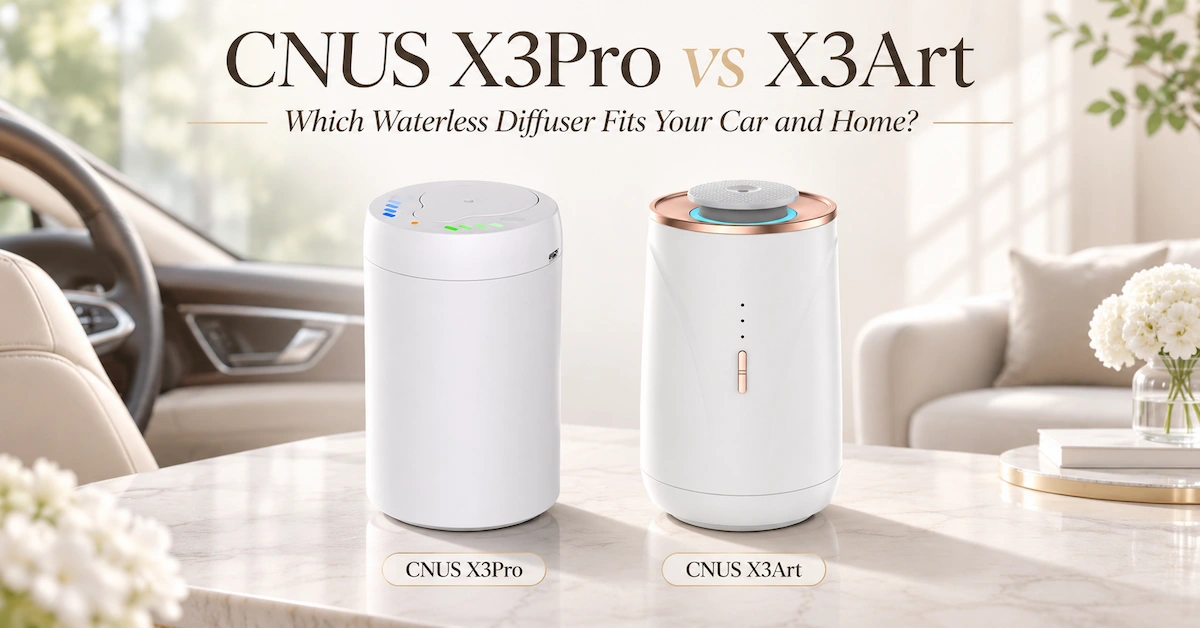

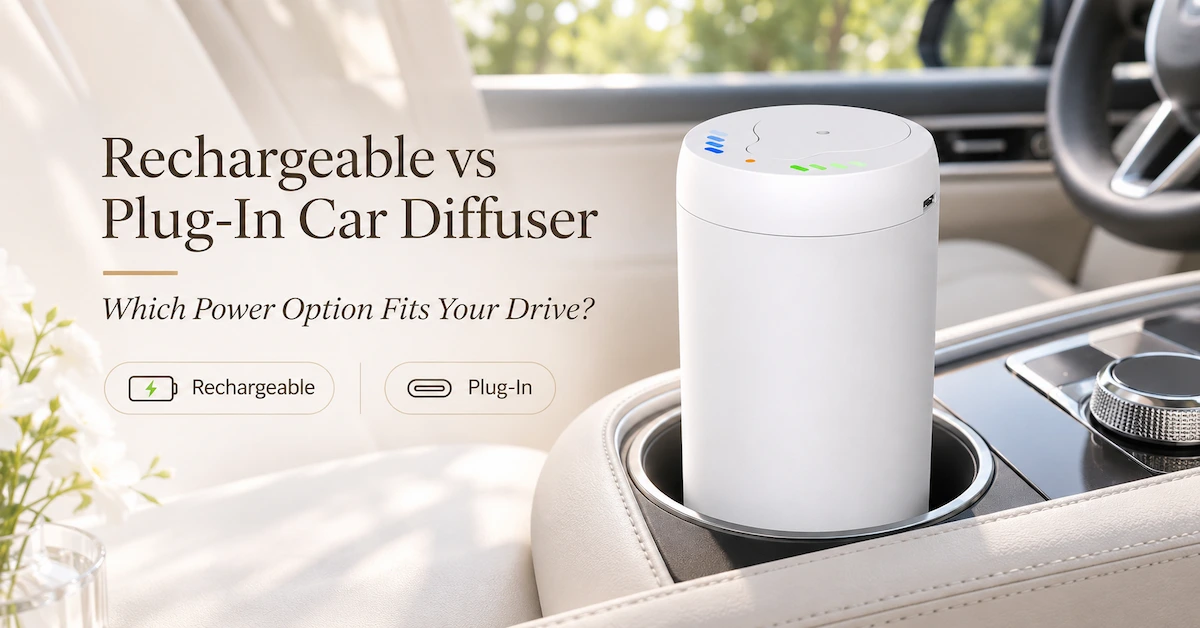
Quick answer: Choose a rechargeable car diffuser when you move between vehicles, want a clean dashboard without a visible cable, or need fragrance in places without a convenient USB port. Choose a plug-in car diffuser when you drive for long periods, have a stable Type-C or USB/DC 5V connection, and prefer continuous power without remembering to charge. The best decision depends on your parking heat, daily driving time, preferred placement, charging habits, and the exact model variant. CNUS X3Pro publicly describes both a Type-C plug-in version and a battery version listed for up to 60 hours after one charge, but the exact SKU, charging behavior and accessories should be confirmed before ordering.
Check the CNUS X3Pro Power Options
Rechargeable vs Plug-In Car Diffuser: The Core Difference
A rechargeable car diffuser stores energy in an internal battery. You charge it before or during use, then operate without a power cable for the period supported by the battery and the selected output mode. A plug-in diffuser receives power through a vehicle port, USB connection, Type-C cable, or another specified input. It can continue operating while connected, provided the power source and the product instructions allow it.
The scenting mechanism may be similar in both versions. The power architecture is what changes the daily experience. The same fragrance oil, bottle and atomizer can still require different handling because a battery model has charging limits and a plug-in model has cable and port constraints.
| Decision factor | Rechargeable car diffuser | Plug-in car diffuser |
|---|---|---|
| Power during a drive | Runs from stored battery energy; no cable is required while the battery has charge. | Runs from the vehicle or USB/Type-C source while connected. |
| Placement freedom | Higher freedom because the unit is not tied to a port, subject to safe mounting. | Placement is limited by cable reach, port location and cable routing. |
| Daily habit | Needs a charging routine and a way to check remaining charge. | Needs a convenient port and cable management, but no separate charging session. |
| Long road trips | Works if the battery has enough reserve or can be charged in the car. | Often convenient for continuous operation if the port remains available. |
| Moving between cars | Usually simpler because the diffuser can travel with you. | Requires a compatible port and cable in each vehicle. |
| Purchase question | Confirm battery capacity, charge time, runtime conditions and replacement support. | Confirm input voltage, connector, cable length and whether an adapter is included. |
Neither power option is automatically better. A driver who always uses one car and commutes for several hours may value continuous plug-in power. A driver who parks in different places, changes vehicles, or dislikes a cable may value a rechargeable unit more. The correct choice is the one that removes the most friction from your actual routine.
What the CNUS X3Pro Page Actually Confirms
The CNUS X3Pro page is useful because it publishes more than a generic “wireless” label. It lists 2 W power, DC 5V input, 10 ml capacity, 100 m³ coverage, a noise level below 34 dB, and 0.3 ml/h ±5% oil consumption. Its product copy states “Type-c connector for plug-in version and quick charge” and says “The battery model can keep long time working of 60 hours once charge.”
These statements support a comparison, but they do not answer every buying question. The page does not establish that every X3Pro listing uses the same battery, that 60 hours applies at maximum output, that the unit can operate while charging, or that a charger and mount are included. Ask for the exact quoted variant before paying.
How to read “up to 60 hours”
“Up to 60 hours” is a maximum-style runtime statement, not a promise that the car will smell continuously for 60 hours. Runtime can change with output intensity, intermittent scheduling, temperature, battery condition, charging state, oil load and the way the device starts and stops. If the diffuser operates in short cycles, its battery may last longer than continuous operation. If it runs at a high output in a hot vehicle, the result may be shorter.
Ask the seller how the runtime was measured. A useful answer should identify the mode, output level, temperature range, battery condition and whether the test was continuous or cyclical. A quote that only repeats “60 hours” without test conditions is not enough to plan a daily schedule.
How to read “Type-C connector”
A Type-C connector identifies the physical interface, not the complete charging experience. Confirm whether the plug-in version is powered directly at DC 5V, whether the battery version uses the same port for charging, what cable is supplied, and whether the port supports operation while charging. A Type-C shape alone does not prove fast charging or a particular charging time.
For comparison, the public X3Art page lists 2 W and DC 5V input, but it does not publish the same battery-version and runtime wording shown for X3Pro. Do not assume X3Art is rechargeable just because it uses a low-voltage input or appears portable. Confirm the exact X3Art variant and included accessories directly.
Choose Rechargeable When Cable-Free Use Solves a Real Problem
A rechargeable car diffuser is most useful when the cable would interfere with placement or when the device needs to move. Its value is not simply that it has a battery. The value is that the driver can place it where the fragrance disperses well without dedicating a USB port or routing a cable through the cabin.
Drivers who change vehicles
If you use a personal car during the week and another vehicle at weekends, a rechargeable unit reduces the setup work. You do not need to check whether both vehicles have the same port location or carry a cable in each car. You still need to move the diffuser safely, keep the oil bottle upright, and charge it before a long trip.
Drivers who want a clean console
Some interiors place the USB port inside a storage compartment while the preferred diffuser position is on a console or cup-holder surface. A battery model avoids a cable crossing that area and can reduce the chance of a cable being pulled by a passenger.
Drivers who use the diffuser at home
A dual-use diffuser can move from a vehicle to a desk, bedroom or reading corner. The X3Pro page describes car mode and indoor mode as a two-in-one use case. A rechargeable version makes that transition easier when a wall outlet or desk cable is not near the preferred location. If home use is the main purpose, compare the model's listed coverage and noise with your room rather than assuming a car-oriented product fits every space.
Choose Plug-In When Continuous Power and Simplicity Matter
A plug-in car diffuser is often the more predictable option for a driver who has a stable port and a fixed placement. Once the cable is routed safely, the diffuser can run without a separate charging reminder. This is valuable for vehicles used for long commutes, delivery work, ride services, or frequent road trips.
Drivers with long or irregular routes
If your driving hours change from day to day, a plug-in setup removes one variable. You do not have to estimate whether the battery will last through an unexpected trip. The vehicle supplies power while the diffuser is connected. You should still confirm that the port remains powered in the required ignition state and that the cable does not create a trip or snag hazard.
Drivers who prefer fewer battery decisions
Some buyers do not want another charging routine. A plug-in diffuser has fewer battery-specific questions; its main checks are input voltage, cable length, adapter compatibility and safe cable placement.
Vehicles with a convenient DC 5V or USB port
When the vehicle has a port near a stable diffuser position, plug-in power can be a clean solution. The X3Pro page lists DC 5V and identifies a Type-C connector for its plug-in version. That makes it a logical candidate for buyers who already have a compatible vehicle port, but the exact cable and adapter package should still be confirmed.
What plug-in ownership adds
The trade-off is dependence on the vehicle. The diffuser may stop when the ignition turns off, the port may be occupied by a phone, or the cable may limit the best placement. A permanent cable also exposes the setup to repeated bending and passenger movement. Ask for the cable length, connector orientation and replacement cable availability before selecting a plug-in version.
Compare Another CNUS Car Diffuser
Charging, Runtime and the Difference Between Battery Life and Scent Life
One of the most common comparison errors is treating battery runtime as fragrance duration. They are different measurements. Battery runtime describes how long the device can operate before it needs electrical energy. Scent life describes how long the oil lasts and how long the fragrance remains perceptible in a moving cabin. A diffuser can run for 60 hours while a 10 ml bottle lasts a shorter or longer period depending on oil consumption and operating mode.
Use the published oil rate carefully
The X3Pro page lists 0.3 ml/h ±5% oil consumption and a 10 ml capacity. A simple continuous-use calculation is approximately 33 hours from 10 ml at 0.3 ml/h, before accounting for tolerance, remaining liquid, cycling, lower settings or a different fragrance formula. That calculation is not a promise of actual refill life. It is a planning reference that shows why battery runtime and oil runtime should be compared separately.
Questions to ask about charging
- What is the battery capacity and rated charging time?
- Does the advertised runtime use continuous or intermittent operation?
- Can the unit operate while charging through the Type-C port?
- Is a cable included, and what power adapter is recommended?
- Does a fast-charge claim specify a test condition?
- What happens when the battery is low: stop, reduce output, or show an indicator?
- Can the battery be replaced, and is replacement support available?
Build a simple daily-use estimate
Write down average driving hours, output schedule and charging opportunities. A published 60-hour maximum may provide a useful reserve for a short cyclical commute, but a long shift at high output can reduce it. For a plug-in unit, check port availability and ignition behavior.
Car Placement: Cable Routing Versus Wireless Freedom
Power choice changes where the diffuser can go, but neither battery nor plug-in power makes an unsafe location acceptable. A car diffuser contains fragrance liquid and should remain stable, upright when required, and clear of airbags, visibility, pedals, controls and heat sources.
Placement questions for a rechargeable unit
Without a cable, a rechargeable unit may fit more locations, such as a stable cup-holder insert, console tray or a dedicated bracket. Confirm that the surface is level enough for the bottle and that braking will not turn the diffuser into a loose object. The X3Pro page mentions magnetic adsorption for the nozzle and essential-oil bottle; do not interpret that as proof that a magnetic vehicle mount is included.
Placement questions for a plug-in unit
A plug-in unit should be placed close enough to the port that the cable does not stretch across the steering area, shift the diffuser during a turn, or hang near pedals. A shorter cable is not always better if it forces an unstable location. Ask whether the connector exits from the side or rear, and whether a right-angle cable is available for the preferred position.
Mounting is a separate purchase question
“Wireless,” “portable” and “magnetic bottle” do not automatically mean “ready to mount in every car.” Confirm the accessory list and whether the quoted SKU keeps the oil bottle upright.
Heat, Storage and Battery-Specific Risk
Cars can become much hotter than the surrounding air when parked in direct sunlight. This matters for both power options because fragrance oil, seals, plastics, cables and electronics all experience the vehicle environment. A rechargeable model adds a battery to that list, so storage instructions deserve more attention.
Rechargeable models
Ask the manufacturer for the recommended operating and storage temperature, charging limits and guidance for prolonged parking. Do not leave a battery diffuser in a hot car merely because it is marketed for vehicle use. If the battery shows swelling, unusual heat, a burnt smell or physical damage, stop using it and contact the supplier. Do not continue testing a device with suspected battery damage.
Plug-in models
Plug-in power avoids battery aging inside the diffuser, but it does not eliminate heat or electrical considerations. Keep the connector and cable away from spilled oil, and unplug the device if the housing, cable or port becomes wet. Confirm whether the unit should be removed when the vehicle is parked for a long period and whether the port remains powered after the ignition is off.
Do not confuse material claims with operating permission
The X3Pro page lists aluminum alloy for its main and atomizer material and also uses language about temperature and corrosion resistance. Those facts are useful evidence, but they do not replace the model's storage instructions. A metal outer part does not make the battery, seal, oil bottle or connector immune to heat.
Fragrance, Oil and Refill Planning
Power does not determine oil compatibility. Both versions may use the same waterless atomization principle, but approved oil still depends on the machine, bottle, nozzle and formula. Use the waterless diffuser oil compatibility guide before treating third-party oil as interchangeable.
For a car, choose a refill routine that matches how often the vehicle is used. A small 10 ml bottle may be convenient for a personal cabin, but a high output or long daily schedule can use oil faster than expected. Do not top up an old fragrance with a new formula simply because the device is rechargeable or plugged in. Residue and mixed scent can be harder to diagnose than a low battery or an occupied port.
If you need a fragrance sample or a confirmed oil pairing, review the CNUS fragrance-oil options and ask the supplier to confirm the exact diffuser variant, bottle connection and operating mode together.
Total Cost: Price, Power and Maintenance
A rechargeable car diffuser can cost more to manufacture because it includes a battery, charging circuit and battery protection. A plug-in model may have a simpler internal power system but can require a cable, adapter or replacement accessory. Purchase price is only one part of the total cost.
| Cost item | Rechargeable version | Plug-in version |
|---|---|---|
| Upfront hardware | May include battery and charging electronics. | May include a simpler power system but still needs a compatible cable or adapter. |
| Energy | Charging cost is small but the battery has a service life. | Uses vehicle or USB power while connected; no internal battery replacement if none is fitted. |
| Accessories | Check charging cable, charger and mount. | Check cable length, connector, adapter and mount. |
| Maintenance | Inspect battery behavior, port and oil path. | Inspect cable, port, oil path and connector. |
| Replacement risk | Battery capacity can decline over time. | Cable or vehicle port can fail, but the diffuser may avoid battery aging. |
| Refill cost | Depends on oil consumption, output schedule, formula and refill price, not on power type alone. | |
For a fair comparison, use the same oil, output mode and schedule for both variants. A higher refill cost may otherwise come from a different setting rather than power type.
Which Power Option Fits Your Driving Pattern?
Short daily commute
For a short commute in one vehicle, either option can work. Choose rechargeable for a cable-free interior if charging is easy; choose plug-in when the vehicle port is close to the preferred placement.
Long-distance travel
For long trips, plug-in power often reduces runtime anxiety because the vehicle can keep the diffuser powered. A rechargeable model can also work if the published runtime covers the trip and you can recharge safely during breaks. Confirm whether it can operate while charging rather than assuming a Type-C port supports both functions.
Multiple cars or rental cars
Rechargeable is usually easier to move between cars because it does not depend on the same cable route. A plug-in model can still be practical if each vehicle has a compatible port and you keep a cable available. For rental cars, avoid a permanent adhesive mount and confirm that the bottle remains secure during transport.
Ride-share or delivery work
A driver who spends many hours in a vehicle may prefer continuous plug-in operation when the port is available. A rechargeable model can keep the console cleaner, but charge checks become part of the workday.
Hot-climate parking
In a hot climate, neither power option should be selected without checking storage guidance. A battery model requires extra attention to charging and heat. A plug-in model avoids an internal battery but still contains electronics, fragrance oil and seals that may need protection. Ask CNUS for the intended operating and storage conditions.
Questions to Confirm Before Buying
Product pages often describe the main experience but leave variant details to the quotation. Use this checklist before choosing between rechargeable and plug-in power.
| Question | Why it changes the decision | Evidence to request |
|---|---|---|
| Which exact SKU is supplied? | Plug-in and battery versions can look similar but include different electronics. | SKU, model photo, variant name and quotation line. |
| What is the input and connector? | Port compatibility determines whether the diffuser can be placed where you want it. | DC voltage, Type-C/USB specification and cable photo. |
| What does the runtime measure? | “Up to” runtime may depend on mode and output. | Test mode, output level, temperature and continuous/intermittent condition. |
| Can it run while charging? | This can decide whether a battery model works on long drives. | Written operating instruction or video demonstration. |
| What is included? | A missing cable, charger or mount can change the real purchase cost. | Box contents, cable length, adapter and vehicle accessory list. |
| What are the oil and output rates? | Battery life does not predict refill life or scent intensity. | ml/h range, settings, duty cycle and approved oil format. |
| What is the heat and storage guidance? | Cars can become hot while parked. | Operating/storage temperature and battery storage instructions. |
| What after-sales parts exist? | Cables, bottles, nozzles and batteries may eventually need support. | Warranty, replacement parts, service route and lead time. |
Common Buying Mistakes
Assuming “wireless” means no charging
Wireless operation means the diffuser can run without a cable for a period of time. It does not mean unlimited operation. Ask how the battery is charged, how long charging takes and what happens at low charge.
Assuming Type-C means every Type-C charger is suitable
Connector shape is not a complete electrical specification. Follow the stated voltage and recommended adapter. Do not substitute a high-power charger or a cable with unknown behavior simply because the plug fits.
Assuming a battery model is always more portable
Portability also depends on size, weight, bottle stability and mounting. The X3Pro lists 0.3 kg and a compact Φ70 × 109 mm size, but the actual carrying experience still depends on the oil bottle and accessory. A cable-free device that rolls in a cup holder is not a practical portable solution.
Assuming a plug-in model must stay in one place
A plug-in unit can move if the cable and port move with it, but the setup is less flexible. You can use a short, protected cable or a vehicle USB adapter where appropriate, provided the product instructions and vehicle layout support it.
Comparing runtime without comparing output
Two devices can use the same battery time but deliver different oil consumption. Always compare output setting, duty cycle, oil rate and perceived scent in the car. A longer battery claim is not necessarily a longer refill interval.
How to Decide in Three Steps
- Map the routine. Write down driving hours, vehicle changes, available ports, preferred placement, parking heat and whether the unit will also be used at home.
- Choose the main constraint. Select rechargeable when cable-free movement is the main need. Select plug-in when continuous power and a stable port are the main needs.
- Verify the missing fields. Confirm the exact variant, connector, runtime condition, charging behavior, cable, mount, oil rate and storage guidance before ordering.
For the current public CNUS evidence, X3Pro is the clearest model to investigate when you want both power paths described on one product page. X3Art remains relevant for car and home use with DC 5V input, but its visible page does not publish equivalent battery and runtime details. That is not proof that a variant cannot exist; it is a reason to ask before buying.
Frequently Asked Questions
1. Is a rechargeable or plug-in car diffuser better?
Rechargeable is better for cable-free placement, moving between vehicles and dual car/home use. Plug-in is better for long or irregular drives when a stable USB or Type-C/DC 5V source is available. The right choice depends on your routine, not on the power label alone.
2. What is the difference between a battery car diffuser and a USB car diffuser?
A battery car diffuser can operate from stored energy after charging. A USB or Type-C car diffuser normally relies on a connected power source, although some products use the same port to charge an internal battery. Confirm whether the exact model is plug-in only, rechargeable, or a two-in-one version.
3. Is the CNUS X3Pro rechargeable?
The X3Pro product page describes a Type-C connector for the plug-in version and a battery model that can work for up to 60 hours after one charge. Confirm the exact SKU, battery specification, charger, charging time and operating-while-charging behavior before purchase.
4. What connector does the X3Pro plug-in version use?
The public page lists DC 5V input and says the plug-in version uses a Type-C connector. Ask whether the cable is included, how long it is, and whether the connector supports the placement you want in your car.
5. Does “60 hours” mean the fragrance lasts 60 hours?
No. It is a public battery working-time statement, not a guaranteed oil or scent duration. Oil life depends on capacity, consumption, output level, cycling, temperature and fragrance formula. Ask for the test conditions behind the runtime claim.
6. Can a rechargeable diffuser run while charging?
Do not assume it can. This is a model-specific operating feature. Ask CNUS to confirm whether the exact battery variant can diffuse while connected to Type-C power and whether doing so changes output or charging behavior.
7. Is a plug-in diffuser safer than a rechargeable diffuser in a hot car?
Neither should be treated as automatically safe in extreme heat. A rechargeable model adds a battery, while a plug-in model still contains electronics, oil and seals. Follow the exact operating and storage instructions and ask the supplier about prolonged high-temperature parking.
8. Which option is better for long road trips?
A plug-in model is often simpler when the vehicle port remains available for the full trip. A rechargeable model can work when its tested runtime covers the journey or when you can recharge during stops. Check whether the diffuser can operate while charging and whether the cable can be routed safely.
9. Which option is better for two cars?
Rechargeable is usually more convenient because it is less dependent on a specific port. A plug-in model can work if both cars have compatible ports and cables.
10. Does a Type-C port mean fast charging?
No. Type-C identifies the connector shape. Fast charging depends on the device, charging circuit, cable and power source. Request the rated input, charging time and recommended adapter instead of assuming fast charging from the connector alone.
11. Do rechargeable and plug-in versions use different fragrance oil?
Power type does not automatically determine oil compatibility. Use the fragrance oil approved for the exact diffuser, bottle and atomizer. Check the CNUS waterless diffuser oil guide and confirm any new formula before filling the device.
12. Where can I compare current CNUS car diffuser specifications?
Review the CNUS X3Pro product page and the CNUS X3Art product page. Use the CNUS contact page to confirm the exact power variant, cable, battery, mount, sample and technical details.
Conclusion
Rechargeable vs plug-in car diffuser is ultimately a routine decision. Rechargeable power gives you cable-free placement and easier movement between vehicles, but you must manage charging, battery aging and hot-car storage. Plug-in power gives you a predictable source for long drives and removes the need to remember a separate charge, but it ties placement to a cable and an available port.
The current CNUS X3Pro page is the clearest public example for this comparison: it lists DC 5V, describes a Type-C plug-in version, and states that the battery model can work for up to 60 hours after one charge. Treat that runtime as a published upper-limit claim, not a guaranteed scent duration. Before you buy, confirm the exact SKU, charging behavior, cable, mount, approved oil, output schedule, storage guidance and after-sales support.
For a portable, cable-free car and home routine, start with the CNUS X3Pro product page. For a model that lists DC 5V input but needs variant confirmation, review the CNUS X3Art product page. When the missing specification could change your choice, ask CNUS for a sample or a written technical comparison rather than buying from the power label alone.