
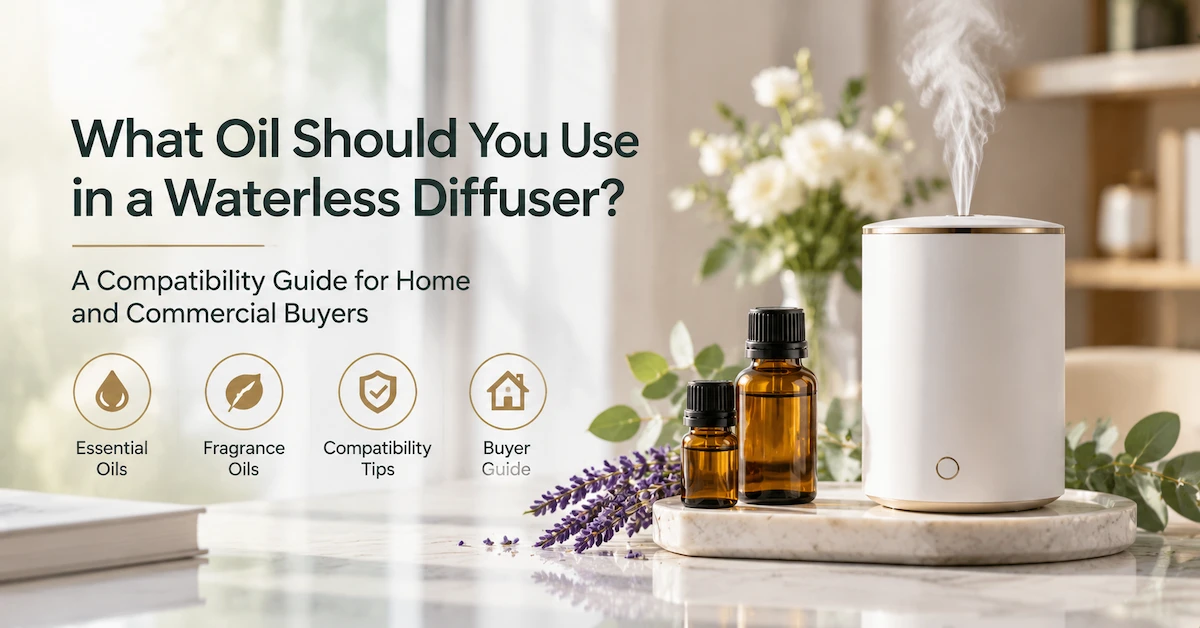
Quick answer: Use only an oil or fragrance formula that the exact waterless diffuser manufacturer approves for its atomizer, bottle connection, and operating instructions. In practice, that usually means a compatible diffuser fragrance oil or a specified essential-oil-based formula with suitable flow behavior, not a random carrier oil, reed diffuser liquid, candle fragrance, cooking oil, or undiluted product chosen only because the label says "natural." Scentsin's public product data identifies several waterless or essential-oil diffuser machines and a wood-series oil page that states suitability for commercial diffusers, but it does not publish a complete oil-by-model laboratory compatibility chart. Treat the list below as an evidence-led selection guide, then confirm the exact oil and machine with a sample test before a home refill or commercial rollout.
The search question what oil to use in a waterless diffuser sounds simple because many products use words such as essential oil, perfume oil, fragrance oil, aroma oil, or scent oil interchangeably. Those labels do not describe the same liquid behavior. A waterless diffuser may use a small bottle, a tube, a pump, a nozzle, a cold-air atomizer, or a cartridge. The oil must travel through that path and leave the machine at a controlled rate without creating a leak, blockage, residue, seal damage, or an unstable scent result.
This article serves both B2C buyers choosing a home or car device and B2B buyers evaluating oils for hotels, stores, offices, spas, and private-label scent programs. It is intentionally a compatibility guide rather than a general aromatherapy article. It does not claim that every essential oil is suitable, it does not make medical or therapeutic claims, and it does not replace the instruction sheet for a particular model.
Review Commercial Diffuser Oil Options
What Oil Can Go in a Waterless Diffuser?
A waterless diffuser should use a fragrance liquid that is explicitly compatible with the machine's atomizer and oil path. Depending on the product, this may be a fragrance oil formulated for scent machines, an essential-oil-based fragrance blend, or a supplier-approved custom fragrance. The words "waterless" and "essential oil" describe different parts of the system: waterless describes the operating format, while essential oil describes one possible fragrance ingredient. Neither word alone proves compatibility.
The most reliable decision rule is a three-part match:
- Machine match: confirm the exact model, bottle size, atomizer, power mode, and manufacturer instructions.
- Liquid match: confirm the formula is intended for a diffuser, scent machine, or the specific oil path, rather than for reeds, candles, skin, or food.
- Test match: run a controlled sample test and record flow, atomization, leakage, residue, scent stability, and consumption before approving the oil.
If any one of these three matches is unknown, do not pour a full bottle into the machine. For a B2C buyer, the correct next step is to check the product page or ask the manufacturer. For a B2B buyer, the correct next step is a written compatibility approval tied to the exact model, oil SKU, fragrance batch, and operating setting.
Essential Oil vs Fragrance Oil for a Waterless Diffuser
Essential oil is a concentrated aromatic material obtained from plant material or a blend that includes plant-derived components. Fragrance oil is a formulated scent liquid that may contain natural, nature-identical, or synthetic aroma materials in a carrier system. A commercial diffuser oil can be designed for evaporation or atomization, while a pure essential oil may have different volatility, density, resin content, and material compatibility.
That distinction does not make one category automatically better. The correct choice depends on the machine, the intended scent profile, the market requirements, the supplier documentation, and the performance target. An essential-oil-heavy formula may be appropriate for one atomizer and unsuitable for another. A fragrance oil designed for a commercial scent machine may provide more consistent batch-to-batch behavior than a single botanical oil, but it still needs to be approved for the exact device.
| Oil category | What it may offer | What must be checked |
|---|---|---|
| Essential-oil-based diffuser formula | Plant-derived aroma character and a formula designed around diffuser use. | Exact machine approval, flow behavior, resin or particulate risk, and whether the supplier specifies waterless atomization. |
| Commercial fragrance oil | A broad scent palette and the possibility of consistent supply for a branded environment. | Machine compatibility, carrier system, SDS or technical documents where required, and the approved operating range. |
| Reed diffuser liquid | Designed for capillary movement through reeds and passive evaporation. | Do not assume it works in a powered atomizer. Viscosity, carrier, and additives may be unsuitable. |
| Candle or soap fragrance | May be formulated for a heated or non-airborne application. | Do not use unless the supplier confirms diffuser compatibility and provides the required handling information. |
| Carrier or cooking oil | Not a suitable default fragrance refill. | Do not add it to a waterless diffuser unless the manufacturer specifically designs the machine for it. |
The practical takeaway is clear: ask for the oil's intended application, not just its name. "For commercial diffusers" is a more useful product statement than "premium oil," but even that statement should be matched to the exact machine and tested at the planned setting.
Why Viscosity and Formula Matter More Than the Label
A waterless diffuser moves liquid through a narrow system. The pump, tube, valve, bottle neck, nozzle, and atomizer each impose a physical requirement. If a liquid is too thick, the machine may struggle to draw it or may atomize it unevenly. If it is too thin, the liquid may travel faster than intended, leak at a connection, or consume more quickly. If the formula leaves solids or sticky residue, the nozzle can become restricted even when the first few hours appear normal.
Viscosity is not the only variable. Density affects how a bottle and tube behave. Volatility affects scent release and consumption. Resinous, colored, or particulate materials may increase residue risk. Alcohol or solvent content can influence seals, plastics, coatings, and transport requirements. A fragrance formula can also change over time if it is exposed to heat, light, oxygen, or an incompatible container.
Information to request from an oil supplier
- Intended use: waterless diffuser, commercial scent machine, ultrasonic diffuser, reed diffuser, candle, or another application.
- Recommended machine types and any excluded atomizers, pumps, bottles, or materials.
- Viscosity or flow information, test temperature, and the method used to measure it.
- Fragrance concentration, carrier description, color, and whether sediment or separation is expected.
- Storage conditions, shelf life, batch identification, and packaging compatibility.
- Safety documents and market-specific compliance information where the buyer's market requires them.
- Recommended output setting, oil consumption range, and cleaning interval for the target machine.
A supplier may not publish every field on a retail page. That is normal for an initial product search, but it becomes a procurement requirement before a bulk order. The buyer should keep the technical response with the approved sample so later replenishment does not silently switch to a different carrier or fragrance batch.
Public Compatibility Evidence from Scentsin Product Data
The current Scentsin product data supports a useful starting point, but it does not provide a single public table proving that every oil works in every machine. The matrix below deliberately uses evidence levels. "Publicly supported" means the indexed product page makes a relevant compatibility or application statement. "Machine format supported" means the page identifies a waterless or essential-oil machine, but the oil SKU still needs a sample approval. "Not confirmed" means the current data does not justify a compatibility claim.
| Oil or machine record | Public evidence | Compatibility status |
|---|---|---|
| Santalwood/Oud/Sandal Wood Series Essential Oil | The page describes 100% pure natural plant essential oils and states they are suitable for aromatherapy, candles, air fresheners, and commercial diffusers. | Strongest public oil evidence. Still confirm the exact machine, concentration, and sample result before production use. |
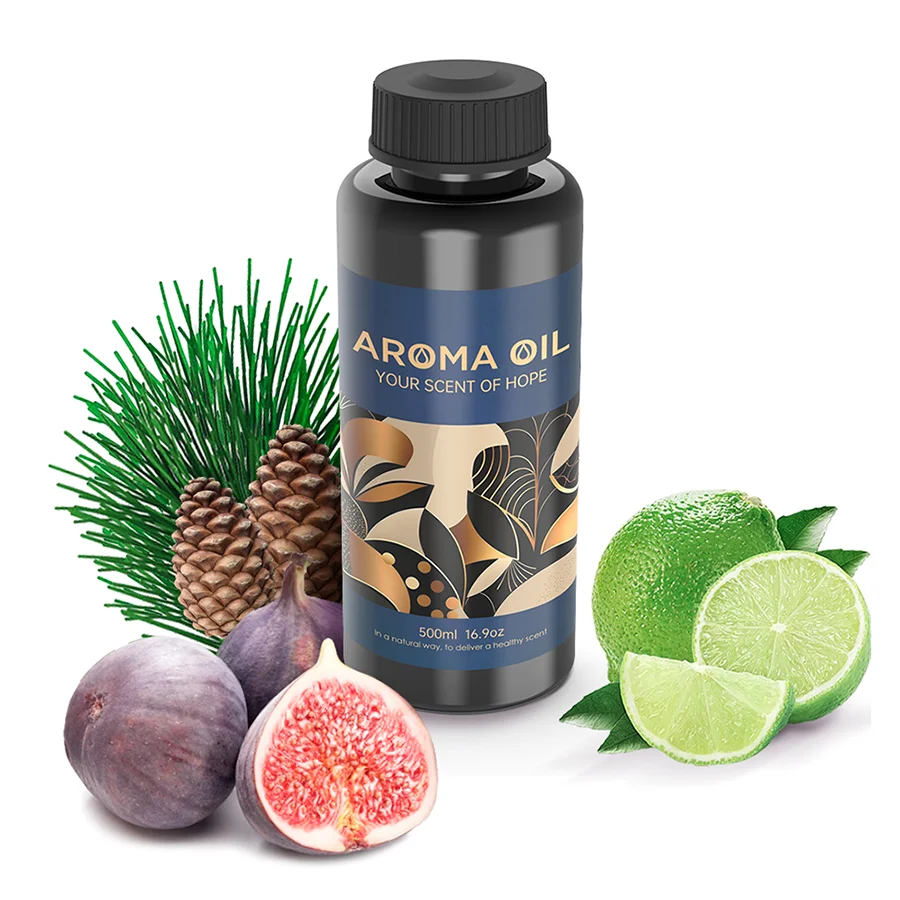
| Sea Salt, Garden After Rain, and Red Baccarat Oil | The page categorizes the product as Flower & Fruit Fragrance Essential Oil and presents CNUS as a scent machine and fragrance manufacturer. | Candidate for testing. The indexed data does not state oil-by-model compatibility for a specific waterless unit. |
| My Way, Good Girl, and New Crown Oil | The page is categorized as Perfume Essential Oil and includes CNUS OEM/ODM, sample, and fragrance-manufacturer information. | Candidate for testing. Do not treat the category name as proof that the oil suits every atomizer. |
| CNUS X3Pro | The product page identifies a portable USB waterless format, a 10 ml capacity, aluminum alloy atomizer, 0.3 ml/h plus or minus 5% oil consumption, and an essential oil bottle connection. | Machine format supported. Use only an approved 10 ml-compatible oil or bottle and confirm the oil SKU by sample. |
| CNUS X3Art | The page identifies a home/car scent diffuser with 10 ml capacity, 100 m3 coverage, 2 W power, DC 5 V input, and composite PP construction. | Machine format supported. Confirm the approved bottle, fragrance format, and material compatibility before filling. |
| CNUS AS3000S | The URL and product data identify a silent cold-air waterless essential-oil tower diffuser with 1,000 ml capacity, 5,000 cbm coverage, metal construction, 15 W power, 12 V voltage, CE and RoHS, and a one-year warranty. | Machine format supported. A commercial oil requires a written approval and a site or bench test. |
| CNUS S3000TF | The product data identifies a floor-standing waterless diffuser with a 1,000 ml format, app remote control, aluminum and acrylic construction, and a magnetic security lock. | Machine format supported. The current data does not publish an oil-by-SKU compatibility list. |
| CNUS S600plus Commercial Scent Air Machine | The page lists 150 ml to 1,000 ml configurations, 600 m3 to 6,000 m3 coverage, metal plus acrylic construction, oil consumption from 1.8 ml/h to 10 ml/h, and aluminum, PP, or PP plus aluminum atomizer options. | Commercial machine format supported. Select the oil with the supplier against the exact capacity and atomizer version. |
This is the most defensible compatibility statement available from the current source files. It gives a buyer a real shortlist without pretending that a public category label is the same as a completed test. For a high-volume deployment, ask the supplier to convert the strongest candidate row into a signed compatibility record with the model, oil batch, operating setting, and acceptance criteria.
What Oils Should You Avoid Unless the Manufacturer Approves Them?
Do not use an oil simply because it smells good in a bottle. The following categories should be treated as unapproved until the manufacturer confirms compatibility:
- Reed diffuser liquid: designed to travel through reeds, not necessarily through a pump or atomizer. Its carrier can behave differently from a machine fragrance oil.
- Massage, carrier, or cooking oils: they are not default diffuser refills and can be too heavy, too stable, or unsuitable for an oil path.
- Candle fragrance: some formulas are intended to dissolve into wax or perform under heat. That does not prove airborne atomization compatibility.
- Water-based fragrance mixtures: a waterless machine is not a water tank. Do not add water or a water-heavy product unless the instructions specifically require it.
- Highly colored, resinous, or particulate liquids: visible sediment or sticky residue deserves a technical review before it reaches a small nozzle.
- Undiluted single botanicals: "pure" describes composition, not suitability for every pump, seal, plastic, or atomizer.
- Unlabeled decanted oil: without an ingredient record, batch number, storage history, or supplier traceability, there is no reliable compatibility trail.
This is not a claim that every product in these categories will fail. It is a purchasing control. The burden of proof should be on the formula and machine combination, especially when the equipment will be used in a public space or under a private-label warranty.
How to Test Oil Compatibility Before Filling a Waterless Diffuser
A compatibility test should answer two separate questions: can the machine move and atomize the liquid, and does the result remain acceptable over time? A machine may run for ten minutes and still develop leakage, residue, or unstable consumption later. Use the exact model, exact bottle or cartridge, exact oil batch, and intended operating mode.
Bench test for a home or car diffuser
- Record the inputs. Write down the model, oil name, batch, bottle size, starting fill, room temperature, and operating setting.
- Inspect before use. Check the bottle neck, cap, tube, nozzle, seal, and connector. Photograph the clean parts so later residue is visible.
- Run a short start test. Operate the diffuser for the manufacturer's minimum recommended period. Check whether the machine starts without repeated priming or unusual noise.
- Check the output. Look for stable atomization, no visible liquid spray, no pooling around the nozzle, and no oil on the outer housing.
- Measure consumption. Weigh or measure the bottle before and after a fixed operating period, and compare the result with the machine's published consumption where available.
- Inspect after cooling. Look at the nozzle, bottle connection, housing, and surface beneath the unit. A clean start is not enough if the oil migrates after shutdown.
- Repeat with the intended fragrance concentration. A formula can behave differently after fragrance blending, rest, or a change in batch.
Acceptance checks for a B2B site test
For a hotel, retail store, office, or spa, extend the test beyond the bench. Run the machine during the actual operating schedule, check the room's airflow and HVAC conditions, record oil consumption, and ask staff whether the scent is stable rather than merely strong. Confirm that the refill interval, access height, cable route, cleaning method, and noise level fit the site. For a multi-room program, test at least one representative small room and one larger or more ventilated room.
| Test item | Pass condition to define | Evidence to keep |
|---|---|---|
| Start and stop | Starts, stops, and restarts at the planned setting without manual intervention beyond the instructions. | Date, setting, video or operator log, and any error code. |
| Flow and atomization | Output is stable and there is no visible pooling, sputtering, or unexpected spray. | Before and after photos, consumption measurement, and nozzle inspection. |
| Leak and seal | No oil appears at the bottle neck, tube, connector, housing, or mounting surface. | Photographs after the planned run and after shutdown. |
| Residue and cleaning | The approved cleaning method removes residue without damaging the machine. | Cleaning record, cloth or swab observation, and replacement-part notes. |
| Scent consistency | Staff or test users judge the fragrance as stable at the agreed setting and schedule. | Room conditions, user notes, and fragrance batch record. |
| Procurement repeatability | The supplier can identify the same oil formula, packaging, batch controls, and replenishment path. | Specification, sample approval, MOQ, lead time, packaging, and contact record. |
There is no universal pass number for every diffuser. The acceptance criteria should be set against the model's published specifications, the user's room, and the buyer's operating schedule. A low-volume home device and a 5,000 m3 commercial tower do not need the same test duration or refill plan.
Check a Compact Waterless Model
Which Oil Format Fits B2C Buyers?
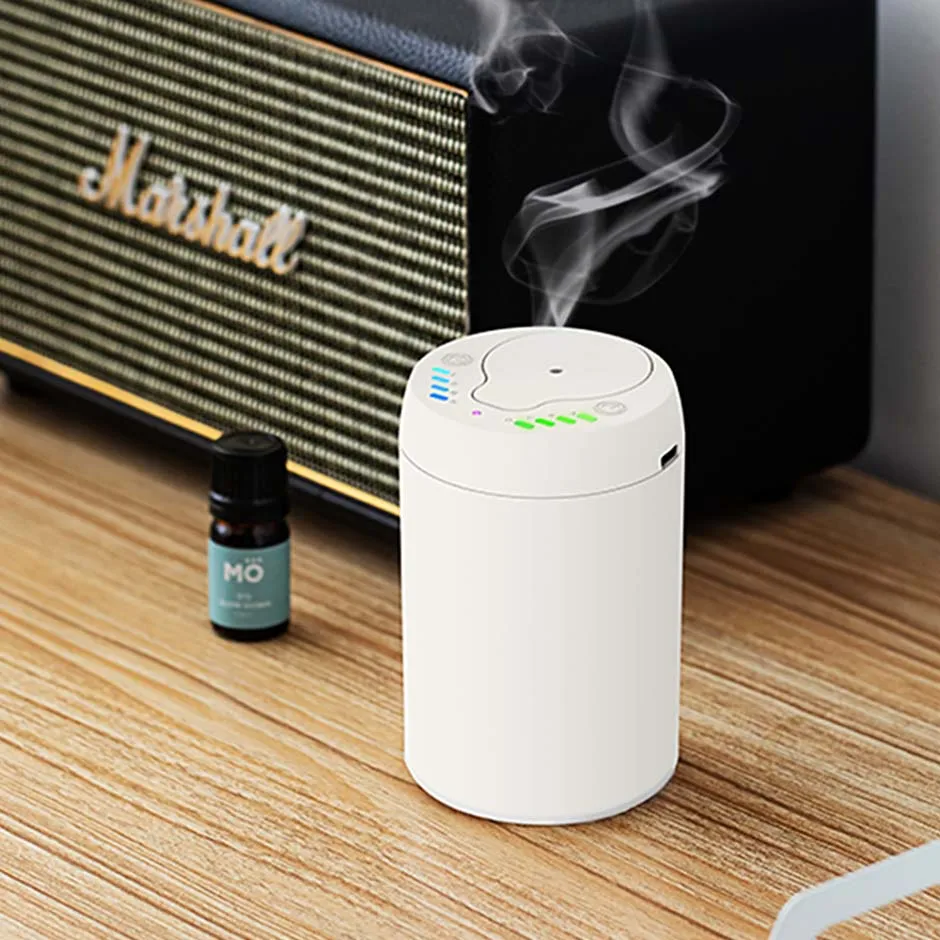
For a home or car buyer, convenience and error prevention matter more than a long list of fragrance names. Buy the oil that is supplied with the machine or listed by the manufacturer as compatible. If a refill is sold separately, match the bottle connection and capacity. The CNUS X3Pro page, for example, lists a 10 ml capacity, an aluminum alloy atomizer, 100 m3 coverage, and a 0.3 ml/h plus or minus 5% oil consumption reference. That information helps a buyer understand the scale of the refill and the expected format, but it does not authorize an unrelated oil.
A compact home or car user should also consider storage and handling. Keep the oil in its labeled container, protect it from heat and direct light, and close it after use. Do not transfer an oil into an unmarked bottle. A small machine can be more sensitive to a blocked nozzle because its flow path is narrow and its refill volume is limited. If the scent is too strong, reduce the operating schedule or output setting within the instructions rather than adding water or another carrier.
The CNUS X3Art page lists a 10 ml home and car scent diffuser with composite PP construction, 2 W power, DC 5 V input, and 100 m3 coverage. This is a useful example of why bottle size and housing material belong in the compatibility discussion. The right refill should be confirmed for the exact bottle and connector, especially when a user wants to switch between fragrances.
Which Oil Format Fits B2B Buyers?
For B2B buyers, the question is not only "what oil works?" It is also "can the same oil be supplied, documented, tested, and serviced across the program?" A hotel, retail chain, office group, or spa needs a stable fragrance brief, predictable refill quantities, consistent packaging, and a clear escalation path when a machine behaves differently at a second site.
Start by selecting the machine family. The S600plus public data lists configurations from 600 m3 to 6,000 m3, capacities from 150 ml to 1,000 ml, oil consumption from 1.8 ml/h to 10 ml/h, metal plus acrylic construction, and atomizer options including aluminum, PP, and PP plus aluminum. The exact oil approval must follow the selected configuration. An oil that behaves acceptably in a 150 ml version should not be assumed to behave identically in a 1,000 ml or different atomizer version.
For a larger commercial environment, the AS3000S page lists a 1,000 ml capacity, 5,000 cbm coverage, metal material, 15 W power, 12 V voltage, CE and RoHS certifications, and a one-year warranty. The page also describes CNUS as a manufacturer with more than ten years of R&D and production experience, SGS factory inspection, ISO9001 quality management information, and OEM/ODM capability. Those are useful supplier evidence points. They are not a substitute for approving the oil formula and the exact operating profile at the buyer's site.
What a commercial oil RFQ should include
- Target machine model, atomizer material, capacity, voltage, and intended coverage.
- Fragrance name, olfactive direction, reference sample, and acceptable batch variation.
- Oil type, carrier description, color, viscosity or flow data, and storage requirements.
- Target oil consumption, working hours, refill interval, and expected operating temperature.
- Sample quantity, sample lead time, bulk MOQ, production lead time, packaging, and carton details.
- Compatibility test method, acceptance criteria, warranty boundary, and responsibility for cleaning or service.
- Required documentation for the destination market, including technical and safety records where applicable.
Scentsin's published FAQ for several diffuser and fragrance pages states that samples are welcome, sample production can be 3-5 days, bulk timing depends on quantity, and OEM/ODM projects can be supported. Treat those as supplier-process references, not as a fixed lead time or MOQ for every oil and machine combination. Ask for the project-specific quotation in writing.
Oil Compatibility by Scentsin Machine Type
The following selection view is designed to help a buyer choose the next page to open. It does not replace the evidence matrix above. The wording "start with" means the machine's public use case is aligned with the oil question; it does not mean every fragrance on the site is automatically approved for that machine.
| Buyer need | Machine page to review | Oil decision |
|---|---|---|
| Car or compact home use | X3Pro or X3Art | Use the exact approved 10 ml bottle or oil format; test for leakage, start-up, and consumption. |
| Home, office, or small hospitality zone | Scent Plug2 or CPD2 | Confirm whether the selected oil is approved for the 130 ml or 150 ml format and its operating mode. |
| Wall or commercial room scenting | S600plus | Match oil to the exact capacity and atomizer; use the commercial diffuser oil evidence as a starting point, not a blanket approval. |
| Large hotel or commercial area | AS3000S or S3000TF | Require a written oil approval, site trial, refill plan, and cleaning/service record before rollout. |
How to Change Oils Without Damaging the Machine
Switching fragrance is a compatibility event, not only a scent preference. The previous formula can remain in the bottle neck, tube, valve, or atomizer. If the new oil has a different carrier or flow behavior, the mixture may temporarily change the scent and the machine's output. Follow the exact cleaning and changeover instruction for the model.
- Turn off and disconnect the diffuser according to the manufacturer's procedure.
- Remove the old bottle or cartridge and label it if it will be retained.
- Inspect the connector, tube, nozzle, seal, and surrounding housing for oil or residue.
- Clean only with the method and material approved for the machine.
- Install the new labeled oil without overfilling or mixing formulas in the same bottle.
- Run a short purge or start cycle if the instructions require it.
- Record the new oil batch and observe the first operating period for leaks, residue, and output change.
Do not improvise with water, alcohol, detergent, or another oil as a cleaning agent. A cleaning method that works for one model can damage another model's seal or surface. If the supplier has not published the method, ask before changing formulas.
Frequently Asked Questions
1. What oil should I use in a waterless diffuser?
Use the oil or fragrance formula approved for the exact diffuser model. This may be a diffuser fragrance oil or an essential-oil-based formula designed for waterless atomization. Do not choose by the words "natural" or "pure" alone. Confirm the bottle, atomizer, flow behavior, and operating instructions.
2. Can I use any essential oil in a waterless diffuser?
No. Different essential oils can vary in volatility, density, resin content, and material compatibility. A pure essential oil suitable for one machine may not suit another. Use only a manufacturer-approved oil or complete a documented sample test before use.
3. Is fragrance oil better than essential oil for a waterless diffuser?
Neither category is automatically better. A commercial fragrance oil may offer a particular scent profile and supply consistency. An essential-oil-based formula may be selected for its plant-derived aroma character. The deciding factors are the exact formula, machine compatibility, documentation, and test result.
4. Can I put reed diffuser oil into a waterless diffuser?
Do not assume it is compatible. Reed diffuser liquid is formulated for passive movement through reeds and evaporation. It may have a carrier or viscosity that does not suit a pump, tube, nozzle, or atomizer. Ask the manufacturer or test it under controlled conditions before use.
5. Can I dilute diffuser oil with water?
Not unless the exact product instructions require water. A waterless diffuser is designed around a different operating format from a water-based diffuser. Adding water can change flow, atomization, contamination risk, and machine behavior.
6. Why does my waterless diffuser leak after changing oil?
Possible causes include an incompatible bottle neck, damaged seal, loose connection, overfilling, residue at the connector, or an oil with different flow behavior. Stop the machine, inspect the connection, and follow the product instructions. Do not continue running a leaking unit.
7. What oil works with the CNUS X3Pro?
The X3Pro page identifies a portable USB waterless diffuser with a 10 ml capacity, aluminum alloy atomizer, and essential oil bottle connection. The exact oil SKU should still be approved for the unit. Use the supplied or manufacturer-confirmed format and verify the result with a short sample test before switching oils.
8. What oil works with a commercial scent machine?
Use a commercial diffuser oil or an essential-oil-based formula that the machine supplier approves for the exact model, capacity, and atomizer. Scentsin's Wood Series page states suitability for commercial diffusers, making it the strongest public oil evidence in the current product data, but a bulk buyer should still complete an oil-by-model sample test.
9. How do I test a new oil before a hotel or retail rollout?
Record the model, oil batch, bottle, setting, room conditions, starting fill, and operating hours. Check start-up, atomization, consumption, leakage, residue, scent stability, cleaning, and refill access. Test a representative small room and a larger or more ventilated room before approving multiple sites.
10. Does Scentsin provide oil samples and OEM support?
The current Scentsin product information states that samples are welcome on several fragrance and diffuser pages, sample production can be 3-5 days, bulk timing depends on quantity, and OEM/ODM projects are supported. Confirm the exact sample fee, MOQ, formula, lead time, packaging, and compatibility record for your project.
11. Where can I compare waterless diffuser machines and oils?
Review the Scentsin product catalogue for machine formats, then compare the Wood Series commercial diffuser oil, the Flower and Fruit fragrance oil range, and the relevant machine page. For an oil-by-model decision, use the Scentsin contact page and provide the model, oil, application, and target quantity.
Conclusion
The answer to "what oil to use in a waterless diffuser" is not a universal ingredient list. Use a fragrance oil or essential-oil-based formula that the exact machine supplier approves, and treat viscosity, carrier, bottle connection, atomizer material, residue, and operating schedule as part of compatibility. Do not assume that every essential oil, reed diffuser liquid, candle fragrance, or unlabeled oil will work.
For B2C buyers, start with the machine's approved refill format and a small, traceable bottle. For B2B buyers, turn the decision into a documented compatibility project: specify the exact model, oil SKU, batch, capacity, coverage, setting, consumption target, sample test, packaging, MOQ, lead time, and service responsibility. Current Scentsin data supports a clear starting point: the Wood Series page explicitly references commercial diffuser use, while the X3Pro, X3Art, AS3000S, S3000TF, and S600plus pages identify waterless or commercial machine formats that still need oil-by-model confirmation.