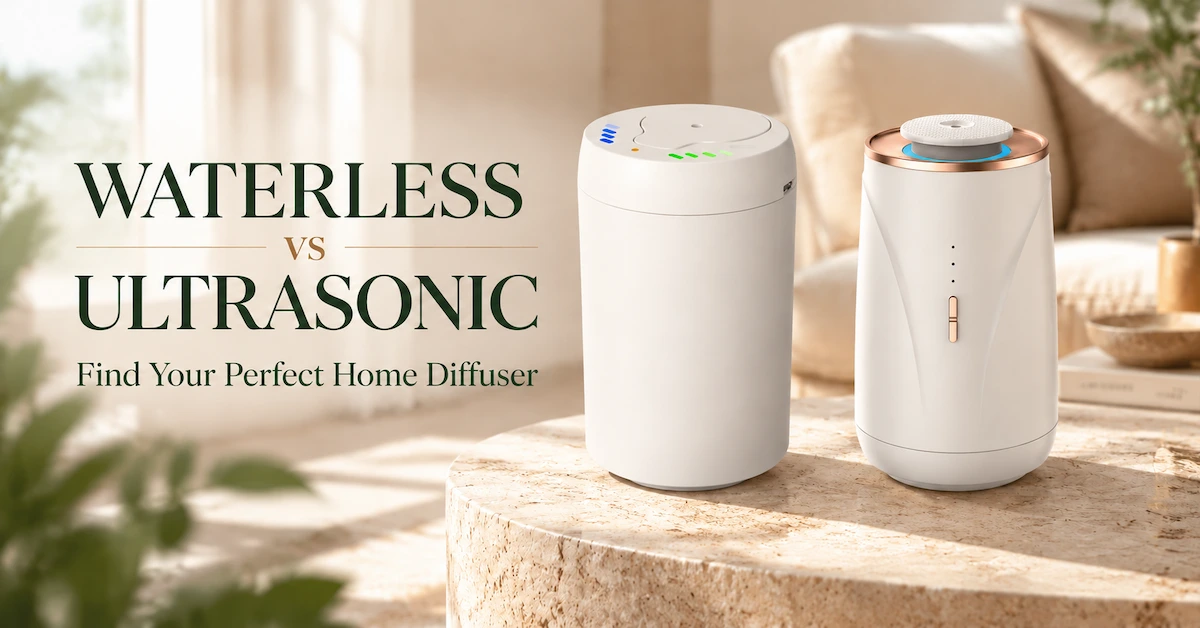

Quick answer: Neither a waterless diffuser nor an ultrasonic diffuser is automatically the best choice for every home. Choose a waterless diffuser when you want fragrance released without filling a water tank and prefer a compact, oil-based setup. Choose an ultrasonic diffuser when you specifically want water-based operation and visible mist. The right decision depends on your routine, room, placement, fragrance format, cleaning habits, and the controls you actually plan to use.
A comparison between these two technologies is useful because the products may look similar on a product page while creating a very different daily experience. One device uses a water reservoir and ultrasonic vibration. The other uses cold-air atomization or another waterless mechanism to disperse fragrance oil without a water tank. That difference affects setup, refilling, cleaning, how the device feels in a room, and which fragrance products can be used.
Explore Waterless Diffuser Options
What Is a Waterless Diffuser?
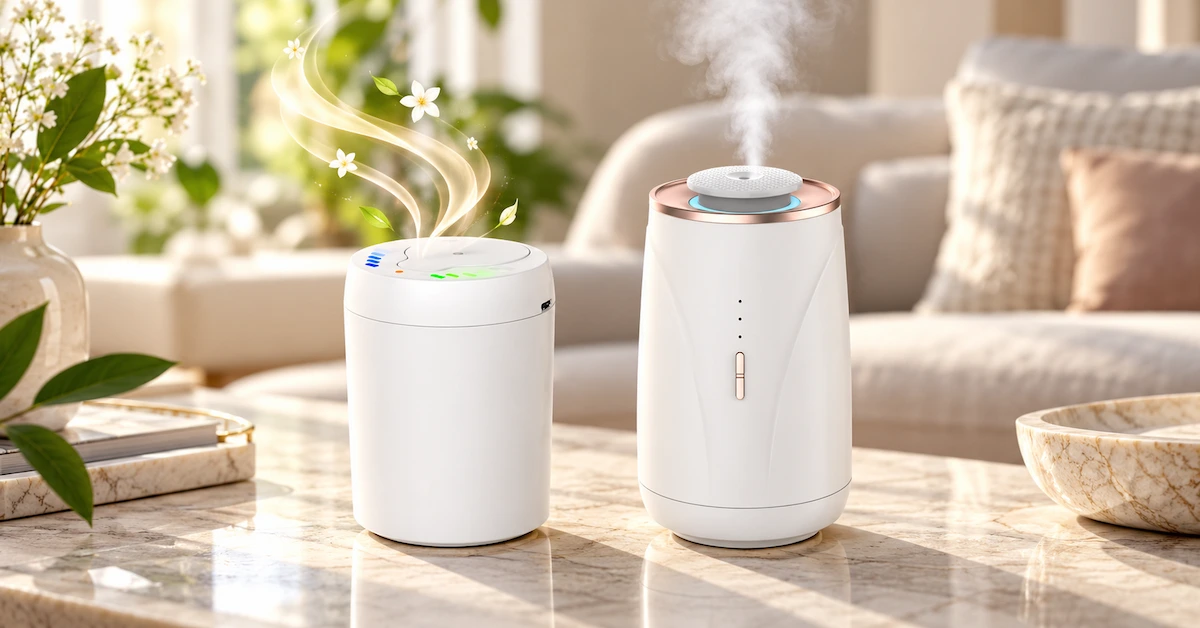
A waterless diffuser disperses fragrance oil without mixing it into a tank of water. Depending on the product design, a pump, air stream, atomizer, cartridge, bottle, or nozzle system turns the fragrance into a fine airborne output. Scentsin describes its waterless range using cold-air diffusion language, and the published product pages identify several compact models as waterless or cold-air devices.
For a home user, the practical meaning is simple: there is no water reservoir to fill before use. Instead, the user needs the correct fragrance container or oil format, a suitable power source, and a placement that matches the device design. The device may be more convenient for someone who does not want to measure water every time, but it still needs sensible handling. The nozzle, bottle connection, atomizer, or oil path should be kept compatible with the product instructions.
Waterless does not mean maintenance-free. A user may still need to wipe the exterior, check the oil supply, clean or replace a fragrance component, and avoid using an oil that the manufacturer does not recommend. The exact routine varies by construction and fragrance formula. Do not assume that every essential oil, perfume oil, or blended fragrance is suitable simply because it is liquid.
How the waterless format changes daily use
- There is no water tank to refill.
- The device is usually designed around fragrance oil rather than diluted water.
- Visible mist should not be assumed; the output may be a fine fragrance aerosol that is not obvious in normal room lighting.
- Oil compatibility, nozzle care, and operating schedules matter.
- Room size and airflow still affect the perceived fragrance experience.
Scentsin's compact waterless models show why specification checking matters. The X3Pro is listed with a 10 ml capacity, 2 W power, 5 V input, an aluminum alloy main material, and 100 m³ coverage. Its product description also identifies a small size, car and indoor modes, USB-C charging or connection depending on the version, and a magnetic bottle and nozzle design. These facts describe that model; they should not be copied to every waterless diffuser.
What Is an Ultrasonic Diffuser?
An ultrasonic diffuser uses high-frequency vibration to break a water-and-fragrance mixture into a fine mist. The user fills a reservoir, adds the compatible fragrance amount, closes the lid, and selects an operating mode. The visible mist can make the diffusion process easy to understand, which is one reason this format is familiar to many home users.
The water tank is also the main operating difference. It adds a step before use and creates a surface that must be emptied and cleaned. Residue from fragrance, minerals in water, and standing liquid can change the condition of the reservoir over time. A user who does not want to maintain a tank may find the process inconvenient. Another user may prefer it because the device is easy to set up with water and a measured fragrance amount.
Not every electric diffuser listed on a website is ultrasonic. Some models use cold-air atomization, some use a fan-assisted system, and some are designed as hybrid products. Product names such as “cool mist” should be checked against the product specification rather than treated as proof of a particular internal mechanism. If the exact technology matters to your purchase, read the product description and operating instructions.
What an ultrasonic setup asks from the user
- Fill the reservoir to the stated level and use the recommended water and fragrance format.
- Empty remaining liquid when the device will not be used for an extended period.
- Clean the tank and other accessible parts according to the manufacturer instructions.
- Place the device on a stable, water-resistant surface with room around the mist outlet.
- Check whether the output, light, timer, or operating schedule suits the room.
Scentsin's product catalog includes devices described as electric, cool mist, or home aroma diffusers. For example, the X2pro is listed with a 500 ml capacity and 400 cbm coverage, while the X2S is listed as a 250 ml, 2-in-1 electric/battery model with 300 cbm coverage. Those published facts help a buyer compare capacity and application, but they do not by themselves confirm that a model is the right choice for every room or that it should be treated as an ultrasonic diffuser. The product page and manual should remain the final reference.
Waterless Diffuser vs Ultrasonic Diffuser: The Main Differences
The most useful comparison is not “which technology is newer?” It is “which operating routine matches the way I use fragrance at home?” The table below gives a practical first pass. It intentionally avoids universal claims about scent strength, health, safety, or oil consumption because those outcomes depend on the device, fragrance formulation, settings, room conditions, and user behavior.
| Decision factor | Waterless diffuser | Ultrasonic diffuser |
|---|---|---|
| Water | No water reservoir is required for the diffusion process. | Requires a water reservoir and a water-and-fragrance mixture. |
| Fragrance format | Usually designed for compatible fragrance oil, cartridge, or bottle formats. | Uses a fragrance amount mixed with water according to the instructions. |
| Visible output | May have no obvious visible mist. | Often produces a visible cool mist, depending on the model and settings. |
| Refilling | Check and replace or refill the fragrance supply. | Fill the water tank and add the correct fragrance amount. |
| Cleaning focus | Oil path, nozzle, bottle connection, and exterior care may matter. | Tank, lid, mist outlet, and accessible water-contact parts need routine care. |
| Placement | Useful where a compact oil-based device fits the available space. | Needs a level, water-resistant surface and clearance for mist. |
| Best first question | Do I want to operate a diffuser without adding water? | Am I comfortable filling and cleaning a water tank? |
Water use and the setup routine
If your main frustration is filling a tank, a waterless diffuser immediately solves that particular inconvenience. You can focus on the fragrance supply and the operating schedule instead. That does not make the device “zero maintenance”; it changes what maintenance looks like. A waterless user checks oil, connections, and the atomizing path. An ultrasonic user checks water, the reservoir, the lid, and the mist outlet.
Think about your actual routine. Someone who uses a diffuser for a short evening session may not mind adding water. Someone who wants a device ready on a desk, shelf, entryway, or compact room may prefer not to handle a reservoir. If the diffuser will be moved between rooms, also consider whether water can spill during transport. A waterless device can remove that water-handling step, but the fragrance container still needs to be secured.
Diffusion method and what you see
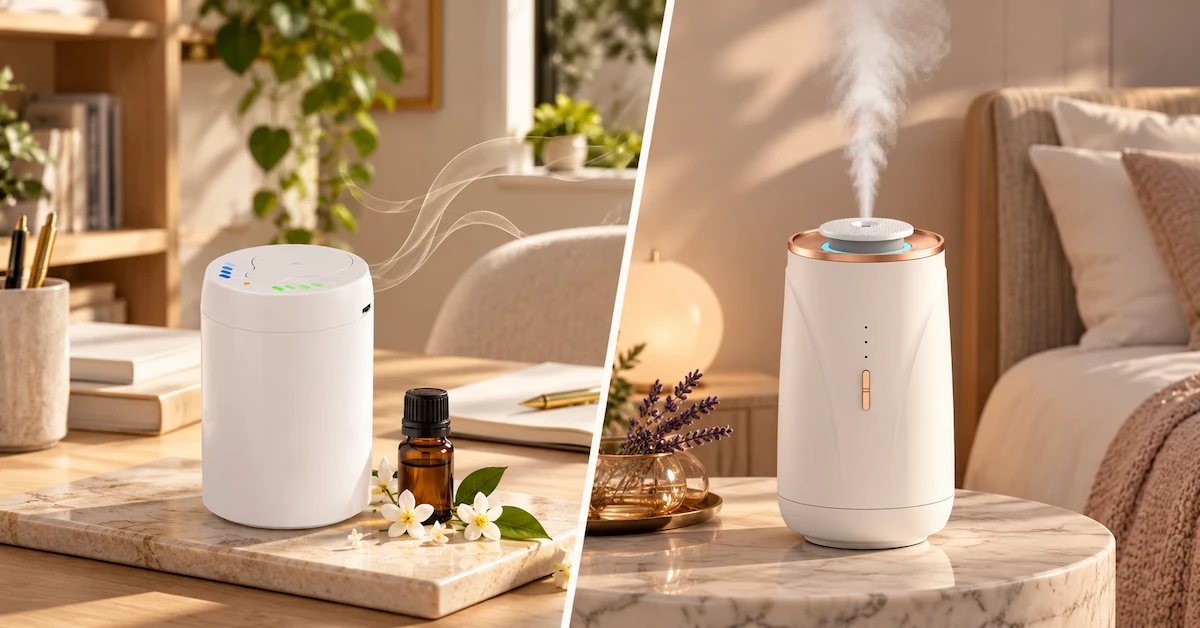
Ultrasonic models are easy to recognize while running because many produce a visible mist. That visual feedback can be reassuring: the user can see that the device is operating. Waterless cold-air devices may be less visually obvious. The fragrance may disperse as a fine output that is difficult to see, so users rely more on indicator lights, timers, app controls, or the product's operating schedule.
Do not use visible mist as a shortcut for judging performance. A visible cloud does not prove that one device is more suitable for your home, and no visible cloud does not prove that a waterless device is underperforming. Perception depends on room size, airflow, temperature, fragrance formulation, output setting, and how long the device has been running.
Cleaning and residue management
Both technologies need appropriate cleaning, but the areas of attention are different. With an ultrasonic diffuser, leftover water and fragrance can remain in the reservoir. A good routine is to follow the product instructions, avoid leaving old liquid sitting for long periods, and clean accessible surfaces at the recommended interval. With a waterless diffuser, oil residue can collect around the nozzle, connector, bottle, or atomizer. The correct cleaning method depends on the materials and the manufacturer's instructions.
Do not pour cleaning chemicals into any part unless the manual allows it. Do not insert a sharp tool into a nozzle to remove residue. If a device has a removable bottle, magnetic connection, or cartridge, check how it is designed to be removed before applying force. A buyer who dislikes maintenance should compare the cleaning instructions before comparing decorative features.
Fragrance compatibility
Fragrance compatibility is one of the most important but most often skipped questions. Ultrasonic diffusers generally expect a diluted water-based mixture. Waterless diffusers commonly expect a fragrance oil or a designated refill format. The correct fluid is part of the device design. Using an incompatible liquid can affect output, residue, seals, or the atomizer.
Read the product page and instructions for the model you are considering. “Essential oil” is not a universal compatibility label. Formulations differ in viscosity, ingredients, and concentration. A fragrance that works in a reed diffuser is not automatically suitable for an electric waterless device, and a product designed for an ultrasonic tank should not automatically be poured into an oil bottle or nozzle.
Noise, controls, and operating schedule
Noise is model-specific. A waterless device may use a pump or fan, while an ultrasonic device uses vibration and may also include a fan or other electronics. Look for a published noise specification when it is available, and do not transfer the value from one model to another. Scentsin publishes noise figures for several products, including less than 32 dB for the Stream2 and less than 38 dB for the X2mini. Those numbers are model data, not a promise that all waterless or all ultrasonic devices have the same acoustic profile.
Controls matter just as much as the diffusion method. Some users want a basic on/off control. Others want a timer, Bluetooth, an app, or a schedule that reduces hands-on operation. The Stream2 product page lists Bluetooth control, while other models have different control and power designs. If your priority is simple operation, choose the control system you are likely to use rather than paying for features that will remain unused.
Which Diffuser Is Better for Different Home Scenarios?
The most reliable answer is scenario-based. Instead of asking which technology wins in general, match the device to the room, the user's routine, and the conditions around the diffuser. A bedroom, living room, home office, and small apartment may each lead to a different decision.
For a bedroom
A bedroom buyer often cares about operating noise, placement, controls, and whether the device can run on a schedule. A waterless model can fit a buyer who wants an oil-based format without a water tank on a bedside table. An ultrasonic model can fit a buyer who prefers visible mist and is comfortable cleaning the reservoir. In either case, keep the device on a stable surface away from bedding, direct contact with skin, and areas where it can be knocked over.
Do not choose a device solely because a product description uses words such as “relaxing” or “sleep.” Fragrance preferences vary, and fragrance products are not medical devices. If children, pets, allergies, or sensitivities are part of the household decision, check the fragrance and device instructions and use your own judgment. The website's general marketing language should not replace the product label or professional advice.
For a living room
A living room usually has more open airflow and a larger volume than a bedroom. The key questions are capacity, coverage information, output scheduling, power access, and where the device will sit. A waterless model may be convenient if you want to avoid a visible water tank. An ultrasonic model may be more familiar if you already have a regular routine for filling and cleaning it.
Do not place either type directly beside an air-conditioning outlet, fan, open window, or high-traffic edge without considering the airflow and safety of the placement. Air movement can change how fragrance travels and how quickly a consumable is used. A larger published coverage figure is not a guarantee that every part of a room will smell the same; room layout and air circulation still matter.
For a home office
Home-office users often want compact dimensions, predictable controls, and a setup that does not interrupt work. A small waterless diffuser can be attractive when the user wants a ready-to-use oil format and does not want a water container near electronics or documents. An ultrasonic unit can work when the user is already comfortable with water-based operation and has a stable, water-resistant location.
Keep the output moderate and consider other people in the home. A fragrance that feels pleasant at a desk can become distracting in a closed room. Start with the manufacturer's recommended setting and adjust only within the device's instructions. Avoid making broad assumptions about concentration or “strength” because actual perception changes with the fragrance formulation and room conditions.
For a small apartment or compact room
Compact rooms do not automatically require a particular technology. They require a device that can be operated at an appropriate output and placed without creating clutter. The X3Art is listed as a 10 ml home and car diffuser with a 100 m³ coverage specification and 2 W power. The X3Pro is also listed with a 10 ml capacity and 100 m³ coverage, plus separate car and indoor modes. These models may be relevant to users seeking a small-format waterless device, but the current product page should be checked for the exact version and application.
An ultrasonic diffuser may also suit a compact room, especially if the user prefers a water-based setup. The deciding factors are not only tank size or product appearance. Check whether the device can operate at a suitable setting, whether the mist outlet has clearance, and whether the surface can tolerate occasional moisture.
For users who dislike daily refills
This is the clearest case for considering a waterless diffuser. If the repeated steps of measuring water, adding fragrance, emptying the reservoir, and wiping the tank are the reason you stop using a diffuser, a waterless format removes the water-specific part of that routine. You will still need to monitor the fragrance supply and follow the cleaning instructions, so the realistic benefit is a different routine, not no routine.
If you enjoy the visible mist and do not mind tank care, an ultrasonic diffuser may still be the better personal fit. A product that matches your habits is more useful than a product that looks better on a comparison chart.
How to Choose Without Paying for the Wrong Features
Before selecting a product, write down the constraints that cannot change. This prevents a common buying mistake: choosing a diffuser because of a stylish housing or a long list of features while missing the daily operating requirement.
- Decide on the fluid format. If you do not want water, begin with waterless models. If you prefer a water-and-fragrance mixture, compare ultrasonic or other water-based products.
- Measure the usable room. Use the product's published application or coverage information as a reference, not as a guarantee of uniform fragrance throughout the room.
- Check the placement. Confirm the device will sit level, have access to power, and remain away from heat, water splashes, children, pets, and areas where it can be knocked over.
- Compare the maintenance path. Read whether the model requires tank cleaning, nozzle cleaning, bottle changes, or other care.
- Check power and control details. Compare USB, DC, battery, app, Bluetooth, timer, and operating mode information only after confirming the exact model.
- Confirm the refill. Verify what fragrance oil, cartridge, or water mixture the device accepts and whether the refill is available for your location.
- Review after-sales information. Check shipping, returns, warranty wording, and contact options before ordering. These details matter more than a generic “premium” label.
For a side-by-side view of the current Scentsin range, start with the Scentsin diffuser collection. The collection page can help you move from an article-level comparison to model-level specifications. Do not assume the first device shown is the correct one; compare its capacity, input, application, control system, and cleaning requirements with your actual use case.
Scentsin Models That Help Illustrate the Choice
Product examples make a technology comparison easier to apply, but they should not be treated as universal recommendations. The following models are included because their published pages contain useful specifications for home buyers. Availability, price, included accessories, and exact versions should be verified on the live page before purchase.
CNUS X3Pro: compact waterless format
The CNUS X3Pro is listed as a portable USB waterless wireless aroma diffuser. The page identifies a 10 ml capacity, 2 W power, DC 5 V input, 100 m³ coverage, 0.3 kg net weight, and aluminum alloy for the main material and atomizer. It also describes car and indoor modes and a magnetic bottle and nozzle connection. This makes the model relevant to users who want a small waterless format that can be considered for both a vehicle and a compact indoor space.
Use those specifications as a starting point, not as a promise that it will produce the same result in every room. A 100 m³ listing does not account for every floor plan, airflow pattern, door position, or fragrance preference. Confirm the exact version, charging arrangement, included fragrance, and operating instructions before ordering.
CNUS X3Art: a home and car option
The CNUS X3Art page lists a 10 ml capacity, 2 W power, DC 5 V input, 100 m³ coverage, 0.41 kg weight, and composite PP for the main material. It is described as a home and car air scent diffuser. For a B2C buyer, its relevance is the flexible placement concept: one compact device category can be considered for a car, desk, entryway, or other small space, provided the location and operating instructions are suitable.
CNUS Stream2: a larger home-oriented format
The CNUS Stream2 is listed as a home scent diffuser with 150 ml capacity, 5 W power, DC 12 V input, aluminum as the main material, and a 400 m³ coverage specification. The page also lists Bluetooth control and a noise level below 32 dB. It is a different buying proposition from a pocket-size model: the buyer should compare the available space, power source, controls, and intended room before deciding whether the larger format is justified.
CNUS X2mini: compact wall-mounted home design
The CNUS X2mini is listed with 130 ml capacity, 400 m³ coverage, 5 W power, DC 5 V input, a noise level below 38 dB, and composite PP as the main material. Its product page describes a wall-mounted home aroma diffuser. That placement style can be useful when a buyer wants to keep the device off a small tabletop, but the installation surface, access to power, and maintenance access should be checked before purchase.
These examples also show why “waterless diffuser vs ultrasonic diffuser” cannot be answered from a single feature. A buyer needs to compare the diffusion method with capacity, control, placement, power, and maintenance. The correct model is the one whose complete setup fits the room and routine.
Compare Home Diffuser Products
Common Buying Mistakes to Avoid
Choosing by the word “waterless” alone
Waterless describes one operating characteristic, not the whole user experience. You still need to compare the fragrance format, refill availability, output schedule, power, noise specification, size, cleaning access, and placement. A waterless model can be a poor choice if its refill format is inconvenient for you or if the device does not fit the room.
Assuming visible mist means better diffusion
Visible mist is a user-interface feature as much as an output characteristic. It can make operation easy to see, but it does not tell you whether a device is right for your room. Compare the intended application, output control, published specifications, and your preferred maintenance routine.
Using the wrong fragrance
Never treat all oils as interchangeable. Follow the model's instructions and use a compatible fragrance format. A product that is formulated for a reed diffuser, a candle, or a water-based ultrasonic mixture may not be suitable for a waterless atomizer. If the product page does not make compatibility clear, contact the seller before ordering.
Ignoring the surface and airflow
Placement changes the experience. A diffuser in a strong air stream may distribute fragrance differently from one placed in a quiet corner. A water-based device also needs a stable, water-resistant surface. A waterless device still needs clearance for the outlet and safe access to the bottle or cartridge. Think through the exact location before adding a product to your cart.
Transferring one model's specification to another
Capacity, coverage, input voltage, noise, power, and oil consumption are model-specific. The X3Pro's published 10 ml capacity does not describe the Stream2's 150 ml capacity, and the Stream2's published Bluetooth control does not prove that every Scentsin model has Bluetooth. Read the exact product page for the exact model you plan to buy.
Frequently Asked Questions
1. Does a waterless diffuser need water?
No. A waterless diffuser is designed to disperse compatible fragrance without a water reservoir. It still needs the correct fragrance format and the maintenance described by the manufacturer. Do not add water unless the product instructions specifically say that the model supports it.
2. Is a waterless diffuser better than an ultrasonic diffuser?
It depends on the user's priorities. A waterless model may be a better fit for someone who does not want to refill and clean a water tank. An ultrasonic model may be a better fit for someone who prefers water-based operation and visible mist. There is no universal winner without knowing the room and routine.
3. What is the biggest difference between waterless and ultrasonic diffusers?
The biggest difference is the operating medium. A waterless diffuser disperses compatible fragrance oil without a water reservoir. An ultrasonic diffuser uses vibration to disperse a water-and-fragrance mixture. That difference affects refilling, cleaning, placement, and fragrance compatibility.
4. Does an ultrasonic diffuser always produce visible mist?
Many ultrasonic diffusers produce a visible cool mist, but the appearance depends on the model, settings, room conditions, and lighting. Do not use visibility alone to judge whether the device is suitable or whether its output is adequate.
5. Are waterless diffusers easier to clean?
They may be easier for a user who dislikes cleaning a water tank, but they are not maintenance-free. A waterless device can require care around the oil bottle, nozzle, connector, or atomizer. An ultrasonic device requires care around the reservoir and water-contact parts. Compare the instructions for the exact model.
6. Can I use any essential oil in a waterless diffuser?
No. Compatibility depends on the device and the formulation. Use only a fragrance or oil format approved by the manufacturer. Viscosity, ingredients, and concentration can vary, so a liquid suitable for one diffuser type may not be suitable for another.
7. Which type is better for a bedroom?
Choose based on noise, control, placement, fragrance preference, and maintenance. A waterless diffuser may suit a buyer who wants an oil-based setup without a tank. An ultrasonic diffuser may suit a buyer who prefers water-based operation. Check the model's noise information and instructions rather than relying on the technology label.
8. Are waterless diffusers suitable for small rooms?
Some are designed for compact spaces, but suitability depends on the published application, output control, and room conditions. Scentsin lists the X3Pro and X3Art at 100 m³ coverage, but that specification should be compared with the actual room, airflow, and the buyer's fragrance preference.
9. How often should I clean an ultrasonic diffuser?
Follow the exact product instructions because cleaning intervals vary by model and use. In general, do not leave old water and fragrance sitting in the reservoir for long periods, and clean the accessible water-contact areas as directed. Use only an approved cleaning method.
10. Where can I compare Scentsin diffuser models?
Use the Scentsin collections page for a product-level starting point, then open the exact model page to review capacity, power, application, controls, and other published specifications. For questions about a model or order, use the Scentsin contact page.
Conclusion
The practical choice between a waterless diffuser and an ultrasonic diffuser comes down to the routine you are willing to maintain. Choose waterless when avoiding a water tank is important and an oil-based format suits your space. Choose ultrasonic when you prefer a water-and-fragrance setup and visible mist. Before buying, verify the exact model's fragrance compatibility, capacity, power, placement, controls, cleaning requirements, and current product information.
Start with the Scentsin waterless diffuser collection to compare available options for home use, then review the model page that matches your room and daily routine.