

How to Choose the Best Waterless Car Diffuser for Daily Driving
If you are searching for the best waterless car diffuser, the main decision is not simply which device has the strongest scent. A good car diffuser must match the way you drive, the size of your vehicle, the available power connection, the amount of fragrance you want to use, and the way the device will stay secure while the car is moving.
For daily driving, a practical waterless car diffuser should be compact, easy to refill, quiet enough for the cabin, and simple to control. It should also use a fragrance format that suits waterless diffusion rather than requiring a water tank. For buyers comparing products online, the most important specifications are often easy to overlook: power supply, battery or plug-in configuration, oil capacity, consumption rate, and mounting method.
This guide explains how to evaluate those details before you buy. It also uses current Scentsin car diffuser specifications as practical examples. The goal is to help individual drivers choose with more confidence and avoid common problems after installation.
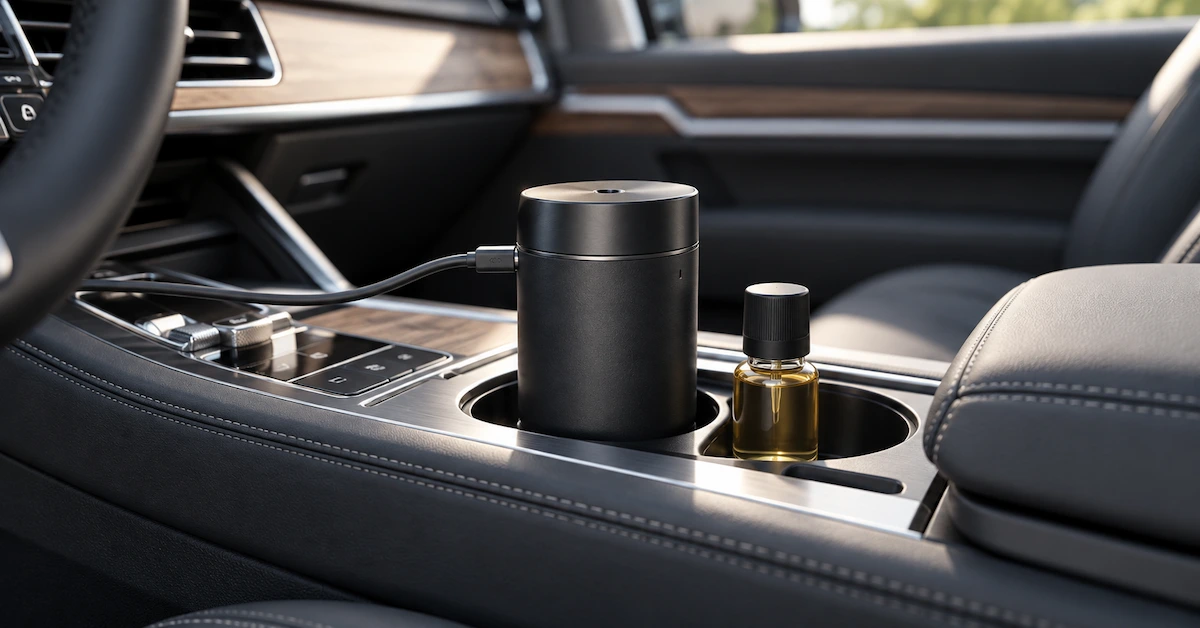
Quick Answer: What Makes the Best Waterless Car Diffuser?
The best waterless car diffuser is the model that provides controlled fragrance in your vehicle without adding unnecessary water, mess, or complicated maintenance. For most drivers, the most important buying factors are:
- A power option that matches the vehicle, such as DC 5V, USB, Type-C, or a rechargeable battery.
- A capacity that supports your driving routine without making the device unnecessarily large.
- A diffusion output that is adjustable enough for a small enclosed cabin.
- A noise level that does not distract from driving, calls, or music.
- A secure and clearly documented mounting or placement method.
- A compatible fragrance oil and a refill process that is easy to manage.
- A clear after-sales path for replacement parts, product support, shipping, and returns.
The right choice is therefore not always the largest diffuser or the machine with the highest coverage number. A car is a small, enclosed environment. A compact diffuser with controlled output can be more comfortable and more useful than a high-output machine designed for a large room.
What Is a Waterless Car Diffuser?
A waterless car diffuser releases fragrance without using a water reservoir. Depending on the design, it may atomize fragrance oil directly or use another water-free diffusion method to disperse the scent. The key difference from an ultrasonic water diffuser is that the user does not need to fill a tank with water before operation.
This design can be useful in a vehicle for several reasons. There is no water tank to spill when the car turns, no need to carry distilled water, and no damp mist intended for humidification. The device is focused on scent delivery rather than adding moisture to the air.
Waterless does not automatically mean that every model is suitable for every fragrance oil. A diffuser may be designed for a specific oil viscosity, fragrance formulation, or refill container. Before using a third-party oil, check the product instructions or contact the seller. Using an unsuitable liquid can affect atomization, clog the nozzle, change the scent intensity, or create a cleaning problem.
For buyers, the phrase “waterless car diffuser” should therefore lead to more questions, not fewer. Ask how the oil is loaded, whether the oil container is replaceable, how output is adjusted, what type of power the machine needs, and how the device is secured inside the car.
Step 1: Match the Diffuser to Your Vehicle and Driving Routine
Start by identifying where and how the diffuser will be used. A compact sedan, a large SUV, and a van do not have the same cabin volume or airflow pattern. A driver who commutes for 30 minutes each day may need a different setup from someone who spends several hours on the road.
Consider these questions:
- Will the diffuser be used only in a private car, or also at home?
- Is the vehicle usually parked in a hot climate?
- Do you prefer a light background scent or a noticeable fragrance?
- Will passengers include children, older adults, or people sensitive to strong odors?
- Does the device need to move between several vehicles?
- Will the diffuser sit in a cup holder, on a console, in a door pocket, or in another location?
- Is a USB or Type-C port available in the preferred placement area?
The answer affects the best product type. A portable dual-use model can be convenient for drivers who want one device for a car and a small room. A compact model with a rechargeable battery may be more convenient for people who switch between vehicles or prefer a cleaner interior.
Do not judge suitability by the word “portable” alone. Portable can mean battery-powered, compact, easy to carry, or simply smaller than a large-room diffuser. Confirm the product size, weight, battery information, cable type, and placement requirements before ordering.
Step 2: Check the Power Supply Before You Buy
Power compatibility is one of the most important details for a car diffuser. A device can have an attractive design and good fragrance performance but still be inconvenient if the power connection does not match your vehicle or your preferred placement.
The current Scentsin CNUS X3Pro product page lists 2 W power and DC 5V input. It also describes a Type-C connector for the plug-in version and a rechargeable battery version that is listed for up to 60 hours after one charge. These details make the power configuration central to the buying decision. A buyer should confirm which version is being purchased, because a plug-in version and a battery version may have different daily-use requirements.
Before checkout, confirm:
- Is the model plug-in, rechargeable, or available in both versions?
- Does it use USB, Type-C, a cigarette-lighter adapter, or another connector?
- Is the cable included?
- Is a wall adapter included, or is the device intended to connect to a vehicle USB port?
- Can the device operate while charging?
- How long does a full charge take?
- Does the advertised working time refer to continuous operation or an intermittent setting?
- Is the battery specification the same for every color and variant?
The difference between a plug-in and a battery model affects installation. A plug-in model may be better for a vehicle with a convenient USB port and a stable location. A battery model may create a cleaner interior appearance and can be moved between vehicles, but it must be charged and may require a different operating schedule.
The phrase “up to 60 hours” should also be interpreted carefully. Battery runtime depends on output level, operating mode, temperature, battery condition, and whether the diffuser runs continuously or intermittently. It should not be presented as a guaranteed scent duration or as a guarantee that the car will remain fragranced for 60 hours after one charge.
For a direct product reference, see the CNUS X3Pro portable waterless aroma diffuser. If your vehicle has a special power arrangement or you need a custom cable, use the Scentsin contact page to confirm compatibility before placing a larger order.
Step 3: Understand Capacity and Oil Consumption
Capacity tells you how much fragrance liquid the device can hold at one time. It does not tell you exactly how long the fragrance will last. Actual duration depends on the oil consumption rate, the operating schedule, the intensity setting, the temperature, and the fragrance formulation.
The CNUS X3Pro page lists a 10 ml capacity and an oil consumption figure of 0.3 ml per hour plus or minus 5 percent. If a device ran continuously at that listed rate, a simple calculation would suggest roughly 33 hours from a full 10 ml fill. In real use, the result may be longer or shorter because a diffuser may cycle on and off, use different output levels, or operate under different conditions.
This is a useful example of why capacity and consumption must be read together. A “10 ml diffuser” is not enough information for a proper buying decision. Ask for:
- The nominal oil capacity.
- The recommended fill level.
- The stated consumption range.
- Whether consumption is measured at the highest setting.
- Whether the device supports timed or intermittent operation.
- Whether the oil bottle or cartridge is easy to replace.
- Whether residual oil remains in the line or atomizer after use.
A larger capacity is not automatically better for a car. A large tank may increase the device footprint, add weight, and make the unit harder to place safely. For a personal vehicle, a smaller capacity with practical control can be easier to manage. For a frequent commuter or long-distance driver, refill frequency and operating cost may matter more than the smallest possible size.
The CNUS X3Art page also lists a 10 ml capacity, 2 W power, DC 5V input, and 100 m3 coverage. However, the current specification shown on that page does not list a specific oil consumption rate. That means buyers should not assume that X3Art and X3Pro have the same operating duration simply because both list 10 ml. Confirm the consumption rate and recommended operating mode for the exact model.
You can compare available fragrance and diffuser options through the Scentsin product collection. Oil compatibility with a specific car diffuser should still be confirmed before use.
Step 4: Do Not Ignore the Mounting or Fixing Method
A waterless car diffuser must remain stable while the vehicle is moving. Braking, turning, vibration, heat, and uneven roads can all affect a loose device. The fixing method is therefore a safety and usability issue, not just a design detail.
The current X3Pro and X3Art product pages identify the products as car aroma diffusers, but the visible specifications do not clearly state that a car clip, adhesive base, magnetic vehicle mount, cup-holder insert, or dashboard bracket is included. This should be treated as an important point to confirm before purchase.
The X3Pro description mentions an innovative magnetic connection for the nozzle and essential oil bottle. That wording should not be interpreted as proof that the complete diffuser includes a magnetic car mount. A buyer should ask specifically:
- What vehicle mounting accessory is included?
- Is the accessory suitable for the dashboard, air vent, cup holder, or another location?
- Does the mounting method leave the oil bottle upright?
- Can the diffuser be removed without damaging the interior?
- Is the device stable during braking and cornering?
- Does the chosen position interfere with airbags, visibility, switches, or gear selection?
- Is the mounting accessory included in every product variant?
If a product does not include a dedicated mount, a buyer may need to use a stable flat surface or a separate accessory. Do not place a liquid-containing device where it can roll into the driver footwell, block a control, obstruct a camera or sensor, or become a projectile in a sudden stop.
For personal use, the fixing question is especially important because the device will be exposed to everyday movement, braking, turns, and temperature changes. Ask for the installation instructions and accessory list before placing an order.
Step 5: Compare Coverage with Real Cabin Use
Coverage figures are helpful, but they should not be read as a promise that every vehicle will smell the same. The listed area may be measured under a particular test method, airflow condition, fragrance concentration, and operating mode. A car cabin also has moving air from ventilation, open doors, windows, and air conditioning.
The X3Pro specification lists 100 m3 coverage. The X3Art specification lists 100 m3 coverage and also shows an approximate 30 square meter or 300 square foot reference. These figures are broader than the interior volume of a typical private car, which suggests that the buyer should focus on control and placement rather than simply seeking the highest coverage number.
In a small cabin, excessive output can make the scent feel sharp or overwhelming. A diffuser with adjustable intensity or intermittent operation is usually easier to live with than a device that operates at one strong output level. If the product page does not explain the settings, ask for the operating modes and output control method.
Coverage should also be separated from scent persistence. A product may distribute fragrance quickly, but the perceived scent will change when the car is ventilated, when the air conditioner is running, or when the vehicle remains closed for several hours. The best waterless car diffuser is one that lets you control the fragrance for your conditions rather than simply maximizing output.
Step 6: Evaluate Noise for a Real Driving Environment
Noise is easy to overlook in product photos but noticeable inside a car. A diffuser that is acceptable in a busy store may be distracting in a quiet cabin, during a phone call, or when the driver is listening to music at low volume.
The current X3Pro page lists a noise level below 34 dB. The X3Art page lists a noise level below 32 dB. These figures provide a useful comparison, but the measurement conditions are not shown in the visible product information. Ask whether the number was measured at a particular output level, at a specific distance, or under a specific test environment.
Do not treat a listed noise figure as an absolute guarantee of silence. Placement can also affect perceived noise. A device touching a hard dashboard surface may transmit vibration differently from one sitting on a padded or isolated surface. A loose mount can create rattling that is not part of the atomizer noise itself.
For daily use, evaluate:
- The published noise level.
- Whether the sound changes at a higher intensity.
- Whether the device vibrates against the placement surface.
- Whether the power cable or accessory rattles.
- Whether a quiet mode or timed mode is available.
If the diffuser is intended for a quiet luxury vehicle or a long daily commute, test it at the preferred output level before relying on it every day.
Step 7: Check Materials and Heat Exposure
A car interior can become hot when the vehicle is parked in direct sunlight. Material selection, battery design, oil container construction, and placement all matter in this environment. The fact that a product is marketed for cars does not remove the need to follow the operating and storage instructions.
The X3Pro page lists aluminum alloy as the main material and also describes composite PP in the product text. The X3Art page lists composite PP as the main material. These details should be read as product information, not as independent proof of long-term performance under every climate condition.
Ask the supplier:
- What temperature range is recommended for operation and storage?
- Should the device be removed from the car during prolonged parking in high heat?
- Is the fragrance container resistant to leakage in the recommended position?
- Are the battery and charging components protected against the intended use conditions?
- Are replacement bottles, nozzles, or seals available?
Avoid making unsupported safety claims about children, pets, health effects, or therapeutic benefits. A fragrance diffuser can improve the perceived atmosphere of a car, but it should not be described as a medical device, an air purifier, or a guarantee against allergies or respiratory symptoms. People who are sensitive to fragrance should use low output, ventilate the vehicle, and stop using the product if discomfort occurs.
Step 8: Choose the Right Fragrance and Refill System
The diffuser is only one part of the scent experience. Fragrance concentration, oil formulation, cabin temperature, ventilation, and personal preference all affect how the scent is perceived.
For a car, a balanced fragrance is usually easier to use than an extremely strong fragrance. Many drivers prefer clean, fresh, woody, citrus, or lightly floral profiles, while others may choose a richer scent for a luxury vehicle or a branded customer experience. The right choice depends on the user and the time spent in the cabin.
Do not assume that every essential oil or fragrance oil is interchangeable. A product designed for waterless atomization may require a compatible oil blend. Ask whether the refill:
- Is intended for waterless cold-air or direct atomization.
- Is supplied in a bottle that fits the diffuser.
- Has a recommended viscosity range.
- Requires dilution or should be used as supplied.
- Can be used in a vehicle without leaking under normal placement.
- Is available in a convenient replacement quantity for personal use.
For personal use, the easiest refill system is one that does not require a funnel, measuring tools, or repeated disassembly. A simple bottle and refill process also make it easier to maintain a consistent scent without creating spills inside the vehicle.
Waterless Diffuser vs Other Car Fragrance Options
There is no single best fragrance system for every driver. Compare the operating principle with your actual priorities.
Waterless Car Diffuser
A waterless diffuser is designed to release fragrance without a water tank. It can provide a more active scenting experience than a passive vent freshener and avoids the need to carry water. It may require charging, a USB connection, or compatible fragrance oil. Its performance depends on output control and the correct refill.
Passive Vent Clip
A passive vent clip is simple, low-cost, and usually requires no battery. It may be suitable for drivers who want a subtle scent with minimal setup. It generally provides less control over output and may be affected by airflow from the vehicle vent.
Reed Diffuser or Bottle-Based Car Freshener
A passive liquid product can operate without electricity, but it must remain upright and stable. It may not be suitable for every placement location. Read the product instructions carefully and avoid placing liquid where a spill could damage the interior.
Water-Based Ultrasonic Diffuser
A water-based model uses a reservoir and may be designed for humidification as well as fragrance. It may be less convenient for a moving vehicle because it requires water, has a tank to maintain, and can create mist. A waterless design is usually simpler when the main goal is fragrance without added water.
The best choice depends on whether you value fragrance control, low maintenance, battery flexibility, low upfront cost, or the simplest possible installation.
Product Comparison for Buyers
| Option | Published or typical use profile | Main advantage | Main question before purchase |
|---|---|---|---|
| CNUS X3Pro Car Aroma Diffuser | 10 ml capacity, 100 m3 coverage, 2 W, DC 5V, below 34 dB, car and indoor modes | Portable dual-use design with plug-in and battery descriptions | Which version is supplied, what is the exact mount, and what is the charging specification? |
| CNUS X3Art Car Air Freshener | 10 ml capacity, 100 m3 coverage, 2 W, DC 5V, below 32 dB | Compact home and car positioning with Type-C options shown | Is the vehicle fixing accessory included, and what is the oil consumption rate? |
| Passive vent fragrance | No electrical specification; performance varies by product | Simple operation and low maintenance | How strong is the scent, how long does it last, and can it leak or obstruct the vent? |
| Water-based ultrasonic diffuser | Uses a water reservoir; specifications vary by model | May combine fragrance with humidification | Is water practical in a moving vehicle, and how will the tank be cleaned and secured? |
The table is a decision aid, not a substitute for the exact product manual. Product variants, accessories, stock, pricing, and packaging can change. Confirm the version shown in your cart before paying.
A Practical Buyer Checklist
Use the following checklist when comparing the best waterless car diffuser options:
- Confirm the product is genuinely waterless and identify the diffusion method.
- Confirm the exact model number and variant.
- Check whether the device is battery-powered, plug-in, or both.
- Confirm the input voltage and connector, such as DC 5V or Type-C.
- Check whether the cable, adapter, charging cable, and battery are included.
- Confirm the nominal oil capacity and recommended fill level.
- Ask for the oil consumption rate and how it changes by output setting.
- Check whether the product supports intermittent or timed operation.
- Review the listed noise level and ask how it was measured.
- Confirm the product size and weight before choosing a mounting location.
- Ask exactly what vehicle fixing accessory is included.
- Confirm that the diffuser can remain upright and stable while driving.
- Make sure the proposed placement does not obstruct airbags, controls, visibility, or ventilation.
- Confirm compatible fragrance oil and replacement bottle requirements.
- Ask about operating and storage temperature.
- Check the warranty, replacement parts, and after-sales process.
- Review the current shipping policy for your destination.
- Review the return and refund policy before placing an order.
- If buying for a second vehicle or as a gift, confirm the power and mounting requirements for the intended car.
- Contact Scentsin if you need help choosing a model or confirming fragrance compatibility.
This checklist helps prevent a common mistake: selecting a product from a short feature list without verifying whether the complete setup works in the actual vehicle.
Common Mistakes to Avoid
Choosing by Coverage Alone
A high coverage number does not automatically mean a better car experience. A small cabin may need lower output and more control. Compare coverage with intensity settings, duty cycle, and placement.
Assuming All 10 ml Products Last the Same Time
Capacity is only the amount of liquid held by the device. Consumption rate and operating mode determine practical duration. Ask for both numbers.
Treating Battery Runtime as Scent Duration
A statement such as “up to 60 hours” usually describes device operation under stated conditions. It does not mean one refill will scent a vehicle for 60 hours, and it does not mean the same result at the highest setting.
Ignoring the Mounting Method
A car diffuser is part of a moving environment. If the page does not clearly state the mounting accessory, ask before ordering. Do not assume that a magnetic oil-bottle connection is the same as a magnetic vehicle mount.
Using an Unverified Oil
An oil that works in a reed diffuser or ultrasonic machine may not be suitable for a waterless atomizer. Confirm compatibility to reduce clogging, leakage, and inconsistent scent output.
Buying the Wrong Power Variant
Plug-in and battery models can have different usage patterns, accessories, and charging requirements. Check the exact variant name on the product page and cart before paying.
Overlooking Heat and Storage
Vehicles can become hot when parked. Follow the product instructions and ask the supplier about storage conditions, especially for battery models and liquid refills.
Choose Based on Your Personal Driving Habits
For an individual driver, the purchase decision usually centers on comfort, convenience, sound, fragrance intensity, and simple refilling. A portable model that can work in a car and a small indoor area may be useful for people who travel frequently or want one diffuser for several spaces.
If you drive mainly to work, prioritize easy charging, quiet operation, and a refill size that matches your weekly routine. If you take long road trips, pay more attention to battery runtime, scent control, oil consumption, and heat storage. If you move between two cars, portability and a reliable power connection may matter more than maximum coverage.
For any personal purchase, use the Scentsin contact page to confirm model-specific details such as the included cable, fragrance compatibility, and vehicle mounting accessory.
Ten Questions to Ask Before Checkout
If you are comparing several products, use a concise checklist before checkout. The answers should identify the exact version and avoid vague statements:
- What is the model number and what is included in the box?
- Is the unit battery-powered, plug-in, or available in both forms?
- What are the input voltage, connector, charging time, and operating time?
- Is the listed operating time continuous or intermittent?
- What is the nominal oil capacity and oil consumption rate?
- Which fragrance oils are compatible with the atomizer?
- What is the exact noise level and test condition?
- What mounting or fixing accessory is included for a vehicle?
- Can the diffuser remain upright during normal driving?
- What are the warranty, replacement, shipping, and return terms for personal orders?
These questions make it easier to choose a product that fits your vehicle instead of relying on a generic feature list.
FAQ
1. What Is the Best Waterless Car Diffuser for Everyday Driving?
The best model is the one that matches your vehicle, power connection, fragrance preference, and placement needs. For many drivers, a compact waterless unit with controlled output, a practical refill size, low operating noise, and a clear mounting solution is more useful than a larger high-output machine. Compare the exact power, capacity, consumption, noise, and accessory information before buying.
2. Is the CNUS X3Pro Suitable for a Car and Home?
The current X3Pro product page describes it as a small model for car and home use with car and indoor modes. It lists 10 ml capacity, 100 m3 coverage, 2 W power, DC 5V input, aluminum-alloy construction, and a noise level below 34 dB. Confirm the exact product variant, battery or plug-in configuration, and included accessories before purchase.
3. Does a Waterless Car Diffuser Need Water or a Water Tank?
No. A waterless car diffuser is designed to release fragrance without a water reservoir. It may atomize compatible fragrance oil directly or use another water-free diffusion system. You still need to use the recommended fragrance formulation and follow the product instructions. Water should not be added unless the manufacturer specifically says that the model supports it.
4. How Long Does a 10 ml Car Diffuser Refill Last?
There is no universal answer. Duration depends on oil consumption, output intensity, operating schedule, temperature, and fragrance formulation. The X3Pro page lists 10 ml capacity and 0.3 ml per hour plus or minus 5 percent oil consumption, but actual use can differ when the unit operates intermittently or at a lower setting. Ask for the consumption rate of the exact model.
5. Does the X3Pro Include a Magnetic Car Mount?
The visible X3Pro product description mentions a magnetic connection involving the nozzle and essential oil bottle. It does not clearly state that a separate magnetic vehicle mount is included. Do not assume the product has a dashboard or air-vent mount. Ask Scentsin to confirm the included fixing accessory and the recommended in-car placement.
6. What Power Supply Does a Waterless Car Diffuser Use?
Power varies by model. The X3Pro specification lists 2 W power and DC 5V input, and the product description refers to a Type-C connector for the plug-in version as well as a battery version. The X3Art specification also lists 2 W and DC 5V and shows Type-C options. Confirm the exact variant, cable, charging method, and whether it can operate while charging.
7. Is a Lower Noise Rating Better for a Car Diffuser?
Usually, a lower published noise figure is helpful in a quiet cabin, but the measurement condition matters. The current pages list below 34 dB for X3Pro and below 32 dB for X3Art. Placement can also create vibration or rattling. For a sensitive application, test the diffuser in the intended vehicle and at the desired output level.
8. Can I Use Any Essential Oil in a Waterless Car Diffuser?
Not necessarily. Waterless atomizers may require a compatible oil viscosity and formulation. An unsuitable oil can affect atomization, clog the nozzle, cause leakage, or change scent performance. Confirm compatibility with the supplier before using a third-party refill, and do not assume that an oil made for a reed diffuser or ultrasonic diffuser will work in a waterless machine.
9. How Should I Choose the Mounting Position Inside My Car?
Choose a stable position where the diffuser remains upright and does not block the driver's view, airbags, controls, vents, cameras, or sensors. Avoid loose placement on a surface where the unit can roll or fall during braking. Because mounting accessories differ by model, confirm the supplied fixing method before installation.
10. Can I Leave a Waterless Car Diffuser in My Car When It Is Parked?
Follow the model's operating and storage instructions, especially in hot weather. A parked vehicle can become much hotter than the surrounding air, so ask whether the diffuser, battery, and fragrance container should be removed during prolonged high-temperature parking. Keeping the unit upright and protected from direct sunlight can also help reduce leakage and heat-related wear.
Conclusion
Choosing the best waterless car diffuser means checking more than fragrance strength. Confirm the power supply, oil capacity, consumption rate, noise level, compatible fragrance, and vehicle fixing method before ordering.
The CNUS X3Pro car aroma diffuser and CNUS X3Art car diffuser are useful options to compare for portable waterless scenting. Confirm the exact variant, included accessories, and mounting solution before purchase.
Ready to choose your model? Browse Scentsin car and aroma diffuser products, or contact Scentsin for fragrance compatibility, mounting accessories, and personal product questions.