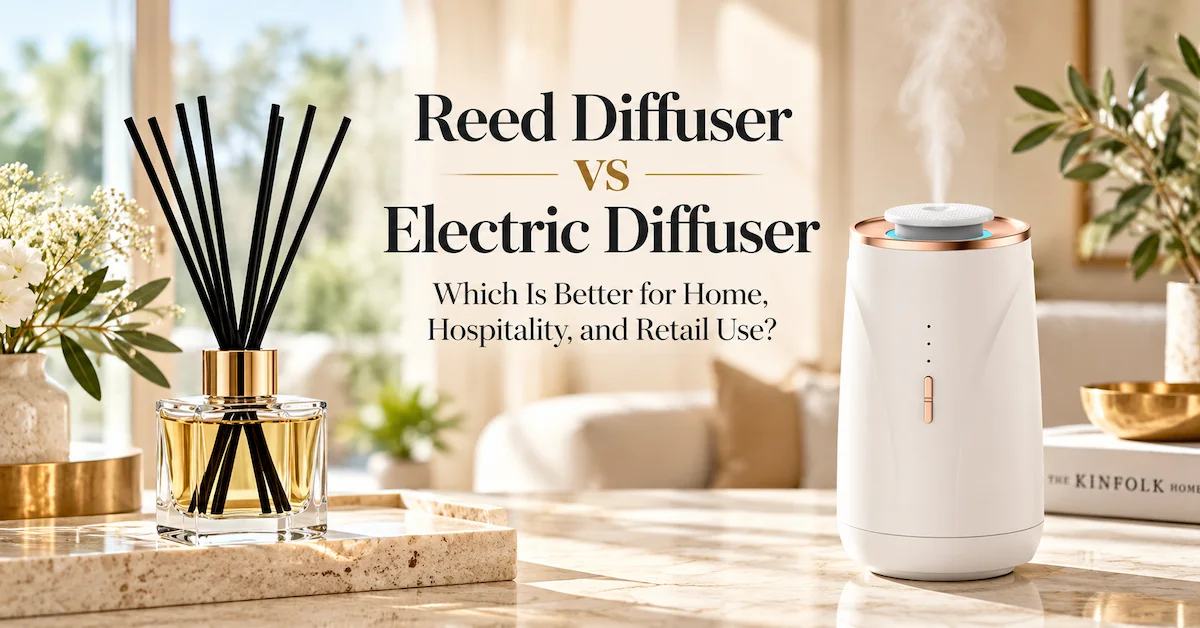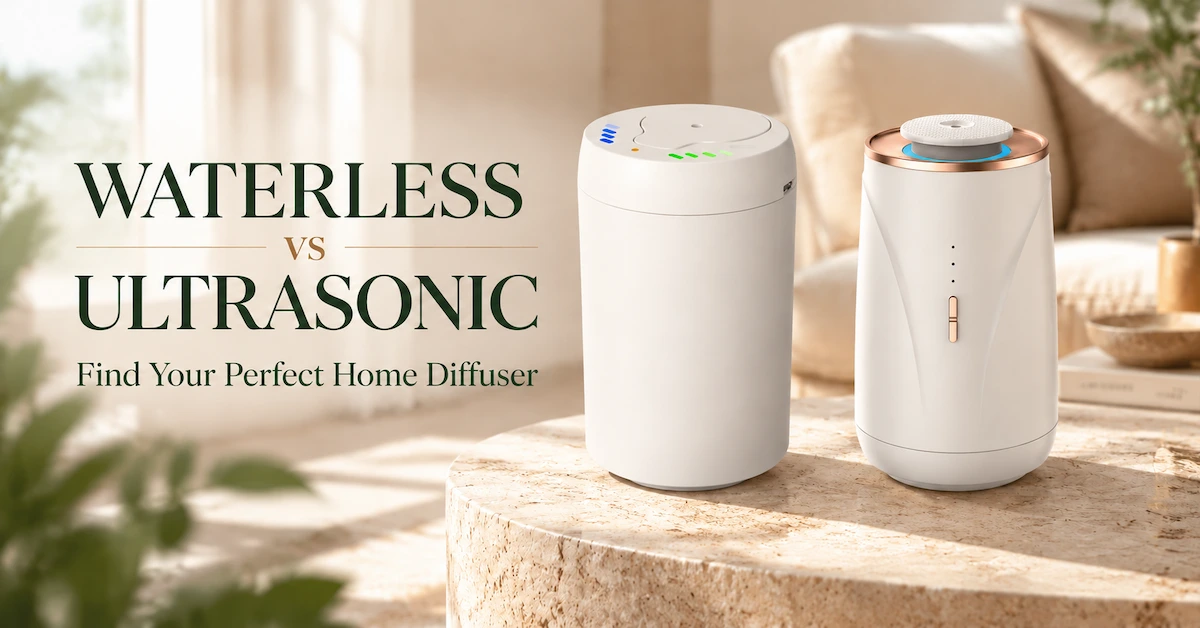

Quick answer: Choose a reed diffuser when you want quiet, continuous, flame-free fragrance with no outlet, charging routine, motor, or schedule. Choose an electric diffuser when you need adjustable output, timed operation, a defined coverage target, or repeatable scent delivery across a larger or busier space. Neither format is universally better: the correct choice depends on room size, airflow, desired control, maintenance tolerance, electricity access, and whether fragrance is part of the decor or part of an operating system.
The phrase reed diffuser vs electric diffuser brings together two products that may sit in the same home fragrance aisle but solve different problems. A reed diffuser uses liquid fragrance, a bottle, and absorbent sticks. An electric diffuser uses a powered atomizer, mist or air system, controls, and a refill or reservoir. A buyer who compares only the bottle price or the word "luxury" can easily choose a product that looks right but behaves badly in the intended room.
This guide is written for homeowners, gift buyers, boutique retailers, hotels, spas, offices, and procurement teams selecting a repeatable fragrance format. It focuses on the decision between a reed diffuser product and an electric aroma diffuser. It does not treat this as a generic comparison of every waterless, ultrasonic, heat, or nebulizing technology. When an electric model uses a particular mechanism, the exact product page and manual should be the final reference.
What Is the Difference Between a Reed Diffuser and an Electric Diffuser?
A reed diffuser releases fragrance through capillary action. The sticks absorb a scented liquid from the bottle and carry it upward. Fragrance evaporates from the exposed reed surface into the surrounding air. There is no motor, battery, plug, water tank, fan, or electronic control panel. The user changes the experience by choosing the number of reeds, turning the reeds occasionally, and placing the bottle where normal air movement can carry the scent.
An electric diffuser uses power to move fragrance into the air. The internal design may use a powered atomizer, a cool-mist system, an air pump, a fan, or another mechanism described by the manufacturer. The important buying difference is that the output can usually be scheduled or adjusted, and the product can be specified by capacity, power, coverage, noise, voltage, and control system. Electric operation is therefore more measurable, but it also adds a power source and a device-maintenance routine.
| Decision factor | Reed diffuser | Electric diffuser |
|---|---|---|
| Power | No electricity or charging. | Needs a plug, USB/DC input, battery, or another specified power source. |
| Output control | Adjust with reed count, reed position, and placement. | Often includes a timer, intensity setting, app, remote, or operating schedule. |
| Fragrance experience | Quiet, gradual, continuous release that becomes part of the room decor. | More active delivery, with output that can be timed or increased when the space is occupied. |
| Maintenance | Monitor liquid, reeds, spills, dust, and replacement timing. | Monitor fragrance supply, clean the product as instructed, and maintain the power connection. |
| Best fit | Bedrooms, bathrooms, entryways, desks, gifts, and small decorative settings. | Larger rooms, hospitality, retail, offices, scheduled scenting, and spaces needing repeatable output. |
How a Reed Diffuser Works in a Real Room
The reed format is deliberately simple. A bottle holds fragrance oil or a fragrance solution. Absorbent sticks sit in the liquid and provide a large exposed surface. As the liquid moves through the reed channels, volatile fragrance components evaporate. A room with moderate air movement can carry that aroma farther than a still room, while an open window, strong HVAC outlet, or high temperature can change the rate of evaporation.
What makes a reed diffuser attractive to home buyers
- No outlet: the product can sit on a shelf, console, vanity, reception table, or bathroom ledge without a cable.
- Quiet operation: there is no fan, pump, motor, or electronic alert.
- Always-on presence: a user does not need to remember to turn it on for every visit.
- Decorative format: the bottle, reeds, label, and color can support the room style.
- Simple intensity adjustment: fewer reeds usually create a lighter experience, while more reeds expose more fragrance surface.
Those benefits do not mean that every reed diffuser is suitable for every room. A bottle placed beside a hot window may consume liquid faster. A bottle in a strong air stream may scent unevenly. A very large open-plan room may need multiple placement points or a powered system with a published coverage specification. A reed diffuser is best understood as a passive scent object, not as a machine that promises identical concentration in every corner.
Evidence from the Scentsin reed diffuser range
The current Scentsin product information gives a concrete example. The Classic&Hot Tropical Fruit reed diffuser is listed at 180 ml, with a stated diffusion range of up to 300 square feet. The set includes a glass fragrance bottle, a 6.3 fl oz mixture of essential oils combined with fragrance, six diffuser sticks, and an artificial flower. Its page describes a natural plant essential oil organic solution and an approximate fragrance period of about 90 days. It also states that the number of sticks can be adjusted.
These details answer the questions a buyer actually has: what arrives in the package, how much liquid is supplied, what room scale the page references, and how the user can adjust the release. They are product-specific evidence, not a universal promise about every reed diffuser. The fragrance period can change with temperature, airflow, reed material, the number of sticks used, and how often the sticks are turned.

How an Electric Diffuser Works in a Real Room
An electric diffuser turns fragrance delivery into an operating routine. The user connects power or charges a battery, fills or installs the compatible fragrance supply, chooses a mode, and positions the device so the outlet has room to work. The exact mechanism varies, so buyers should avoid treating "electric diffuser" as a technical specification by itself. A model described as electric may have a reservoir, a cold-air atomizer, a battery, a fan, or a smart control system.
What an electric diffuser adds
The main value is control. A timer can reduce output when a room is empty. A higher setting can prepare a reception area before guests arrive. A wall-mounted unit can keep the fragrance source away from a small tabletop. A commercial model can be selected by coverage, capacity, power, voltage, oil consumption, and control connectivity. These features matter when a fragrance program has to operate consistently across a schedule or multiple sites.
The trade-off is responsibility. The buyer must provide a safe power source, keep the device accessible for refill and cleaning, use the correct fragrance format, and review the operating instructions. Electrical parts also add a failure point that a passive bottle does not have. A well-chosen electric diffuser is more controllable; it is not automatically simpler.
Published electric diffuser examples
Scentsin product pages illustrate the range of electric formats. The CNUS X2S is listed as an electric/battery 2-in-1 model with 250 ml capacity, 300 cbm coverage, 4 W power, 4.5 V input, PP/PC construction, and a one-year warranty with CE and RoHS certifications. It is relevant to a buyer who wants a powered format for a smaller area and values the option of battery operation.
The CNUS X2pro is listed with 500 ml capacity, 400 cbm coverage, 4 W power, 6 V input, PP/PC material, and a one-year warranty with CE and RoHS certifications. The CNUS X2mini is listed at 130 ml, 400 m3 coverage, 5 W power, DC 5 V input, composite PP main material, PP atomizer material, and a noise level below 38 dB. Those numbers help a buyer compare a compact device with a larger reservoir or different placement format.
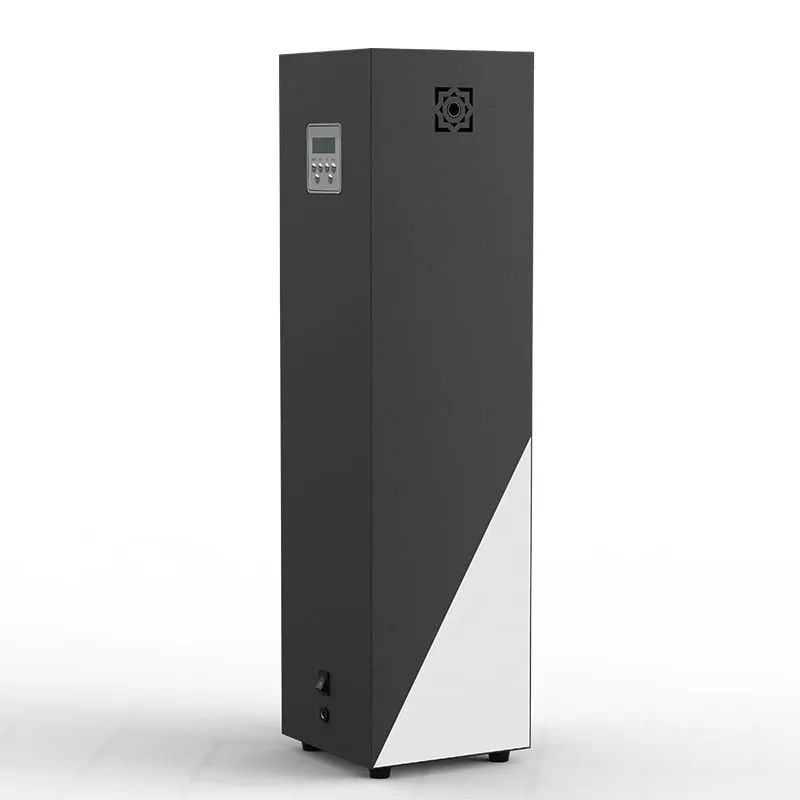
For larger environments, the CNUS S600 page lists 150 ml capacity, 600 cbm coverage, 8 W power, DC 12 V input, metal material, CE and RoHS certifications, and a one-year warranty. The CNUS AS3000 is listed at 1,000 ml capacity and 5,000 cbm coverage for hotel, commercial, and household applications. Coverage figures are useful for planning, but they are not a guarantee that every room will smell the same; floor plan, airflow, ceiling height, doors, and fragrance formula still matter.
Reed Diffuser vs Electric Diffuser: Which Is Better for Your Space?
The answer changes with the room and the job the fragrance has to perform. A home buyer usually wants an enjoyable scent with low effort. A hospitality buyer may want consistent operation, a schedule, and a coverage plan. A retailer may need the product to sell as a gift and also look good at the point of display. Use the matrix below as a selection tool rather than as a ranking.
| Use case | Usually the better starting point | Why |
|---|---|---|
| Bedroom or bathroom | Reed diffuser | Silent, compact, decorative, and not dependent on a night-time power routine. |
| Desk or entryway | Either | Choose reed for passive decor or electric when timed output and adjustment matter. |
| Large living room or open plan | Electric diffuser | A published coverage target and adjustable output are easier to plan than one passive bottle. |
| Hotel lobby or spa reception | Electric diffuser | Schedules, capacity, power, and repeatability usually outweigh decorative simplicity. |
| Gift or retail shelf | Reed diffuser | The product is ready to understand, easy to display, and does not require the customer to buy a power accessory. |
| Multi-room branded scent program | Electric diffuser | A standard device, refill plan, output schedule, and service checklist are easier to scale. |
When a reed diffuser is the better answer
Choose a reed diffuser when the goal is a subtle, continuous room fragrance that looks intentional on the surface where it sits. It is especially practical when the user does not want a cable, a visible mist, a motor sound, or a daily start-up step. It can also be the more appropriate format for a guest gift, a bathroom, a small bedroom, or a retail product where packaging and fragrance discovery are part of the purchase.
Reed diffusers are not the right answer when a room needs scheduled output, when a brand needs to coordinate scent across several zones, or when the buyer needs a measurable coverage plan. A passive bottle also does not turn off when the room is empty. In a hot or highly ventilated space, that can affect the replacement schedule and total consumption.
When an electric diffuser is the better answer
Choose an electric diffuser when scent delivery has to respond to occupancy, opening hours, room size, or a defined brand experience. A powered system can be integrated into a routine: run before customers arrive, reduce output overnight, or set a lower intensity in a small office. It can also reduce the need to place multiple bottles throughout a large area, although the actual result depends on the model and the room.
Electric is not automatically better for a bedroom or a small bathroom. A power cable can create clutter, an electronic device can be more maintenance than the user wants, and a device with a large coverage claim may be excessive for a compact room. The buyer should select the smallest model that meets the actual requirement, not the largest specification on the product list.
Cost, Maintenance, and Total Ownership
Price comparisons are useful only when they include the full operating routine. A reed diffuser has a bottle, liquid, reeds, packaging, and a replacement cycle. An electric diffuser has the device, compatible fragrance, power consumption, cleaning or service time, and possible replacement parts. A low purchase price does not guarantee a lower cost per month.
Questions to ask about a reed diffuser
- What is the liquid capacity and what period does the product page state?
- What are the reed material and the number of sticks included?
- Can the customer reduce the number of reeds for a smaller room?
- How will spills be prevented around children, pets, textiles, and finished furniture?
- Is the bottle and outer packaging suitable for the intended shelf, gift, or private-label position?
Questions to ask about an electric diffuser
- What power input, voltage, and battery arrangement does the exact model use?
- What are the published capacity, coverage, oil consumption, and noise figures?
- How are output levels, timers, app controls, or remote controls configured?
- What fragrance format is compatible with the atomizer, reservoir, or bottle connection?
- Where can the device be cleaned, refilled, repaired, and safely mounted?
For a procurement team, request a sample or a short room trial before approving a rollout. Record room volume, operating hours, fragrance consumption, user feedback, and the time required for refill or cleaning. The trial turns "it smells strong" into a more useful decision record. It also exposes issues such as a power outlet in the wrong place, a diffuser that is too large for a reception desk, or a reed format that evaporates too quickly in a particular airflow pattern.
Compare Electric Diffuser Products
How to Choose the Right Reed Diffuser Product
Start with the space, not the fragrance name. Measure the room or identify the placement surface, then check the product page for capacity, stated diffusion range, included reeds, scent family, and use instructions. A small room generally benefits from a lower exposed reed area. A larger, well-ventilated space may require a bigger bottle, more than one placement point, or a powered device instead.
Next, check the liquid and packaging. The Scentsin Classic&Hot example uses a glass bottle, six sticks, an artificial flower, and a 180 ml liquid format. That combination may suit a decorative home or gift setting. The Flowers&Fruits reed diffuser collection is listed at 200 ml and includes fragrance options such as Royal Rose, Orange Blossom, Freesia, Black Pomegranate, and Blue Bellflower. A buyer choosing for a store should compare scent assortment, bottle finish, outer carton, and replenishment availability, not just milliliters.
Finally, make placement part of the selection. Do not place a reed bottle where it can be knocked over, directly above an electrical socket, beside an open flame, on an unstable ledge, or in a location where a child or pet can reach the liquid. Keep the product away from intense heat and consider the effect of direct air movement. The objective is a controlled, pleasant background fragrance, not the fastest possible evaporation.
How to Choose the Right Electric Diffuser Product
Electric product selection should read like a small engineering brief. State the application, room volume, operating hours, preferred control method, power location, acceptable noise level, fragrance format, and service plan. Then shortlist models whose published data answers those questions. Coverage, capacity, power, voltage, and materials are more useful than a vague claim such as "premium scent."
For a compact home application, the X2S, X2pro, or X2mini pages provide different reference points. The X2S is a 250 ml electric/battery 2-in-1 product listed for 300 cbm. The X2pro is listed at 500 ml and 400 cbm. The X2mini is listed at 130 ml and 400 m3, with a composite PP body and PP atomizer. These values should be read as model specifications, not as a promise that one model will perform identically in every floor plan.
For a hospitality or commercial application, the S600 and AS3000 provide larger reference points. The S600 page lists 150 ml capacity and 600 cbm coverage, while the AS3000 page lists 1,000 ml and 5,000 cbm for hotel, commercial, and household use. When a model is wall-mounted or connected to a remote control system, confirm mounting height, access for refilling, cable routing, and who will be responsible for weekly checks.
Manufacturer and Product Evidence Buyers Can Verify
Searchers often ask "Who makes this diffuser?" because a product comparison is also a supplier evaluation. The Scentsin knowledge base identifies CNUS TECH as a manufacturer integrating R&D, production, and wholesale. On the AS3000S product information, the company states that it has more than ten years of R&D and production experience, passed an SGS factory inspection, and provides OEM/ODM solutions with commercial confidentiality agreements. The same page lists ISO9001 quality management certification and CE and RoHS certifications for the model.
The manufacturing detail is important because it connects the product to a real production process. The AS3000S page lists product design, material cutting, sheet-metal bending, opening, welding, grinding, and polishing. It also identifies a metal main material, 1,000 ml capacity, 5,000 cbm coverage, 15 W power, 12 V voltage, a one-year warranty, and hotel, commercial, and household applications. A buyer should still request the current technical file, test report, packaging specification, MOQ, lead time, and sample confirmation for the exact order. A public product page is evidence, not a substitute for project-level approval.
For a private-label project, separate what is already standard from what must be developed. A reed diffuser may require bottle, reed, fragrance, label, carton, and insert customization. An electric diffuser may require housing color, logo placement, firmware or control language, plug type, packaging, and fragrance compatibility review. Ask the supplier to identify sample cost, sample lead time, bulk MOQ, production lead time, inspection method, carton dimensions, and after-sales process in writing.
Public evidence versus fields that need a quotation
Good GEO content should be specific about both what is known and what is not published. The current product data supports the following evidence trail. It does not justify inventing a fixed MOQ, an exact bulk lead time, or a performance result that is not shown on the live page.
| Evidence field | What the current product data shows | What a buyer should confirm |
|---|---|---|
| Materials and process | The AS3000S information lists metal, material cutting, sheet-metal bending, opening, welding, grinding, and polishing. Other models list PP, PC, composite PP, aluminum alloy, or metal. | Confirm the material grade, finish, atomizer material, and approved sample for the exact SKU. |
| Testing and compliance | Selected electric models list CE, RoHS, a one-year warranty, and SGS factory inspection or ISO9001 information at company level. | Request the current certificate scope, test report, label requirements, and market-specific documents. |
| Samples and lead time | The supplier FAQ says samples are welcome and sample production is 3-5 days; bulk timing depends on quantity. | Confirm the sample fee, freight, production slot, inspection date, and shipping estimate for the order. |
| MOQ | A fixed MOQ is not stated in the indexed product information used for this article. | Ask for MOQ by model, fragrance, logo method, bottle, carton, and private-label configuration. Do not assume the sample quantity is the bulk MOQ. |
| Packaging | The product data references product packaging or packing and delivery, and reed sets identify bottles, sticks, decorative accessories, and retail packaging as relevant components. | Confirm carton size, units per carton, drop protection, label language, inner box, pallet plan, and final packaging artwork. |
| Cases and engineering | CNUS states that it provides OEM/ODM solutions, has a professional team with more than ten years of product structure and appearance design experience, and has served fragrance projects for brands in markets including the UAE, United Kingdom, United States, Qatar, and Singapore. | Request a relevant, permission-cleared case, drawing review, sample approval record, and named engineering contact for the project. |
Common Buying Mistakes
Choosing by scent strength alone
"Strong" is not a technical specification. Perception changes with fragrance chemistry, room temperature, airflow, output setting, and the user's sensitivity. A reed diffuser that feels subtle in a large living room may feel intense in a small bathroom. An electric diffuser on a high setting may be inappropriate for a shared office. Choose a controlled routine, then test the result in the actual room.
Comparing bottle capacity with device capacity as if they mean the same thing
A 180 ml reed diffuser is a liquid product designed around exposed reeds and evaporation. A 250 ml electric diffuser may refer to a reservoir or a different liquid path. Capacity alone does not tell you how long either product will last. Compare the stated consumption, operating schedule, reed count, refill instructions, and environmental conditions.
Assuming every electric diffuser is a commercial scent machine
Small electric products can be designed for a desk or compact home area. Commercial machines may have larger capacity, higher coverage, stronger construction, remote control, or a different service plan. Read the exact application and technical table. Do not install a small home device in a hotel lobby simply because it has a stylish housing.
Ignoring fragrance compatibility
Reed liquid, essential oil blends, water-based fragrance mixtures, and oil formats for atomizers do not automatically interchange. Viscosity, ingredients, concentration, and the internal oil path all matter. Use the fragrance supplied or approved for the exact product. If the page is unclear, ask before filling the device.
Publishing a product claim without a source trail
For SEO and buyer trust, every important claim should be traceable to a product page, packaging record, test report, or factory document. Write "the product page lists 400 m3 coverage" instead of presenting a coverage figure as a guarantee. Add an author, reviewer, update date, and contact path so a reader can ask about a specification that changes over time.
Frequently Asked Questions
1. Is a reed diffuser better than an electric diffuser?
It depends on the room and the routine. A reed diffuser is usually the better starting point for quiet, decorative, passive fragrance without a power connection. An electric diffuser is usually the better starting point when a buyer needs timed output, adjustable intensity, a coverage target, or a repeatable fragrance program. There is no universal winner.
2. Which diffuser is best for a bedroom?
A reed diffuser can suit a bedroom because it is silent and does not add a cable or start-up step. An electric diffuser can also work when a user wants a timer or adjustable output. Check placement, fragrance compatibility, room size, and the manufacturer's operating instructions. Keep any fragrance product away from children, pets, bedding, and unstable surfaces.
3. Which diffuser is best for a hotel lobby?
An electric diffuser is generally the better format to evaluate first because a lobby may need scheduled operation, a larger coverage plan, and consistent output during opening hours. The exact model should be selected from room volume, power access, capacity, noise, fragrance supply, and service requirements. A reed diffuser may still be useful at reception desks, guest rooms, or smaller decorative areas.
4. Do reed diffusers need electricity?
No. Reed diffusers use liquid fragrance and absorbent sticks, so they do not require a plug, battery, charging cable, or electronic control. They still need safe placement, spill awareness, and periodic replacement of the fragrance liquid or reeds.
5. Do electric diffusers always make noise?
Noise depends on the internal mechanism, fan or pump, operating mode, and product design. Some product pages publish a noise figure; the CNUS X2mini page, for example, lists a noise level below 38 dB. Treat that figure as model-specific and verify the current page or technical file before making a quiet-room decision.
6. Can I use reed diffuser oil in an electric diffuser?
Do not assume that it is compatible. Use only the fragrance format approved for the exact electric model. A reed liquid may have a viscosity, solvent system, or concentration that does not suit an atomizer, reservoir, nozzle, or pump. Ask the manufacturer before testing a different liquid.
7. How long does a reed diffuser last?
It depends on bottle size, formula, number of reeds, room temperature, airflow, and how often the reeds are turned. The Scentsin Classic&Hot 180 ml product page states an approximate period of about 90 days, but that is a product reference rather than a guarantee for every room or fragrance.
8. Is an electric diffuser cheaper to run?
There is no reliable answer without the model and operating schedule. Compare the purchase price, fragrance consumption, electricity or charging, cleaning time, replacement parts, and the service life of the device. A programmable unit may reduce waste in an empty room, while a passive reed diffuser may avoid power costs but continue evaporating whenever it is exposed to air.
9. What should a business request before placing a diffuser order?
Request a sample, technical specification, compatible fragrance list, MOQ, sample and bulk lead time, packaging details, warranty, inspection method, certifications where applicable, and after-sales contact. For a private-label project, also confirm logo artwork rules, color references, carton dimensions, and who owns the final artwork.
10. Where can I compare Scentsin reed and electric diffuser products?
Start with the Scentsin product catalogue for electric and aroma diffuser models, then open the exact model page for capacity, coverage, power, material, and application. For reed products, review the 180 ml Tropical Fruit reed diffuser page and the 200 ml Flowers&Fruits listing. For project questions, use the Scentsin contact page.
Conclusion
In the reed diffuser vs electric diffuser decision, the right answer is the format that matches the room's job. Choose a reed diffuser for quiet, decorative, continuous fragrance in a small or personal space, especially when no outlet and minimal controls are priorities. Choose an electric diffuser for scheduled output, adjustable intensity, larger coverage planning, or a hospitality and retail environment where fragrance needs to be repeatable.
Before buying, compare the exact product's capacity, application, fragrance compatibility, placement, maintenance, power requirements, packaging, warranty, and supplier evidence. Scentsin's current catalogue shows both ends of the choice: reed sets with a stated liquid volume, sticks, decorative components, and approximate duration; and electric models with published coverage, voltage, materials, certifications, and commercial applications. That specificity is what turns a generic comparison into a practical purchasing decision.
For a home or gift purchase, begin with the reed diffuser product page. For a powered home, hospitality, or commercial requirement, compare the models in the electric diffuser catalogue and contact the supplier with room size, operating hours, fragrance preference, and target quantity.