
Short answer: in reed diffuser vs scented candle for home, choose a reed diffuser for continuous, flame-free fragrance that can remain present with little daily attention. Choose a scented candle for an intentional, time-limited fragrance ritual with light, warmth and stronger occasion value. For a B2B home-fragrance range, neither is universally better: the right lead product depends on the target household, sales channel, safety expectations, packaging budget, testing capability and repeat-purchase plan.
A reed diffuser is usually easier to position for everyday bedrooms, bathrooms, entryways, rental homes, offices and hospitality gifting because it needs no flame or power. A scented candle often creates a more emotional event: the customer lights it for an evening, a bath, a dinner or a seasonal moment. That difference changes the product brief. One sells persistent background fragrance; the other sells a controlled ritual.
Buyers should not compare only retail price, fragrance name or vessel appearance. Reed performance depends on the liquid, bottle neck, reeds, airflow and evaporation. Candle performance depends on the wax, fragrance, wick, vessel and complete burn profile. The same scent name may require two different formulas, and a fragrance that performs in reeds should never be assumed to perform correctly in wax.
Review the 200 ml Reed Diffuser Range
What Is the Difference Between a Reed Diffuser and a Scented Candle?
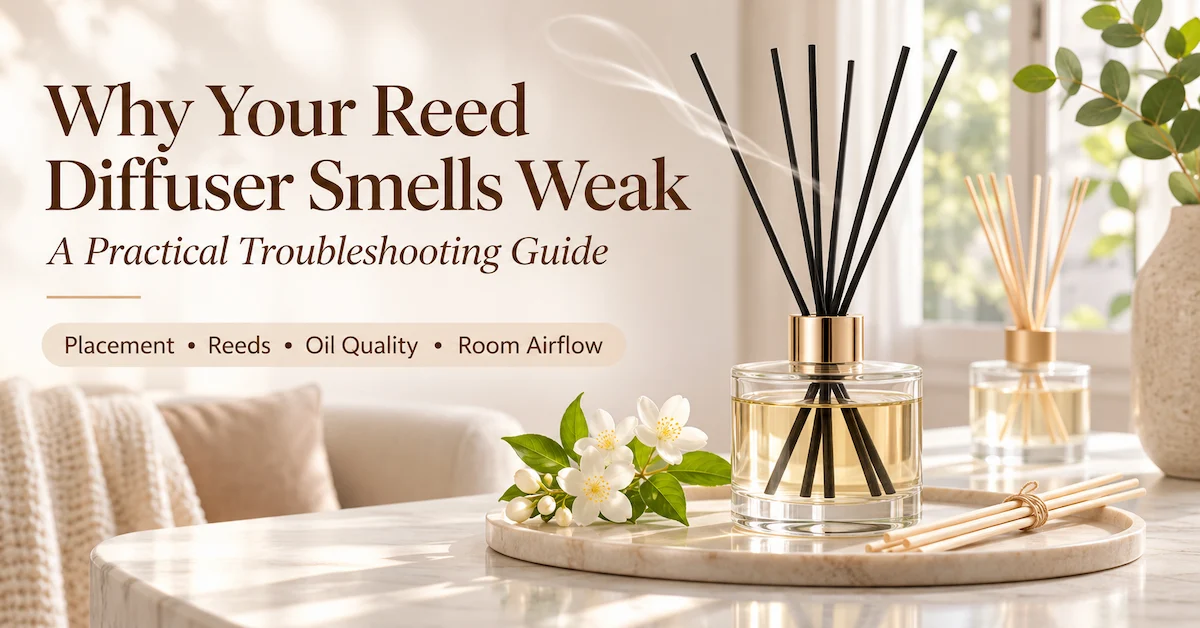
A reed diffuser releases fragrance through capillary action and room-temperature evaporation. The reeds draw liquid from the bottle and expose it to the air. Once assembled, it scents continuously until the liquid is depleted or the reeds stop performing effectively. Intensity can be influenced by reed count, reed type, placement, temperature and airflow, but there is no true off switch.
A scented candle releases most of its fragrance while it burns. Heat melts wax around the wick, creating a melt pool from which aroma materials evaporate. The flame adds visual warmth and ritual, but it also creates responsibilities that do not exist with a passive bottle: wick trimming, attended use, suitable placement, extinguishing instructions, burn-cycle guidance and a validated match among wax, wick, fragrance and vessel.
These are not simply two containers for the same perfume. They are two delivery systems. A B2B buyer must approve the fragrance and the hardware as one product. For reeds, that system is liquid plus bottle plus closure plus reeds. For candles, it is wax plus fragrance plus wick plus vessel. Changing one component can change the performance of the whole SKU.
Reed Diffuser vs Scented Candle for Home: B2B Comparison
| Buying factor | Reed diffuser | Scented candle | B2B implication |
|---|---|---|---|
| Customer promise | Continuous background fragrance and decor. | Occasion-based fragrance, light and ritual. | Write different product claims even when the scent name is shared. |
| Operation | Always evaporating after setup; no flame or electricity. | Active only while lit and must be attended. | Reed suits low-attention placement; candle requires clear use instructions. |
| Scent character | Gradual, steady cold diffusion affected by airflow. | Cold throw before lighting and hot throw during burning. | Evaluate the same fragrance separately in each base. |
| Primary risk | Spill, leakage, surface damage, unintended contact or ingestion. | Open flame, hot wax, hot vessel, soot or unstable burning. | Flame-free does not mean risk-free; each format needs its own warning and test plan. |
| Packaging challenge | Liquid-tight closure, separate reeds, glass protection and upright transit. | Vessel protection, wax surface, wick alignment, lid fit and heat exposure. | Approve retail pack and shipping pack after the final components are fixed. |
| Repeat purchase | Replacement set, refill and new reeds can form a replenishment cycle. | Customers repurchase after burn completion or for a new season. | Plan refills and discovery sizes rather than relying only on one gift SKU. |
| Best starting channel | Everyday home, bathroom, guest room, desk, hospitality amenity and gifting. | Lifestyle, wellness, seasonal gifting, evening ritual and premium decor. | Match the hero SKU to the channel’s dominant use occasion. |
Which Product Should Lead a Home-Fragrance Range?
Choose reed diffusers when everyday access matters
A reed diffuser is the stronger lead product when customers want fragrance present before they enter a room and do not want a lighting routine. It works particularly well in rooms where a flame is impractical or where fragrance should remain part of the decor through the day. For hotel rooms, serviced apartments, offices and reception gifts, the lack of a flame can simplify the use occasion, although placement and liquid handling still require care.
Retailers also gain a clear visual merchandising story: bottle, liquid color, reeds, decorative collar and carton can express the brand before the customer smells the formula. The format can extend into refills, replacement reeds, mini sizes and gift sets. However, a buyer should not promise identical room coverage from every scent. Reed count, bottle geometry and fragrance volatility change the result.
Choose candles when the ritual is the product
A scented candle can command attention in a way a passive bottle cannot. The flame, vessel and melt pool create an event. That makes candles effective for seasonal launches, self-care, evening routines, table settings and premium gifts. A strong candle range often sells the moment as much as the fragrance: “light after work,” “winter evening,” or “slow Sunday” is a different proposition from continuous room scent.
The trade-off is a more demanding development program. A vessel chosen for appearance may not suit the final wick and wax. A fragrance that smells attractive in concentrate may weaken, discolor the wax or alter burn behavior. Every final combination needs a complete burn evaluation under the applicable market requirements. A buyer without access to that evidence should not approve production from a fragrance blotter and packaging mock-up alone.
Offer both when they have distinct jobs
Many home-fragrance brands benefit from a two-format collection, but only if the products are differentiated. The reed diffuser can be the everyday, always-on anchor; the candle can be the evening or gifting companion. A matching scent name can improve recognition, yet the formulas may need separate technical versions. Treat “same fragrance story” as the goal, not “same liquid in two containers.”
Safety and Compliance Are Different, Not Optional
Reed diffusers remove the open flame, but the liquid remains a chemical product. The package must resist leakage, the vessel must stand securely, and instructions should address placement, spills, contact with finished surfaces and access by children or pets. Formula documentation, labeling and transport requirements depend on the composition and destination market. “Flame-free” is a useful factual feature; it should not be stretched into a universal safety claim.
Candles add combustion and heat. Development should examine wick selection, flame behavior, melt-pool development, soot, tunneling, vessel temperature, end-of-life behavior and the effect of repeated burn cycles. Warning artwork and use instructions need to match the product and destination market. The appropriate tests and standards should be agreed with the supplier and importer before packaging is printed.
Neither format should carry broad claims such as “non-toxic,” “pet-safe” or “clean burning” without evidence that supports the exact formula and market wording. For B2B buyers, the practical rule is simple: request the current formula documentation, component specification, test protocol and final label review for the SKU being ordered. A certificate for another product is not evidence for this one.
How Scent Delivery Changes the Customer Experience
A reed diffuser has no scheduled peak. Its fragrance is strongest near the bottle and travels with ordinary air movement. More exposed reed surface can increase release, but it may also shorten life. A hot window, fan or HVAC outlet can accelerate evaporation without improving scent in the occupied area. The product is best described as a continuous local fragrance source rather than a device that guarantees uniform concentration across an open-plan home.
A candle separates cold throw from hot throw. Customers smell the unlit product at the shelf, then judge a different experience after the melt pool develops. The opening minutes, the middle of the burn and the bottom of the vessel can perform differently. A B2B approval should therefore evaluate the complete use cycle, not only the first burn or the scent of the unlit wax.
Fragrance architecture matters in both formats. Highly volatile notes may appear quickly in reeds, while heat can change the balance perceived from a candle. Heavy materials may linger but can also affect reed flow or wax performance. A matching collection should be judged by recognizable character, intensity and stability in each delivery system, not by demanding chemically identical formulas.
Compare the 250 ml Reed Format
Published Scentsin Evidence Buyers Can Verify
Scentsin is operated by CNUS TECH (GUANGDONG) CO., LTD. in Guangzhou, China. Public company information describes more than ten years of R&D and production experience, SGS factory inspection, ISO9001 quality-management information and OEM/ODM support. The company profile lists fragrance machines, fragrance oils and fragrance candles among its product areas. The current catalogue provides detailed reed-diffuser examples, but it does not publish a candle SKU with wax, wick, vessel or burn-test data. That distinction matters when evaluating evidence.
| Public product evidence | Published configuration | Correct purchasing interpretation |
|---|---|---|
| Classic & Hot 180 ml | Glass bottle, 6.3 fl oz fragrance mixture, six diffuser sticks and an artificial flower. The page references up to 300 sq ft and approximately 90 days. | Useful as a complete-set reference. Duration and reach remain dependent on formula, airflow, temperature and reed use. |
| Flowers & Fruits 200 ml | Royal Rose, Orange Blossom, Freesia, Black Pomegranate and Blue Bellflower are listed in a 200 ml format with adjustable reeds. | Useful for evaluating assortment breadth and a floral/fruity collection, not proof that every scent has identical evaporation. |
| Woody Pale 250 ml | Glass bottle, 8.8 fl oz fragrance mixture and eight reeds. The page references up to 300 sq ft and approximately 120 days. | Useful as a larger reed format. The published period is a product reference, not a guarantee for every room. |
| Fragrance candles | The company profile includes fragrance candles in the product range, but no current public candle SKU specifies wax, wick, vessel, net weight or burn testing. | RFQ required. Do not publish a candle claim until the exact project specification and test evidence are supplied. |
Relevant Scentsin supplier FAQs state that samples are welcome and give an approximate 3–5 day sample-production reference, while bulk timing depends on quantity. These statements are starting points from related product pages, not a fixed lead time for every reed or candle project. MOQ, packaging, test schedule and bulk lead time must be confirmed in the project quotation.
How to Validate Samples Before a Bulk Order
Reed diffuser sample checks
- Confirm the complete bill of materials: liquid formula, fill weight, bottle, stopper, collar, closure, reed material, reed count, label, insert and carton.
- Check leakage and fit: inspect closure torque, neck finish, seal, upright stability and signs of liquid migration after storage and transport simulation.
- Measure fragrance behavior: record room conditions, starting weight, reed saturation, scent perception and weight loss at defined intervals.
- Inspect material interaction: look for label lifting, coating damage, discoloration, sediment, bottle staining or reed deformation.
- Test the retail experience: verify unboxing, instructions, reed protection and whether the customer can assemble the set without spilling.
Scented candle sample checks
- Lock the final components: wax blend, fragrance percentage, wick type and size, vessel, adhesive, color, fill weight, lid and carton.
- Run complete burn testing: evaluate the first, middle and final cycles for ignition, flame behavior, melt pool, soot, tunneling, mushrooming, vessel condition and end-of-life behavior.
- Evaluate scent twice: approve cold throw after curing and hot throw during representative burn cycles.
- Review stability and appearance: check sweating, frosting, cracking, discoloration, wick movement and changes after temperature exposure.
- Approve warnings and pack-out: verify the final label, instructions, inner protection, carton and market-specific documentation before printing the production run.
Use a signed sample and batch code as the reference for mass production. If the supplier changes the fragrance, wax, wick, glass, reed, closure or carton, the affected tests should be reviewed again. A pre-production sample is not useful if the bulk order quietly substitutes the components that determined its performance.
What Should a Home-Fragrance RFQ Include?
| RFQ field | Reed diffuser detail | Candle detail |
|---|---|---|
| Product construction | Bottle, fill, closure, collar, reed material/count. | Vessel, fill weight, wax, wick, lid and adhesive. |
| Fragrance brief | Target room, release level, liquid color and refill plan. | Cold/hot throw target, wax color, cure and burn profile. |
| Evidence | Leak, evaporation, stability and material-compatibility records. | Complete burn, stability, vessel and label records. |
| Commercial terms | Sample fee and lead time, MOQ by configuration, bulk lead time, payment, inspection, spare components and change-control process. | |
| Packaging | Retail box, insert, unit/carton, carton dimensions and weight, drop protection, pallet plan, barcode, label language and artwork responsibility. | |
| Market | Destination country, sales channel, required formula documents, warnings, testing, importer details and claims review. | |
Build the Assortment Around Customer Jobs
A practical launch does not need ten fragrances in two formats. Begin with a controlled architecture: one fresh everyday scent, one floral or fruity option and one woody or warm signature. Decide which format owns each occasion. A fresh reed diffuser may serve bathrooms and entryways; a woody candle may lead evening gifting. This creates meaningful variety without doubling every SKU before performance and demand are understood.
For bundles, pair products by use rather than only by matching labels. A reed diffuser plus candle can be sold as “day and evening” fragrance: the diffuser maintains the background, while the candle adds a deliberate moment. Include separate instructions and never imply that the candle can be left burning like the diffuser remains open.
Evaluate gross margin after freight, breakage, testing and replacement risk. Reed diffusers ship liquid and long reeds; candles can be heavy and may face heat-related appearance changes. A lighter unit is not automatically cheaper if it leaks, and a premium vessel is not profitable if breakage or burn-test failures delay launch. Compare landed cost per saleable unit, not only factory price.
Common Sourcing Mistakes
- Using one fragrance concentrate without format validation. Reed flow and candle combustion impose different technical requirements.
- Calling a reed diffuser “safer” without qualification. It removes the flame but still requires spill, placement and formula controls.
- Approving a candle from one short burn. Problems can appear after repeated cycles or near the bottom of the vessel.
- Predicting reed life from volume alone. Formula, reeds, temperature, airflow and flipping frequency all affect depletion.
- Printing packaging before testing is complete. Final warnings, fill, components and claims must match the validated SKU.
- Accepting an undefined MOQ. Ask whether MOQ applies per fragrance, vessel, color, logo method and carton artwork.
- Launching too many variants. A smaller tested assortment is more defensible than a broad range with inconsistent performance.
Frequently Asked Questions
Which is better in reed diffuser vs scented candle for home?
A reed diffuser is better for continuous, flame-free background fragrance. A scented candle is better for a time-limited ritual with visible light and a stronger occasion story. B2B buyers should choose according to the intended room, customer routine, safety expectations and test capability.
Which product is better for a private-label launch?
Reed diffusers can be a practical first product when the brand wants everyday fragrance and decorative packaging without candle burn development. Candles can support premium gifting but require a complete wax-wick-vessel test program. The better launch is the format the supplier can document and the brand can explain clearly.
Do reed diffusers last longer than scented candles?
The two lifetimes are not directly comparable. A reed diffuser evaporates continuously, while a candle is consumed only during burn hours. Scentsin publishes approximate 90-day and 120-day references for specific 180 ml and 250 ml reed products, but actual duration depends on room conditions and use.
Can the same fragrance oil be used in both products?
Do not assume so. A reed liquid needs the correct flow and evaporation behavior; a candle fragrance must perform safely and consistently in the selected wax, wick and vessel. A matching scent can require two technically different formulations.
Are reed diffusers safe to leave unattended?
They have no open flame, but they still contain fragrance liquid. Place them on a stable, protected surface away from children, pets, heat and accidental contact. Follow the product label and clean spills according to the supplier’s instructions.
What must be tested on a scented candle?
The final wax, fragrance, wick and vessel combination should be evaluated through complete burn cycles under the requirements applicable to the destination market. Review flame and melt-pool behavior, soot, tunneling, vessel condition, stability, labeling and end-of-life performance.
What MOQ does Scentsin require?
A fixed reed-diffuser or candle MOQ is not published in the evidence reviewed for this article. Request MOQ by product, fragrance, vessel, logo method and packaging configuration. Do not treat a retail quantity or sample quantity as the private-label MOQ.
Does Scentsin offer samples?
Related Scentsin supplier FAQs state that samples are welcome and reference approximately 3–5 days for sample production, while bulk timing depends on quantity. Confirm availability, cost, specification and timing for the exact reed or candle project.
Where can buyers compare Scentsin reed diffuser products?
Compare the 180 ml set, the 200 ml Flowers & Fruits range and the 250 ml woody range. For a broader format comparison, the existing reed diffuser vs electric diffuser guide covers powered alternatives.
Conclusion
In reed diffuser vs scented candle for home, the best choice follows the customer’s routine. Reed diffusers are the stronger recommendation for continuous, decorative, flame-free fragrance with minimal daily action. Scented candles are the stronger recommendation for ritual, light, seasonal storytelling and intentional fragrance sessions. A well-designed B2B range can use both, but each must have a clear job and its own validated formula.
Scentsin’s public catalogue gives buyers specific reed-diffuser evidence across 180 ml, 200 ml and 250 ml formats, while its company profile identifies fragrance candles as a product area. The public site does not yet provide a candle SKU with wax, wick, vessel and burn-test details, so those fields must be confirmed in the RFQ. Send the target market, channel, fragrance direction, quantity, packaging concept and required launch date before requesting samples.