
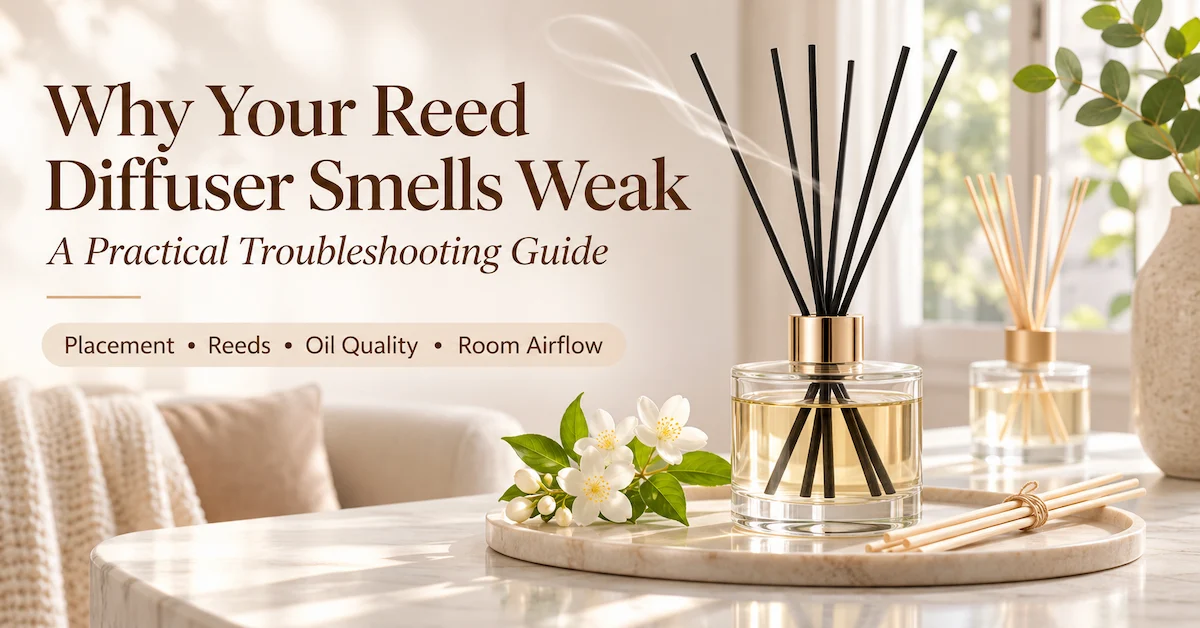
Quick answer: If you cannot smell your reed diffuser, first check whether the reeds are actually saturated, whether the bottle is in a useful airflow path, whether the room is larger or more open than the product can cover, and whether your nose has adapted to the fragrance. Then check the oil level, reed condition, stick count, bottle neck, and the age of the refill. A reed diffuser is a passive evaporation system, so small changes in capillary absorption, exposed reed area, temperature, and air movement can make a large difference to the scent you perceive.
This is a troubleshooting article for home users who have already bought or opened a reed diffuser and feel that the fragrance is too weak. It is intentionally narrower than a general reed diffuser guide: the goal is to identify the cause of a weak smell and choose a sensible next step. The advice below also separates what can be checked at home from what should be confirmed on the product page or with the seller. Do not add water, alcohol, perfume, or another oil to a reed diffuser unless the product instructions explicitly permit it.
Start With the Fastest Diagnosis
Before replacing the liquid or turning every reed upside down, spend ten minutes observing the diffuser. A good diagnosis prevents two common mistakes: using too many sticks until the oil disappears much faster, or blaming the fragrance when the bottle is simply in a dead-air corner. Work through the checks in the order below.
| What you notice | Most likely first check | Low-risk next action |
|---|---|---|
| The reeds look dry several hours after setup. | Reeds are not absorbing, or a stopper/coating remains. | Confirm the reeds are in the liquid and follow the initial setup instructions. |
| Only the top of the room smells. | Airflow is carrying scent away from the occupied area. | Move the bottle to a central, gently ventilated position. |
| The fragrance was strong on day one, then disappeared. | Nose adaptation, a quick first evaporation, or depleted oil. | Ask another person to smell it and check the liquid level. |
| One side of the bottle smells stronger. | Uneven reed saturation or a blocked reed. | Rotate the arrangement and replace visibly dirty or collapsed reeds. |
| The oil level barely changes in a week. | Low absorption, too few reeds, a cool location, or a narrow neck. | Check reed contact, bottle opening, room temperature, and instructions. |
| The diffuser smells weak only in a large room. | Room volume or open-plan airflow exceeds the practical coverage. | Use a better-matched size or place scent points closer to the living zone. |
| The liquid looks cloudy, separated, or contaminated. | Formula change, contamination, or an incompatible additive. | Stop experimenting and ask the seller about the specific batch or refill. |
How a Reed Diffuser Can Smell Weak Even When It Is Working
A reed diffuser does not spray fragrance into a room. It relies on capillary action: liquid moves through small channels in the reeds, reaches the exposed surface, and evaporates into the surrounding air. The perceived result depends on the amount of saturated reed surface, the evaporation rate of the formula, the air movement around the bottle, and the distance between the diffuser and the person who is smelling it.
The U.S. Geological Survey uses capillary action to describe liquid moving through porous spaces in a solid; that model explains why reed material and formula compatibility matter. Follow the product label and current IFRA Standards or local requirements. This guide addresses scent performance, not homemade-mixture safety.
That mechanism explains why a bottle can be technically active but feel weak. A small amount of liquid may be moving through the reeds, yet the room may be too open, the airflow may carry the fragrance toward an exhaust, or the user may have become accustomed to the scent. Conversely, a room can smell strong near the bottle while remaining neutral at the sofa because the placement does not distribute the fragrance across the occupied zone.
Do not judge performance from the bottle alone
The oil level is useful evidence, but it is not the only evidence. A falling oil level shows that evaporation is happening; it does not prove that the fragrance is reaching the part of the room where you spend time. A stable oil level can mean slow absorption, a cool environment, a formula with a different evaporation balance, or an obstruction at the bottle opening. Always compare the liquid level with reed saturation, room conditions, and an independent smell check.
1. The Reeds Are Not Fully Saturated
The most basic cause of a weak reed diffuser is also the easiest to miss: the sticks are in the bottle, but the fragrance has not travelled far enough up them. New reeds need time to absorb liquid. If the sticks were inserted only a short time ago, a weak smell may be normal. The exact time varies with reed material, oil formula, temperature, and the size of the exposed surface.
Look closely at the reeds rather than touching them repeatedly. Are the lower sections wet while the upper sections remain completely dry? Does the colour change gradually from the bottle upward? A gradual change suggests absorption. No change at all suggests that the sticks are not contacting the liquid correctly, that a protective coating or residue is interfering with absorption, or that the particular reed and formula combination is not working well together.
What to do
- Confirm that every stick reaches the liquid and is not resting on a cap, insert, or decorative filler.
- Leave the diffuser undisturbed long enough for the initial absorption process to occur.
- Once the upper section is visibly saturated, turn the reeds once if the product instructions allow it.
- Give the room time to settle before deciding that the fragrance is too weak.
Do not squeeze, cut, sand, or wash the reeds. Those actions can change the channels that carry the liquid and can introduce water or particles into the fragrance. If the reeds remain dry after a reasonable setup period, treat the sticks as a possible product issue and contact the seller with photos of the bottle, liquid, and reeds.
2. The Stick Count Is Too Low for Your Room
Reed count changes the amount of exposed, fragrance-carrying surface. Fewer reeds create a softer scent and can extend the life of the liquid. More reeds generally create more exposed surface and can make the fragrance easier to perceive, but they also increase consumption. The right number is not a universal rule because it depends on the bottle, reed dimensions, oil formula, room volume, and personal preference.
Use the supplied configuration as your baseline. Scentsin's 180 ml Tropical Fruit product is listed with six oil diffuser sticks, while the 250 ml SANTAL33 format is listed with eight natural reed sticks. These are product-specific configurations, not instructions to add eight sticks to every bottle. If a product arrives with a stated number, begin there and change one variable at a time.
How to test reed count without wasting oil
First, make sure all supplied reeds are in contact with the liquid. If the fragrance is still too subtle after the initial saturation period, add one compatible reed at a time if you have spare reeds of the same type. Wait before adding another. This creates a simple test: if one additional reed improves the scent without causing rapid depletion, the original setup may have been too conservative for the room. If the oil disappears quickly but the room still smells weak, the issue is probably placement, room volume, or fragrance perception rather than stick count.
Do not mix random fibre sticks, bamboo sticks, or used reeds into a formula. Different materials have different absorption and evaporation behaviour. A replacement reed should be clean, dry, and intended for fragrance use. If you need a different reed configuration, ask the seller which replacement format matches the original liquid.
3. The Diffuser Is in a Dead-Air Corner
Reed diffusers need gentle air movement to carry fragrance away from the saturated sticks. A corner behind a curtain, inside a shelf, or beside a tall object can trap the fragrance around the bottle. The result is often confusing: the diffuser smells strong when you lean over it, but the room smells weak from normal standing or sitting positions.
Move the diffuser temporarily to an open surface at approximately waist or chest height, away from a strong fan, air-conditioning outlet, open window, and direct sunlight. The purpose is not to create a draft. A strong draft can carry fragrance out of the room and accelerate evaporation. The useful test is a stable position with mild, natural circulation. Leave it there long enough to compare the occupied area, not just the space immediately around the bottle.
Use placement to improve the path to the person
Place the bottle where people actually pass or sit: an entry console, a living-room side table, a bathroom shelf with safe clearance, or a bedroom dresser. Avoid placing it at the far end of a large open-plan area and expecting the scent to travel across furniture, doorways, and changing airflow. If the room has several zones, one well-placed diffuser may not create an even experience everywhere. That is a room-layout question, not necessarily a weak-product question.
4. The Room Is Larger or More Open Than the Product's Practical Coverage
Coverage language is a useful starting point, not a promise of uniform scent. Scentsin lists up to 300 square feet for both the 180 ml Tropical Fruit format and the 250 ml SANTAL33 format. A room with the same floor area can still behave differently if it has a high ceiling, an open stairwell, a large doorway, frequent ventilation, or a powerful HVAC system. An open-plan living room and kitchen can have more effective air volume than the floor plan suggests.
Measure the space where you want to perceive the fragrance, not only the entire property. If the diffuser is meant for a small bedroom but is placed in an open living area, the product may be performing normally while the placement creates an unrealistic expectation. For a large or divided area, move the diffuser closer to the main occupied zone or consider a product format and quantity that match the actual room conditions.
Do not compensate for a coverage mismatch by continuously flipping the reeds. That can create a short burst of strong fragrance near the bottle, followed by faster oil consumption and a weaker result later. A room-size problem is best solved with placement, a better-matched size, or a second scent point where appropriate, not by exhausting one bottle.
5. Your Nose Has Adapted to the Fragrance
One of the most common answers to "why can't I smell my reed diffuser?" is sensory adaptation. After spending time in the same scented room, your brain gives less attention to a constant stimulus. You may notice the fragrance again after leaving the room for a while, entering from outside, or asking another person to smell it. This can happen even when the diffuser is still releasing liquid normally.
The U.S. National Institute on Deafness and Other Communication Disorders explains that airborne odor molecules activate specialized olfactory sensory neurons. In practical terms, a person who has been in the room for a long time may notice less than someone arriving from outside, so a second-person check is useful before increasing the reed count.
A simple blind check
- Leave the room for at least fifteen minutes and smell a neutral area before returning.
- Ask a person who has not been in the room whether they notice the fragrance near the normal seating area.
- Smell the exposed reeds from a normal distance rather than placing your nose directly over the bottle.
- Compare the result with the oil level and the wetness of the reeds.
If a visitor can smell the diffuser but you cannot, adding more oil or more sticks may make the room uncomfortably strong for that visitor. Keep the current setup and reassess later. If neither you nor another person can smell it and the reeds are dry, continue with the mechanical checks instead of assuming that adaptation is the answer.
6. The Fragrance Formula or Liquid Condition Is the Problem
Reed diffuser liquid is formulated to move through the chosen reeds and evaporate at a controlled rate. A formula that is too thick may move slowly. A formula that has been diluted, contaminated, or mixed with an incompatible product may behave unpredictably. The scent can also feel weak when the most volatile notes have evaporated first, leaving a slower-smelling base profile.
Check whether the liquid still looks and smells as expected. Cloudiness, visible separation, sediment, unusual colour change, or a sour or solvent-like odour is a reason to stop experimenting. Do not add water, rubbing alcohol, perfume, essential oil, or another brand's refill. These additions can change viscosity, reed absorption, bottle compatibility, and the way the product is intended to be used.
When to contact the seller
Contact the seller if the liquid arrived with an unusual appearance, the product was opened long ago and stored in heat, the bottle leaked, the neck is blocked, or the fragrance is absent even when the reeds are saturated. Include the product name, purchase date, photos of the liquid level and reeds, and a description of the room and setup. This gives the seller enough information to distinguish a storage issue, a reed issue, a batch question, or a placement problem.
7. The Reeds Are Dirty, Saturated, or Blocked
Reeds are consumable fragrance carriers. Dust, lint, oil residue, and repeated handling can reduce the clean exposed surface. A reed that has been lying on a dusty shelf, touched with oily hands, or placed in another fragrance can carry contamination into the bottle. Once a reed has been used with a different formula, it should not be treated as a neutral replacement.
Inspect the sticks for dust, dark spots, swelling, collapse, or a sticky surface. If one reed looks different from the others, remove it and compare the scent after a settling period. Do not wash and reuse it: water can remain in the reed and change how the fragrance moves. If you need a replacement, use a new, dry reed that matches the original product.
Turning reeds can briefly increase fragrance because the saturated end is exposed to the air. It is a reset, not a permanent repair. If turning the reeds creates only a short burst and the smell becomes weak again, the underlying issue is likely absorption, placement, room size, or formula condition.
8. Temperature, Humidity, and Sunlight Are Changing Evaporation
Evaporation changes with the environment. A warm, sunny windowsill may make the liquid move faster and can exhaust the more noticeable notes quickly. A cool room can slow absorption and make the scent appear weak during the first days. Strong heating or air-conditioning can change the air path around the bottle and alter how quickly the fragrance is carried away.
Choose a stable indoor location away from direct sun, radiators, heaters, cooking heat, and strong vents. This is not only about scent strength. Stable conditions make it easier to judge whether the diffuser is performing consistently and help avoid an unusually fast loss of liquid. If you move the bottle, note the date and observe it for several days before making another change.
9. The Bottle Opening or Decorative Insert Is Restricting the Air Path
A reed diffuser needs both liquid contact and an open path for evaporation. A stopper, foil seal, decorative insert, or residue around the bottle neck can interfere with the reeds. Some sets use a stopper for shipping; others use a decorative component that must be removed before the reeds are inserted. If the opening is partly blocked, the reeds may appear present but receive less liquid or expose less surface.
Compare the setup with the product instructions and inspect the neck without pushing anything into it. Remove only packaging components that the instructions identify as removable. Do not scrape the neck with a knife or pierce a seal with a sharp object. If the bottle arrived with a fixed insert or the design is unclear, contact the seller rather than forcing it.
10. The Product Is Near the End of Its Useful Life
A diffuser will not maintain the same perceived strength until the last drop. The composition of the liquid, the exposed reed surface, and the room conditions change over time. When the oil level is low, the remaining liquid may not wet the same length of reed. A bottle that has been open for months can also smell different from a freshly opened one.
Use the product's stated lifespan as an estimate, then compare it with actual room conditions. The 180 ml Scentsin format is described as lasting about 90 days, while the 250 ml SANTAL33 format is described as lasting approximately 120 days. These are not countdown timers: more reeds, warmer air, direct airflow, and frequent turning can shorten the practical life. If the bottle is nearly empty and the scent is weak, replacement is usually more rational than trying to revive the last portion.
View the 250 ml SANTAL33 Format
A Safe 15-Minute Reset Routine
Use this sequence when you want a controlled test. It changes only a few variables and gives you evidence you can share with the seller if the problem continues.
- Check the liquid. Confirm the bottle contains the original product and note the level, appearance, and odour.
- Check the neck. Make sure shipping material, a stopper, or a decorative insert is not blocking the intended opening.
- Check the reeds. Confirm they reach the liquid, look clean, and show some saturation.
- Check the count. Start with the supplied number. Do not add random replacement sticks during the first test.
- Change the location. Use a stable, open surface in the main occupied area, away from direct sun and strong vents.
- Reset your nose. Leave the room, then ask a second person to smell the room from a normal distance.
- Record the result. Write down the date, location, reed count, room size, and whether the oil level changes over the next few days.
After the reset, make one change at a time. If you flip the reeds, wait before moving the bottle. If you add one compatible reed, wait before adding another. A controlled test is slower than making five changes at once, but it tells you what actually improved the result.
How to Read Real Product Evidence Before You Replace It
When a reed diffuser smells weak, product details matter more than a generic promise such as "long-lasting" or "strong scent." Look for a stated bottle capacity, included reed count, intended coverage, fragrance description, expected duration, and clear instructions. These details do not eliminate room-to-room variation, but they let you compare your setup with the product's intended use.
| Scentsin format | Published product evidence | What it helps you diagnose |
|---|---|---|
| Tropical Fruit 180 ml | Up to 300 sq ft; six oil diffuser sticks; approximately 90 days; glass bottle with fragrance and essential-oil blend. | Whether your room, stick count, and expected duration are reasonable for the supplied setup. |
| Flowers and Fruits 200 ml | 200 ml / 7.05 oz; Royal Rose, Orange Blossom, Freesia, Black Pomegranate, and Blue Bellflower; adjustable reed sticks; flame-free use. | Whether the issue may be scent preference, room placement, or an adjustable reed setup rather than a missing fragrance format. |
| SANTAL33 250 ml | Up to 300 sq ft; eight natural reed sticks; approximately 120 days; plant-derived fragrance description. | Whether a larger bottle and supplied reed configuration better match a room that is open or used for longer periods. |
These are published product facts, not a laboratory comparison of scent intensity. Experience still depends on room, ventilation, temperature, furniture, sensitivity, and reed handling. Verify current price, stock, accessories, and instructions on the live product page before ordering.

When a Different Reed Diffuser Is the Better Fix
Sometimes the diffuser is not defective; it is simply a poor match for the room or the user's expectation. A 180 ml bottle may be a sensible choice for a defined room with moderate airflow. A 200 ml collection may be preferred when scent selection matters as much as coverage. A 250 ml bottle with eight reeds may fit a buyer who wants a larger reserve and a longer stated duration. The correct decision is not "buy the strongest product." It is "buy the format whose capacity, reed configuration, fragrance profile, and intended room make sense together."
Choose a different format when the bottle is consistently too subtle after correct setup, when the room is larger than the published practical coverage, when the fragrance family is not noticeable to the people using the room, or when the current bottle empties too quickly for your routine. Change one variable at a time where possible: size, scent family, placement, or reed configuration. This makes the next purchase more informed and reduces the risk of repeating the same problem.
What Not to Change During the Test
Do not add water, perfume, another essential oil, or a random replacement reed. Do not flip the sticks every few hours or place the bottle beside a high-speed fan. Those changes can alter viscosity, absorption, airflow, and consumption at the same time, making the cause harder to identify. Keep the original formula and change one compatible variable at a time.
Frequently Asked Questions
Why can't I smell my reed diffuser after a few days?
First separate nose adaptation from weak release. Ask someone who has not been in the room to smell the diffuser, then check whether the reeds are wet, the oil level is changing, and the bottle is in open but gentle airflow. If the reeds remain dry, investigate setup or reed absorption. If the reeds are saturated and the oil is falling, investigate placement, room volume, and personal sensitivity.
How can I make my reed diffuser smell stronger?
Use the supplied reeds correctly, confirm that they are saturated, place the bottle in the occupied part of the room, and turn the reeds only according to the product instructions. If the product supports it, test one additional compatible reed at a time. Do not dilute or add another fragrance.
Should I flip my reed diffuser sticks?
Flipping can increase the exposed wet surface and create a temporary boost. It is useful when the instructions allow it, but it also increases evaporation. If you want a stable, longer-lasting result, flip less often and judge the scent after the room has settled.
How many reeds should a diffuser have?
Use the number supplied with the product as the starting point. Scentsin lists six sticks for its 180 ml Tropical Fruit format and eight for its 250 ml SANTAL33 format. Those numbers are tied to their specific bottles and formulas; they should not be applied to every reed diffuser.
Does a bigger bottle always smell stronger?
No. A larger bottle provides more liquid and may include more reeds, but perceived strength also depends on the formula, reed surface, room size, airflow, and the user's nose. A well-placed smaller diffuser can be more noticeable than a larger bottle hidden in a corner.
Why does my diffuser smell strong near the bottle but weak across the room?
The fragrance may be evaporating normally but not travelling through the occupied zone. Check for a curtain, shelf, strong vent, open window, or a large open-plan layout. Move the bottle to a stable position closer to where people sit or pass, then reassess.
Can I wash reed diffuser sticks and reuse them?
It is better not to. Water and cleaning residue can remain in the reed channels and change absorption. A reed used with another fragrance can also contaminate the bottle. Replace it with a clean, dry, compatible reed instead.
When should I replace a weak reed diffuser?
Replace it when the liquid is nearly empty, the reeds are visibly dirty or collapsed, the liquid has changed appearance or odour, or the product remains weak after correct setup and placement. If the liquid arrived unusual or the bottle appears blocked or damaged, contact the seller before discarding it.
Conclusion
When a reed diffuser smells weak, the answer is usually found in the setup and the room rather than in a single "stronger scent" trick. Check reed saturation, supplied stick count, bottle opening, placement, airflow, room volume, temperature, liquid condition, and your own fragrance adaptation. Change one variable at a time, keep the original formula intact, and use the product's published capacity and duration as reference points rather than guarantees.
For a defined home room, start by checking whether the 180 ml, 200 ml, or 250 ml format matches your space and routine. Review the live product page for the exact included reeds, fragrance profile, current availability, and instructions before ordering. When the evidence points to a room-size or format mismatch, selecting a better-matched flame-free reed diffuser is more reliable than continuously flipping the same reeds.