
Quick answer: To scent a living room evenly, place the diffuser in the occupied part of the room where air can move past it gently, but keep it out of the direct path of an air-conditioning supply, exhaust fan, open window, or return grille. Start at a low output, keep the room in its normal ventilation condition, and check the fragrance at three points: near the seating area, at the room entrance, and at the farthest occupied corner. If the machine smells strong but the sofa does not, improve the air path before increasing output.
The question how to scent a living room evenly usually appears after a frustrating first attempt. The diffuser is running, the bottle is getting lighter, and yet one person notices a sharp cloud beside the device while another person on the sofa smells almost nothing. In an open-plan home, the scent may drift toward the kitchen, disappear through a doorway, or be pulled into an air return before it reaches the seating area. The result feels like a weak diffuser even when the device is working normally.
Even room fragrance is not created by turning a dial to maximum. It is a small air-distribution problem: the fragrance source, the room volume, the furniture, the HVAC system, windows, doors, and the operating schedule all interact. This guide focuses on that practical setup. It does not repeat the site's broader home diffuser selection guide, which compares models and features. Here, the decision is narrower: how to position and operate a home diffuser so a living room feels balanced instead of concentrated in one spot.
What “Evenly Scented” Should Mean in a Living Room
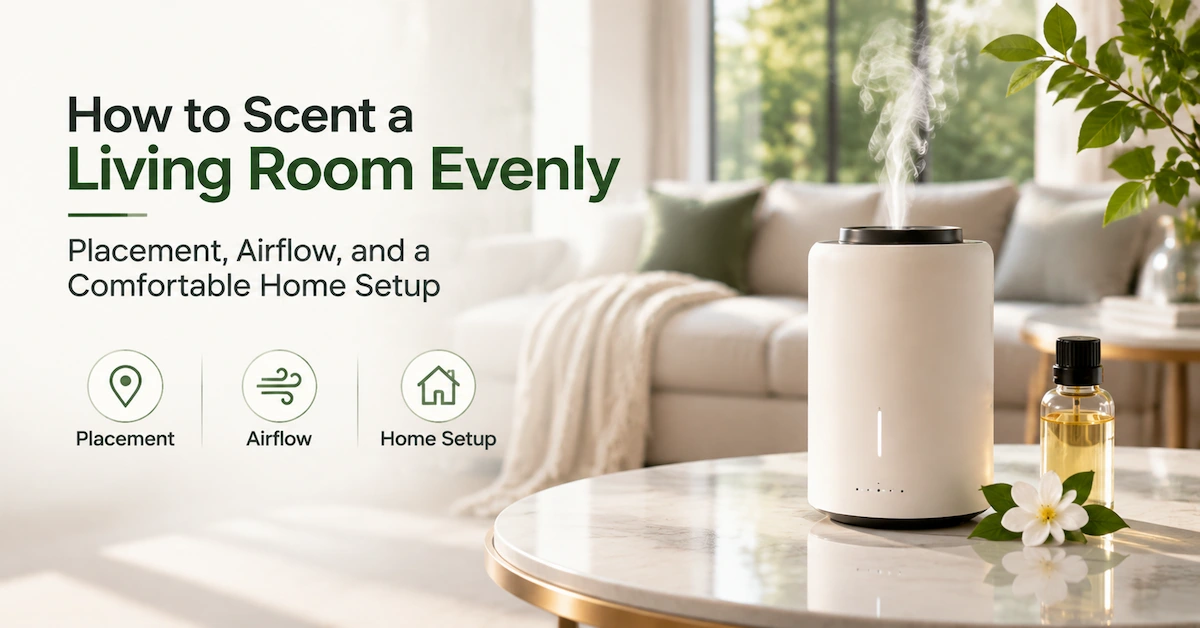
In a real home, “even” does not mean that every cubic meter contains an identical fragrance concentration. People move, doors open, sunlight changes the room temperature, and ventilation cycles start and stop. A more useful definition is comfortable consistency: the scent is noticeable along the normal living path, no seat is hit by an intense jet, and the far side of the room does not feel completely disconnected from the diffuser.
This distinction prevents a common mistake. A homeowner stands next to the machine, decides the fragrance is weak, and increases the output. The area around the unit becomes overpowering while the rest of the room remains uneven. The better test is taken from the places where people actually sit, read, watch television, or walk in from the hall.
Three signs that the room is balanced
- The fragrance is detectable at the sofa or main seating zone without leaning toward the device.
- The entrance and the far occupied corner have a similar general character, even if they are not identical in intensity.
- No one receives a cold, concentrated blast directly from the outlet, and the fragrance does not vanish immediately into a window or exhaust path.
If the room meets those conditions, it is usually better to keep the setting stable than to chase a stronger scent. Fragrance perception changes as the nose adapts, so a room can feel less noticeable to the person who has been sitting in it for an hour while still being clear to someone who has just entered.
Why a Living Room Smells Strong in One Spot and Weak in Another
Living rooms are harder to scent evenly than small enclosed rooms because they are often connected to other spaces. A sofa, bookcase, kitchen opening, stairwell, ceiling fan, and air-conditioner supply can create several different air paths. The diffuser releases fragrance into that pattern; it does not control the pattern itself.
Open doors and connected rooms
An open doorway can behave like a second room with its own pressure and temperature. A diffuser placed near the doorway may send fragrance into a hallway rather than across the seating area. If the living room opens directly into a kitchen, cooking exhaust can remove fragrance quickly and introduce competing odours. In that layout, a position just inside the living-room zone is usually easier to control than a position at the boundary.
Supply air, return air, and exhaust
Air-conditioning outlets push air into a room; return grilles pull it back; kitchen and bathroom fans remove air from the home. A diffuser placed immediately beneath a supply outlet can be carried across the room too fast, while a unit beside a return grille can lose fragrance before it reaches the occupants. A window opened for fresh air can have the same effect when wind creates a strong one-way path.
This is consistent with the way professional building engineers describe room air distribution. ASHRAE notes that supply and return locations, airflow rates, furniture, obstructions, and heat sources all influence room air patterns. The ASHRAE room-air-distribution guidance is written for indoor environmental systems rather than home fragrance, but the underlying lesson is directly useful: placement changes the path that air takes.
Furniture creates dead zones
A diffuser behind a tall sofa, inside a shelf, or tight against a curtain may be running normally while the released fragrance remains trapped in a small pocket. A large coffee table can also split the lower air path. The device needs clear space around its outlet and a stable surface, but it does not need to sit in the middle of the floor. The practical goal is a clear route toward the occupied zone without placing the source where it can be knocked over.
Temperature and sunlight change the perception
A sunny window, radiator, fireplace, or warm electronics can change evaporation and the way a fragrance is perceived. Direct heat may make a fragrance feel sharper near the source and shorten refill life. A cool corner may feel weaker even with the same output. Keep the machine away from direct heat and compare the room at the time it is normally used, not only during a warm afternoon.
How to Map Your Living Room Before Choosing a Position
You do not need a professional airflow instrument to make a better placement decision. A short room map is enough to identify the main source of unevenness. Draw the room or use a phone note and mark the following:
- Primary seating zone: sofa, reading chair, dining edge, or any place where people spend the most time.
- Air movement: air-conditioning supply, return grille, ceiling fan, floor fan, open window, balcony door, and kitchen or bathroom exhaust path.
- Boundaries: doorways, half walls, stair openings, high cabinets, and furniture that blocks a direct route.
- Safe surfaces: level tables or shelves that stay dry, remain away from children and pets, and do not put the bottle or cable at risk.
- Power access: the outlet or adapter route that will not cross a walkway or force the diffuser against a wall.
Then identify the room's air destination. Where would a light tissue or a thin piece of ribbon move when the HVAC or fan is on? This is only a visual clue, not a measurement, but it can reveal a strong jet or a stagnant corner. Do not hold anything over a hot appliance or near a moving fan blade. The exercise is simply to understand whether air travels toward the sofa, a doorway, or an exhaust point.
Where to Put a Living Room Diffuser for More Even Coverage
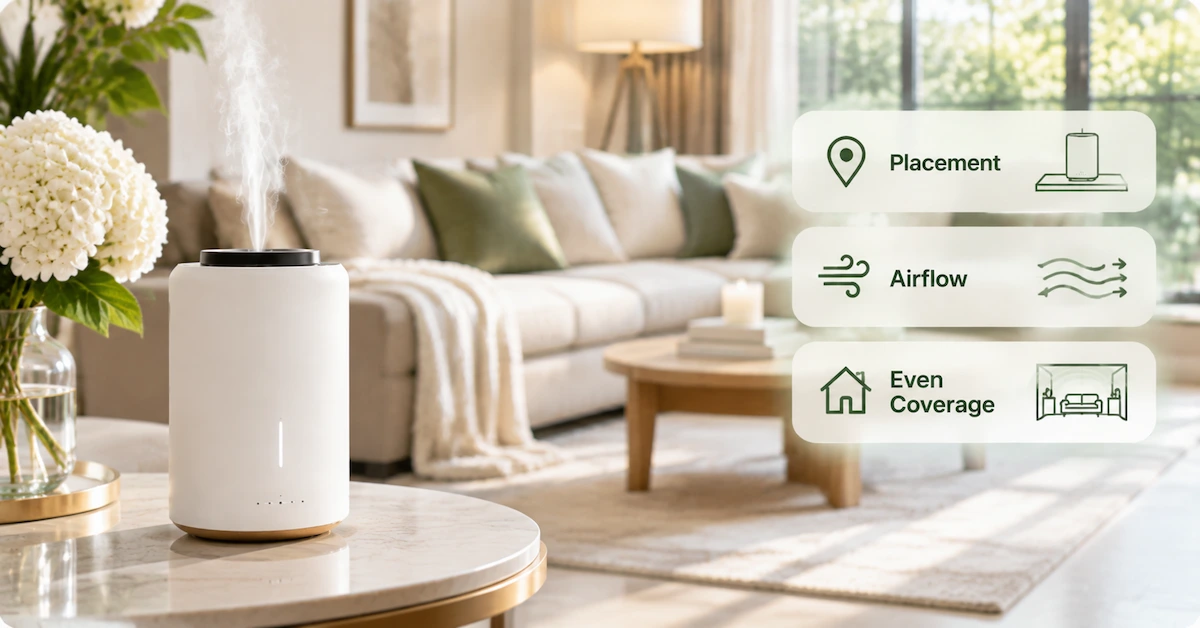
There is no single universal “center of the room” position. In many homes, the most effective position is near the edge of the seating zone, on a stable surface with open space around the outlet and a clear path toward the people using the room. This keeps the fragrance close enough to be useful without forcing it through a wall of furniture.
Start near the occupied zone, not the unused corner
If the sofa is along one wall and the television is opposite it, a side table or console near the side of the seating zone is often a better starting point than a remote corner. Place the machine where it can scent the normal path between the entrance and seating area. If the room is long, orient the outlet toward the long axis rather than directly into a wall.
Keep the unit upright and leave the outlet unobstructed. A waterless cold-air model should not be hidden inside a cabinet or placed under a cloth. A water-based model also needs a surface that can tolerate moisture and an outlet that will not leave condensation on electronics. Always follow the exact model's instructions.
Keep a respectful distance from faces
A living room diffuser should not blow directly at a person's face or remain close enough that one seat receives every atomization cycle. Begin with the device offset from the main seating line and adjust after a short trial. People vary in fragrance sensitivity; a position that feels pleasant to one person may feel intense to another when the outlet is aimed at the sofa.
Do not use a window ledge as the default
Window ledges look convenient, but the air path can change whenever the window opens or wind direction shifts. Sunlight can also warm the bottle and surrounding surface. If the living room needs regular ventilation, choose a position that remains usable when the window is open and closed, then reduce or pause output during strong cross-ventilation rather than compensating with maximum intensity.
Use wall mounting only when access remains practical
A wall-mounted model can clear a crowded tabletop and keep the unit away from accidental knocks. It also changes the test: the wall can transmit vibration, the refill must remain reachable, and a leak must not run toward an outlet or cable. For a wall-mounted home model, confirm the mounting method and service access before drilling. The CNUS X2mini is a relevant example because its product page describes a wall-mounted format; the position still needs to be chosen for airflow and safe maintenance, not only appearance.
Ventilation Conditions: When to Run, Reduce, or Pause the Diffuser
Ventilation is not the enemy of home fragrance. Fresh air is important for comfort and indoor air quality, but strong air exchange can dilute or remove fragrance faster. The aim is to operate the diffuser during the home's normal ventilation pattern and adjust the schedule to the room, rather than sealing the room tightly or overpowering it with oil.
The U.S. Environmental Protection Agency explains that indoor air quality depends on source control, ventilation, and filtration, and that outdoor air and mechanical systems affect how air moves through a home. Its indoor air quality guidance supports a sensible boundary for fragrance use: never sacrifice necessary ventilation simply to keep a scent concentrated. Follow the fragrance and diffuser instructions, and ventilate when the room needs it.
| Room condition | What usually happens | Better operating response |
|---|---|---|
| Windows closed, HVAC on normal setting | Air movement is predictable enough to compare seating and entrance points. | Start low, test three points, and keep the diffuser out of the supply and return path. |
| Window or balcony door open | Wind can carry fragrance outdoors or create a strong one-way stream. | Use a lower schedule or pause during strong cross-ventilation; reassess when the room returns to normal use. |
| Ceiling fan running | Mixing may improve, but a high speed can thin the scent and increase refill use. | Use the lowest comfortable fan speed and avoid placing the diffuser directly under the blade path. |
| Kitchen exhaust or cooking | Exhaust can pull fragrance away while food odours compete with it. | Do not raise fragrance to cover cooking. Ventilate first, then restart a normal schedule after the activity. |
| Air purifier or strong return grille nearby | Air may be pulled toward the filter before the seating area receives a balanced scent. | Move the diffuser away from the intake and check the far side of the room before changing output. |
| Open-plan living and dining area | The fragrance may spread beyond the living zone or become weak at the far end. | Place the source in the living zone, consider a larger home format, and test each occupied zone separately. |
If anyone experiences irritation, headache, breathing discomfort, or an unpleasantly strong scent, stop or reduce the fragrance and ventilate. A comfortable room is the priority; an even scent is not a reason to ignore personal sensitivity.
How to Set Output Without Creating a Strong Spot
Output control works best when it is treated as a second-stage adjustment. First fix the source position and the airflow path. Then use the lowest setting or shortest schedule that makes the fragrance clear in the occupied zone. Increasing output is a reasonable response only when the placement is already sound and the far zone remains weak.
Use a one-variable test
Change only one factor at a time: move the diffuser, change the schedule, alter the room ventilation, or change the fragrance. If you move the machine and increase the output simultaneously, you will not know which change created the improvement. Keep a quick note of the location, setting, time, and result. This is especially helpful when the room is used at different times of day.
Allow the room to settle
Do not judge the room by standing over the outlet for two minutes. Let at least one complete operating cycle finish and check the seating area after the fragrance has had time to travel. A short burst can smell intense near the source and still take longer to reach the far corner. The exact timing depends on the model, fragrance, room size, and ventilation; the important point is to compare at a consistent interval.
Use a schedule when the room is empty
A living room often sits empty during work or school hours. Continuous maximum output wastes oil and can make the first return home feel overpowering. If the model supports timing or app control, set a start window before the room is occupied and use a moderate cycle while people are present. The CNUS Stream2 is listed with Bluetooth control, 150 ml capacity, 400 m3 coverage, 5 W power, DC 12 V input, and a noise level below 32 dB; those specifications make it a useful home-format candidate for a scheduled living-room routine. They do not guarantee uniform scent in every floor plan, so placement still comes first.
Choosing a Home Diffuser for a Living Room Without Repeating the Selection Guide
The model decision matters, but it should follow the room map. For this article's purpose, the useful questions are: can the device sit in the chosen position, can its output be moderated, does the refill capacity fit the routine, and is the power or mounting arrangement practical? A larger coverage number is only a starting reference, not proof that a room will smell the same in every corner.
| Home model to investigate | Published product facts | Living-room placement implication |
|---|---|---|
| CNUS Stream2 | 400 m3 listed coverage, 150 ml capacity, 5 W, DC 12 V, below 32 dB, aluminum, Bluetooth control. | Useful when a living room needs a larger home format and scheduled control. Keep it away from HVAC supply and test the sofa and far corner. |
| CNUS X2mini | 400 m3 listed coverage, 130 ml capacity, 5 W, DC 5 V, below 38 dB, composite PP, 0.6 ml/h +/-5% listed oil consumption. | Wall placement can free a console, but confirm the wall, cable route, refill access, and vibration before installation. |
| CNUS X2S | 300 cbm listed coverage, 250 ml capacity, electric/battery 2-in-1, 4 W, 4.5 V, PP/PC, one-year warranty listed. | Worth considering when a larger refill and flexible power routine matter. Confirm battery behaviour and the exact operating instructions. |
| CNUS CPD2 | 400 cbm listed coverage, 150 ml capacity, metal and acrylic, DC 5 V, 6 W, 5 V/2 A adapter. | A portable-looking option for a defined zone; confirm its intended continuous-use routine and keep the adapter and cable clear of walkways. |
The table uses current public product information and deliberately separates facts from recommendations. Coverage, noise, consumption, and battery claims are model-specific. They should not be transferred to another model, and they are not a promise that a particular living room will have identical fragrance at every seat.
A 15-Minute Living Room Placement Test
Use this test before deciding that a machine is too weak or too strong. It is designed for a homeowner, not a laboratory, and it should be repeated whenever the room layout or ventilation pattern changes.
Step 1: Return the room to normal
Close or open windows as they normally are during the time you want fragrance. Set the HVAC or fan to its usual comfort setting. Do not test immediately after cooking, cleaning with strong chemicals, or opening every door in the home unless that is the normal living condition. Write down which devices are running.
Step 2: Choose a stable trial position
Place the diffuser on a level, uncluttered surface near the occupied zone. Keep the outlet clear, the bottle upright, and the cable away from a walkway. Do not place the unit in a closed cabinet, directly beside an air return, under a ceiling fan, or where children or pets can reach the oil.
Step 3: Start at a conservative setting
Use the manufacturer's starting setting or the lowest practical output. Confirm the fragrance format and bottle connection for the exact model. Do not dilute oil with water or another carrier unless the instructions explicitly allow it; an improvised mixture can change atomization, residue, leakage, and the useful life of the device.
Step 4: Check three points
After one complete cycle and a consistent waiting period, smell the room at the sofa, the entrance, and the farthest occupied corner. Move between points rather than sniffing the outlet. Ask another household member to make the same walk if possible, because the person who has been in the room may already be nose-adapted.
Step 5: Diagnose the pattern
| Observed pattern | Most likely first check | Next change to try |
|---|---|---|
| Strong beside the machine, weak at sofa | Direct jet, hidden outlet, or poor route into the seating zone. | Move the source slightly toward the occupied area or out of the supply-air path before increasing output. |
| Strong at entrance, weak at far corner | Doorway or HVAC is carrying fragrance away from the room. | Move the source deeper into the living zone and test with the normal door position. |
| Strong near window, weak everywhere else | Cross-ventilation is pulling scent outdoors. | Reduce output or pause while the window is open; reassess under the normal closed-window condition. |
| Balanced but too intense after returning home | Output is continuous while the room is empty, or the fragrance is too concentrated for the household. | Use a schedule or lower setting. Do not solve discomfort by moving the device next to an exhaust fan. |
| Weak at all three points | Wrong oil format, empty bottle, blocked path, unsuitable room scale, or output set too low. | Check compatibility and maintenance instructions, then review the model's stated application before replacing it. |
Repeat only the relevant change and record the result. A small movement of 30 to 60 cm can produce a more useful improvement than a large increase in output, especially in a room with a strong air-conditioning jet. The distances in this test are practical starting points, not universal manufacturer requirements.
Fragrance and Maintenance Choices That Affect Uniformity
Placement cannot compensate for an incompatible or poorly maintained fragrance path. In a waterless device, the oil, bottle, connector, nozzle, and atomizer work as one system. A liquid that is too thick, contaminated, or not approved for the model can change the spray pattern and leave residue. The Scentsin waterless diffuser oil guide explains why an “essential oil” label alone is not proof of compatibility.
Use the fragrance format specified for the exact diffuser. Keep the bottle closed when it is not installed, replace it according to the instructions, and clean the accessible oil path as directed. If output becomes intermittent, the machine begins to sputter, or one side of the room suddenly smells stronger after a refill, stop and inspect the connection instead of increasing the setting.
For a home user, maintenance is also a consistency issue. A partly blocked outlet can make a machine appear weak, prompting an unnecessary setting increase. A loose bottle can create leakage or an irregular plume. A clean, approved oil path gives you a more stable baseline for placement testing.
Frequently Asked Questions
1. What is the best place to put a diffuser in a living room?
Start on a stable surface near the main occupied zone, with clear space around the outlet and a gentle route toward the seating area. Keep it away from direct HVAC supply and return air, open windows, exhaust fans, heat, unstable edges, and places accessible to children or pets. The best position is the one that produces a comfortable result at the sofa and far corner, not necessarily the visual center of the room.
2. How do I scent an open-plan living room evenly?
Map the living, dining, kitchen, and entrance zones first. Place the diffuser inside the living zone rather than at an open doorway, keep it away from kitchen exhaust, and test each occupied area under normal ventilation. If the far zone remains weak, consider a model with a suitable published application or a second controlled zone instead of running one compact unit at maximum output.
3. Should a diffuser be near an air conditioner?
Usually not directly under or beside the supply outlet, and not immediately beside the return grille. Strong airflow can carry fragrance away before it reaches the seating area. Use the normal HVAC setting, place the diffuser where the air path is gentle, and compare the three test points before adjusting output.
4. Why can I smell the diffuser but not the rest of the room?
The outlet may be trapped by furniture, aimed at a wall, or sitting in a strong air jet. The fragrance may also be leaving through a window or return grille. Move the source toward the occupied zone, clear the outlet, and repeat the test at the sofa and far corner. Do not assume that increasing output is the first fix.
5. How long should I wait before judging a living room diffuser?
Wait through at least one complete operating cycle and use the same waiting period for each placement test. The right interval depends on the model, fragrance, room size, and ventilation. Judge from the occupied zone rather than from the outlet, and remember that your nose can adapt after sitting in the room.
6. Is a waterless diffuser suitable for a living room?
It can be suitable when you want oil-based scent delivery without a visible water tank and the model has an appropriate application, output control, and power arrangement. A waterless design still needs compatible oil, safe placement, and cleaning. Review the exact home model rather than assuming every waterless diffuser has the same coverage or control.
7. Which Scentsin home model should I investigate for a living room?
Start with the room and routine. Stream2 is listed as a home scent diffuser with 400 m3 coverage, 150 ml capacity, Bluetooth control, and below-32-dB noise. X2mini is listed as a wall-mounted home model with 400 m3 coverage and 130 ml capacity. X2S lists 300 cbm coverage and a 250 ml capacity with electric/battery 2-in-1 power. These are product-page references, not promises of equal scent in every room. Check the exact page, mounting, oil, schedule, and power requirements before buying.
8. Should I run a diffuser continuously?
Not automatically. A schedule or intermittent output can reduce oil use and prevent the room from feeling overpowering when nobody is home. Follow the model instructions, start low, and adjust for the actual time people spend in the room. Stop or ventilate if anyone feels discomfort.
9. Can I open a window while the diffuser is running?
Yes when fresh air and weather conditions make it appropriate, but open windows change the airflow and may carry fragrance outdoors. Use a lower setting or pause during strong cross-ventilation, then retest when the room returns to its usual condition. Never compromise necessary ventilation just to preserve scent concentration.
10. What should I do if fragrance is uneven after changing oil?
Stop and check that the new oil, bottle, connector, and cleaning method are approved for the exact model. Look for a loose connection, residue, a blocked outlet, or a change in viscosity. Return to the previous compatible oil or follow the manufacturer's support process before increasing output. A new fragrance should be tested as a complete configuration, not judged by its label alone.
Conclusion
Learning how to scent a living room evenly is mostly a matter of managing the air path. Place the diffuser near the occupied zone, keep the outlet clear, avoid direct supply and return airflow, and test the room at the sofa, entrance, and far corner. Use the lowest comfortable output, schedule the device around real occupancy, and keep necessary ventilation in place. If the scent is strong beside the machine but weak elsewhere, change placement before changing intensity.
For a home purchase, use the room map to choose the right product page next. Stream2, X2mini, X2S, and CPD2 have different capacities, power arrangements, coverage references, and placement formats; the correct model is the one that fits your room, routine, refill preference, and safe installation point. Review the Scentsin home diffuser collection, open the exact model specification, and contact the team if you need help matching a living-room layout to a practical setup.