
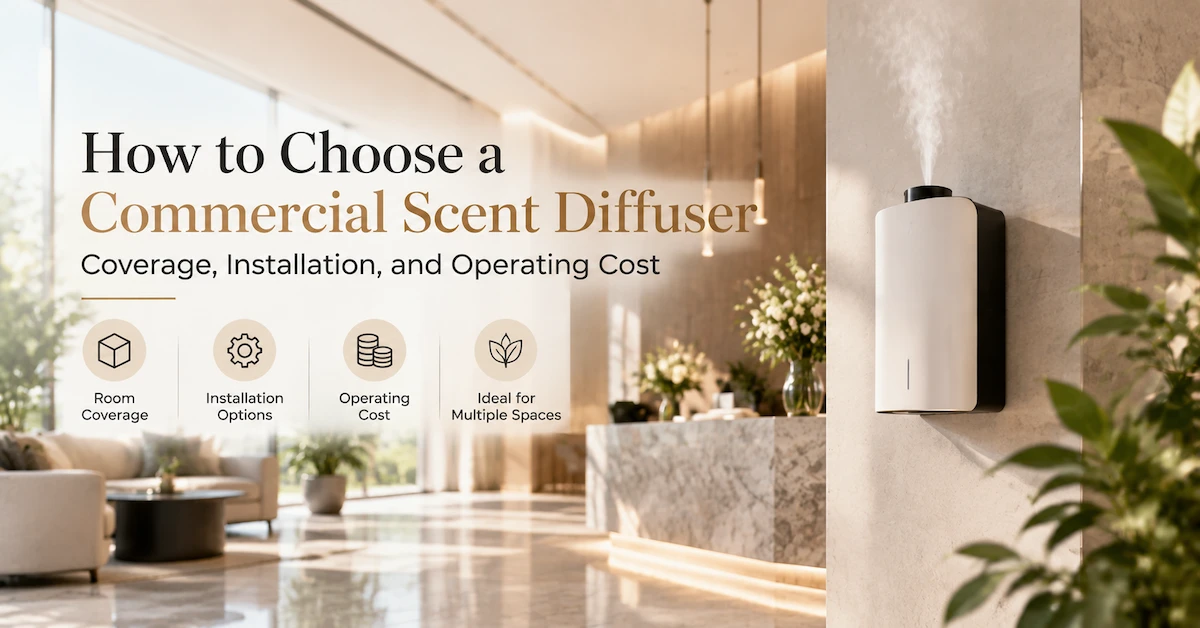
Quick answer: Choose a commercial scent diffuser by starting with the space, airflow, operating schedule, and installation method rather than the largest advertised coverage number. A small retail zone or office may need a compact wall or desktop unit with controlled output. A hotel lobby, showroom, or connected public area may need a larger commercial scent machine, a floor-standing format, multiple zones, or HVAC integration. The published Scentsin range gives buyers a practical starting ladder: S600/S1500/S3000/S6000 configurations list 600 to 6000 m3 coverage, while AS3000S lists 5000 cbm and a 1000 ml capacity. These figures are product specifications, not a site design or a guarantee that one machine will scent every building evenly. Confirm airflow, ceiling height, occupancy, fragrance target, oil compatibility, refill access, and a sample test before placing a project order.
The query how to choose a commercial scent diffuser usually comes from a buyer planning a hotel lobby, retail store, office reception, clinic, showroom, spa, restaurant, or multi-site brand program. The decision affects customer experience, staff workload, fragrance consistency, operating cost, service access, and rollout support.
A commercial scent machine is part of a system: machine, oil, bottle, controls, placement, ventilation, schedule, and maintenance all affect the result. A large tank can still perform poorly when air moves to an exhaust or the refill point is inaccessible. A smaller unit may be the better choice when the zone is enclosed and output can follow business hours.
This guide focuses on specification-led purchasing. It uses current Scentsin product information where a model is mentioned and labels items that require a live sample, engineering review, or written quotation. It does not treat a nominal coverage figure as a substitute for a site survey.
Review Commercial Scent Machine Options
1. Define the Commercial Scenting Job Before Comparing Models
The first question is not “Which machine has the highest coverage?” It is “What job must the fragrance system perform?” A retail store may need a consistent atmosphere during open hours. A hotel may need a recognizable signature scent in the arrival path without over-scenting guest rooms. An office may want a discreet reception experience with low maintenance. A facility operator may need remote visibility across several locations.
Write the decision brief in operational terms
Before requesting a quotation, write down the location, usable area, ceiling height, connected rooms, ventilation pattern, target fragrance intensity, operating hours, preferred mounting position, and refill access. Add the number of units, the expected monthly consumption, the preferred fragrance family, and the person responsible for daily checks. This turns a broad request for a “commercial aroma diffuser” into a brief a supplier can evaluate.
- Space: floor area, ceiling height, volume, doors, partitions, and open connections.
- Airflow: HVAC supply and return locations, fans, escalators, entrances, and exhaust paths.
- Schedule: opening hours, quiet periods, cleaning windows, and seasonal changes.
- Control: local buttons, timer, Bluetooth, Wi-Fi, 4G, app, or a building-control interface.
- Service: who refills the oil, where stock is stored, and how faults are reported.
Separate one zone from a multi-zone project
One open lobby and a chain of connected rooms are different installations. A single unit may suit a defined zone with predictable airflow; multiple zones may need separate devices so intensity and schedule can be adjusted independently. Hotels may vary settings between entrances and lounges, while retail brands often keep one formula but change schedules by store size.
Ask the supplier whether the recommended coverage assumes one uninterrupted room, a particular ceiling height, or a typical ventilation condition. If those assumptions are not documented, mark the coverage as a starting reference and request a site-specific recommendation.
2. Understand Coverage: m3 Is a Starting Point, Not a Promise
Commercial diffuser pages often show coverage in cubic metres, square metres, or a square-foot equivalent. These numbers help organize the shortlist, but they do not describe fragrance uniformity, perceived intensity, or how a machine performs in a real building. Air movement can carry aroma away from the target area. High ceilings increase volume without necessarily increasing the same way as floor area. Open doors and stairwells can create a much larger effective zone.
Use volume and airflow together
For an initial estimate, calculate approximate room volume as floor area multiplied by average ceiling height. Then identify where air enters, where it leaves, and whether the target visitor path crosses the moving air. A 300 m2 shop with a low ceiling and moderate air movement can behave differently from a 300 m2 lobby with a tall atrium, revolving doors, and a strong supply vent. The supplier should know these conditions before recommending a high-output model.
Read the current Scentsin coverage ladder
The S600plus product page lists a commercial scent air machine family with four configurations: S600 at 600 m3, S1500 at 1500 m3, S3000 at 3000 m3, and S6000 at 6000 m3. The listed capacities are 150 ml, 500 ml, 1000 ml, and 1000 ml respectively. The same page lists output-related differences, including oil consumption from 1.8 ml/h to 10 ml/h, power from 8 W to 24 W, and noise thresholds from below 32 dB to below 48 dB. These values show why a buyer should choose the configuration from the room and schedule, not only from the maximum coverage number.
| Configuration | Published coverage | Capacity | Published oil consumption | Control or operating note |
|---|---|---|---|---|
| S600 | 600 m3 | 150 ml | 1.8 ml/h | Below 32 dB listed; Wi-Fi, Bluetooth, and 4G support shown for the family. |
| S1500 | 1500 m3 | 500 ml | 3.2 ml/h | Below 35 dB listed; suitable for a larger zone when refill interval matters. |
| S3000 | 3000 m3 | 1000 ml | 6 ml/h | Below 38 dB listed; confirm output and schedule for occupied spaces. |
| S6000 | 6000 m3 | 1000 ml | 10 ml/h | Below 48 dB listed; request a site trial when sound or nearby seating matters. |
Use this table to screen models, not to promise a monthly bill. Consumption varies with output, duty cycle, formula, temperature, and controls, so ask for the test conditions behind every quoted figure.
3. Match the Machine Format to the Installation Environment
Installation format affects service access, visual impact, cable routing, security, and distribution. Wall-mounted units preserve counter space; floor-standing machines can act as a visible lobby element with a larger reservoir; portable formats suit reception or pilot zones. HVAC-connected equipment needs a separate engineering review of duct and control conditions.
Wall-mounted or compact commercial units
Wall-mounted formats can suit corridors, reception zones, offices, and smaller retail spaces where floor and counter space are limited. Check the mounting surface, oil-bottle access, service clearance, cable route, and whether the wall can transmit vibration. The Scentsin S600, C400, and similar 150 ml class products can be investigated for smaller zones, but the supplier should confirm the correct coverage and installation position from the site plan.
Floor-standing commercial machines
The S3000TF page describes a floor-standing scent diffuser with faster diffusion, app remote control, a magnetic security lock, and aluminum and acrylic construction. This format is relevant when the buyer wants a free-standing display position, a larger enclosure, or easier access than a high wall installation. It should still be anchored and located so that visitors cannot knock it over, block a walkway, or access the oil bottle without authorization. Confirm the actual capacity, coverage, output, and dimensions in the current quotation because the visible page is more descriptive than numeric.
HVAC-connected systems
An HVAC scent diffuser may distribute fragrance through a building's air-handling system, but it is not interchangeable with a stand-alone machine. The C400 product page uses HVAC scent diffuser language and lists 150 ml capacity, 8 W power, 12 V input, metal construction, and public, home, office, and hospital use. Those details identify a product direction, not proof that it fits every duct, fan, filter, or building-management system. Before specifying HVAC integration, request connection drawings, pressure and airflow requirements, injection-point guidance, oil compatibility, access requirements, and responsibility for commissioning.
Portable and display formats
CPD2 is presented as a portable hotel aroma diffuser with a 150 ml oil capacity, 400 cbm space coverage, metal and acrylic construction, and DC5V, 6W input. It can be useful for a sample zone, a small reception, or a hospitality setting where the appearance matters. A portable format is not automatically a temporary product. Confirm whether it is designed for continuous duty, how often it needs refilling, and whether the adapter and cable placement meet the project's safety requirements.
Compare the S600plus Commercial Range
4. Choose Capacity, Continuous Operation, and Control as One Operating System
Capacity determines how often staff must refill the machine. Control determines when and how strongly the oil is released. The best commercial scent machine balances both. A 150 ml unit with a low duty cycle may be easier to service than a large unit that runs at a high output to compensate for poor placement. A large reservoir can lower refill frequency, but it does not remove the need to monitor leaks, residue, and oil quality.
Capacity and refill workload
Estimate refill workload from the planned consumption rather than tank size alone. For example, a 150 ml tank at a stated 1.8 ml/h would theoretically represent about 83 hours of continuous output. A real schedule may run intermittently, but the actual interval depends on the machine's usable fill level, output settings, formula, temperature, and whether the unit stops before the bottle is empty. Use the calculation as a planning check, not a promise.
Local, app, and remote control
Remote control can reduce site visits and help a brand maintain consistent schedules across locations. The S600plus family lists Wi-Fi, Bluetooth, and 4G support, while S3000TF lists app remote control and Stream2 lists Bluetooth control. Confirm which functions are available on the exact configuration, whether a SIM or subscription is required, what happens when connectivity drops, and who owns the account. A remote system should also provide a practical local fallback for commissioning and service.
Schedule around occupancy
Commercial fragrance should be scheduled around the actual customer journey. A hotel lobby may need a gentle pre-opening cycle, a stable daytime setting, and a lower overnight setting. A retail store may stop output during cleaning or after closing. A clinic may require a conservative setting and a clear response process for fragrance-sensitive visitors. Ask the supplier to show the schedule in hours, duty cycle, intensity, and expected refill interval instead of accepting “long-lasting” as an operating specification.
Separate continuous-duty approval from intermittent use
A two-hour launch event is not the same approval basis as daily operation. For continuous or near-continuous use, ask whether the exact configuration, adapter, atomizer, bottle, and control mode support the planned duty cycle. For intermittent use, record pulse length, rest period, start-up behavior, and active hours. Scentsin pages do not publish a universal 24-hour guarantee, so confirm continuous-duty suitability in the quotation or sample test.
5. Compare Oil Consumption and Total Operating Cost
Purchase price is only one part of a commercial scenting budget. Total operating cost includes fragrance oil, electricity, staff time, service visits, replacement atomizers or bottles, connectivity, packaging, and the cost of an inconsistent customer experience. A machine that costs less but consumes more oil can become more expensive over a year. A remote-controlled unit may justify a higher purchase price when it reduces routine visits across many locations.
Use a transparent consumption formula
A simple planning formula is:
Estimated monthly oil use = reference consumption per hour × active hours per day × operating days × duty-cycle factor.
The duty-cycle factor must be based on the actual schedule. If the machine runs continuously, the factor may be close to 1. If it runs in timed pulses, it is lower. Do not compare one supplier's continuous figure with another supplier's intermittent figure. Request the output setting, oil formula, room condition, and test duration for every quoted number.
Example using the published S600plus ladder
At the listed 1.8 ml/h reference for S600, a continuous 10-hour operating day over 26 days would be about 468 ml before any duty-cycle adjustment. At the listed 6 ml/h reference for S3000, the same schedule would be about 1,560 ml. These are arithmetic examples, not a Scentsin operating guarantee. They show why a project should specify the intended hours and control mode before the buyer compares oil quotations.
Include fragrance supply and compatibility
Oil cost is meaningful only when the fragrance is compatible with the exact machine, atomizer, bottle, seal, and cleaning procedure. The Scentsin Wood Series page states suitability for commercial diffusers, but a buyer should still request an oil-by-model approval record. Do not substitute reed diffuser liquid, candle fragrance, cooking oil, or an unlabeled decant into a commercial atomizer. For a separate compatibility workflow, use the waterless diffuser oil compatibility guide.
| Cost item | What to ask the supplier | Why it changes the decision |
|---|---|---|
| Machine | Exact model, configuration, warranty, replacement parts, and lead time. | A nominal model name may include several sizes with different outputs and noise. |
| Fragrance oil | Approved formula, price basis, bottle size, batch consistency, and sample process. | Oil is often the recurring cost and can affect atomization and maintenance. |
| Electricity | Power draw, input voltage, adapter, and active schedule. | Power is usually smaller than oil cost but matters across many sites. |
| Service | Cleaning interval, remote support, site visits, and response time. | Hard-to-access machines can turn a small fault into an operational disruption. |
| Connectivity | Wi-Fi, Bluetooth, 4G, account ownership, and subscription charges. | Remote control benefits disappear if network or account requirements are unclear. |
6. Review Noise, Placement, and Visitor Experience
Noise is a commercial consideration in hotels, offices, clinics, premium retail, and reception areas. The S600plus page lists thresholds from below 32 dB to below 48 dB across its configurations. A larger model may offer useful coverage but also require a placement away from quiet seating, guest rooms, or staff workstations. Ask whether the published number is measured at a fixed distance, on a specific output setting, and with the intended oil.
Test the complete installation
A sample test should include the machine, oil, bottle, adapter, mounting or stand, and control schedule. Listen for start-up, atomization pulses, vibration against furniture, app notifications, and low-oil alerts. Test the unit at the visitor position and at the nearest staff desk. A unit that is quiet in a warehouse can sound different on a hollow counter or against a metal panel.
Balance visibility and security
Hidden and visible installations both need security planning. A floor-standing unit needs a stable base and controlled oil access; a wall or service-room unit needs clear refill, ventilation, and fault-response routes. The S3000TF page references a magnetic security lock for public areas, but confirm what the quoted configuration includes.
7. Decide Between Stand-Alone and HVAC Scenting
Stand-alone diffusion is easier to pilot because the machine can be placed in a defined zone with fewer building dependencies. HVAC scenting can help distribute fragrance through a larger system, but it requires coordination with facilities, mechanical contractors, fire and safety requirements, access panels, and building controls. The choice should follow the building's operational constraints, not a general claim that one technology is always superior.
Choose stand-alone when the zone is clear
A stand-alone machine is often easier for a single lobby, showroom, boutique, reception, or office floor. The buyer can move the unit, adjust the schedule, and evaluate the fragrance without changing the HVAC system. It is also easier to attribute a result to one zone. Select a format that can be secured and serviced without obstructing visitors.
Investigate HVAC when distribution is the main problem
HVAC may be appropriate when the project needs controlled distribution across a connected floor and the building team can support installation. Ask for a schematic and confirm the injection point, airflow range, filter arrangement, oil isolation, and access. Do not describe a machine as HVAC-compatible solely because a product page includes the phrase “HVAC scent diffuser.” It must be confirmed for the exact building system and the exact machine configuration.
Hotel lobby and retail store need different operating profiles
A hotel lobby has a long arrival path, changing occupancy, doors, elevators, and a brand-scent expectation during quiet periods. A retail store has a defined sales floor, opening hours, staff nearby, and a need to pause or reduce output during cleaning and stock work. Hotel specifications should emphasize visitor-path consistency, refill access, security, and overnight scheduling; store specifications should emphasize zone boundaries, staff comfort, local adjustment, and repeatability across branches. The Scentsin product catalogue supports the shortlist, but the quotation must contain these site assumptions.
8. Evaluate Supplier Evidence Before Requesting a Bulk Quote
A commercial diffuser supplier should answer more than “Yes, we can do OEM.” CNUS TECH (GUANGDONG) CO., LTD. identifies itself on Scentsin pages as a Guangzhou, Guangdong, China manufacturer integrating R&D, production, and wholesale. Request the model number, technical sheet, oil statement, sample process, warranty, packaging, and installation contact. Several pages state samples are welcome, sample production can take 3–5 days, bulk timing depends on quantity, and OEM/ODM is available. Public pages do not state one universal MOQ, so confirm MOQ by model, logo method, packaging, and customization level.
Ask for a model-level evidence pack
- Exact model and configuration, including coverage, capacity, power, voltage, material, and control method.
- Noise and oil-consumption test conditions, including output setting and measurement distance.
- Approved oil list, bottle or cartridge interface, cleaning method, and storage requirements.
- Installation drawing, clearance, mounting hardware, cable route, and security method.
- Warranty period, spare parts, service response, and what unauthorized oils or modifications void.
- Packaging, carton quantity, sample fee, production lead time, inspection process, and shipping terms.
Separate a sample from a production approval
A sample proves that one unit can be evaluated. It does not automatically prove that every production unit, oil batch, firmware revision, and housing finish will perform identically. Record the sample model, serial or batch information, oil, schedule, room, temperature, sound observations, refill behavior, and any changes requested for OEM. For a multi-site rollout, approve a repeatable configuration rather than a product photograph.
9. Build a Site Trial That Produces a Purchase Decision
A useful trial has a pass or fail question. “Does the room smell good?” is too vague. Define whether the fragrance is detectable at the entrance, balanced at the visitor path, acceptable to staff, stable across the day, and manageable within the refill schedule.
Trial checklist for one zone
- Map the room, doors, ceiling height, supply vents, return vents, and visitor path.
- Install the machine in the proposed position with the intended oil and schedule.
- Record start time, output setting, room conditions, and the responsible operator.
- Check fragrance at several fixed points rather than only next to the diffuser.
- Record staff and visitor feedback separately from the supplier's sales language.
- Measure oil use, refill access, sound, leakage, residue, and any control failures.
- Adjust placement or schedule before jumping to a larger machine.
Do not confuse intensity with coverage
A strong scent near the machine does not prove that the whole zone is covered. Walk the visitor path at different times of day and note where fragrance is absent, sharp, or diluted. Check whether doors, escalators, or HVAC cycles change the result. A smaller output with better placement can be more comfortable than a larger output aimed at a poor airflow path.
Document the final operating profile
When the trial passes, record the model, oil, bottle, output, schedule, placement, maintenance interval, and refill trigger. This profile becomes the baseline for future stores or hotel locations. It also gives the supplier a clear reference if an atomizer, oil formula, or control system changes.
10. Commercial Scent Diffuser Shortlist by Buyer Scenario
The following shortlist uses public product evidence to identify the next model page or supplier question. It is not a universal ranking. The correct choice depends on the site trial, the operating schedule, and the current quotation.
| Buyer scenario | Model or family to investigate | Published evidence | Decision gate |
|---|---|---|---|
| Small commercial zone, reception, or office | S600 or C400 | 150 ml class; S600 lists 600 m3, below 32 dB, and remote-control family features. C400 lists 150 ml, 8 W, 12 V, and metal construction. | Confirm exact control, coverage assumptions, HVAC requirement, and refill interval. |
| Hotel lobby or medium connected area | Stream2, S1500, or CPD2 | Stream2 lists 400 m3, 150 ml, Bluetooth, and below 32 dB. CPD2 lists 400 cbm, 150 ml, metal and acrylic construction. | Run a visitor-path trial and confirm continuous-duty suitability. |
| Retail store or branded showroom | S1500 or S3000 | S600plus family lists 1500 or 3000 m3 configurations, 500 ml or 1000 ml capacity, and app/remote features. | Match output to opening hours, staff sensitivity, and oil budget. |
| Large hotel, commercial floor, or visible lobby installation | AS3000S or S3000TF | AS3000S lists 5000 cbm, 1000 ml, 15 W, 12 V, metal construction, CE/RoHS, and OEM/ODM context. S3000TF lists floor-standing design, app remote control, and magnetic security lock. | Require site plan, sample, security, sound, and service-access approval. |
| Building-wide distribution | C400 HVAC direction or a custom system review | C400 page uses HVAC scent diffuser language and lists 150 ml, 8 W, 12 V, and metal construction. | Obtain duct, airflow, injection-point, access, and commissioning evidence. |
Frequently Asked Questions
1. What is the best commercial scent diffuser for a hotel lobby?
There is no single best model without the lobby area, ceiling height, airflow, operating hours, fragrance target, and installation position. AS3000S and S3000TF are reasonable large-format models to investigate because their pages describe commercial use, while S600plus configurations provide a coverage ladder. Request a sample and site-specific recommendation before choosing.
2. How do I size a commercial scent machine?
Start with approximate room volume, then adjust for airflow, doors, ceiling height, connected areas, and target intensity. Use the published coverage figure to create a shortlist, not as a guarantee. A site trial should confirm fragrance distribution at the visitor path and the schedule needed to maintain it.
3. Is a larger tank always better for commercial use?
No. A larger capacity can reduce refill frequency, but the machine may have higher oil consumption, power draw, size, sound, and service requirements. Choose capacity together with duty cycle, refill access, and the cost of the approved fragrance oil.
4. How much oil does a commercial diffuser use?
Use the exact model's reference consumption and operating schedule. The S600plus page lists 1.8 ml/h for S600, 3.2 ml/h for S1500, 6 ml/h for S3000, and 10 ml/h for S6000. These figures must be checked against output mode, oil formula, temperature, and the test conditions behind the specification.
5. Should I choose stand-alone or HVAC scenting?
Choose stand-alone when you need a clear, controllable zone with simple piloting and service. Investigate HVAC when the building requires distribution through connected air handling and the facilities team can support drawings, access, commissioning, and maintenance. Do not infer HVAC compatibility from a keyword alone.
6. Can one diffuser scent several hotel floors?
Do not assume that one machine will scent several floors evenly. Floors may have separate air systems, doors, pressure differences, and visitor paths. A multi-zone project usually needs a zone plan, separate controls, or a properly designed HVAC system. Ask the supplier for the assumptions behind the recommendation.
7. What control method is best for multiple retail stores?
Remote control can help a brand apply schedules and review several locations, but the best method depends on network coverage, account ownership, local fallback, and service policy. The S600plus family lists Wi-Fi, Bluetooth, and 4G support. Confirm which option is included in the exact configuration and how a disconnected unit behaves.
8. What should I test in a commercial diffuser sample?
Test fragrance distribution, sound, oil consumption, leakage, residue, start-up and stop behavior, schedule control, connectivity, refill access, security, and cleaning. Use the intended oil, bottle, adapter, mounting or stand, and operating hours. Record the result so a production order can be matched to the approved sample.
9. Can a commercial diffuser use any essential oil?
No. Oil compatibility depends on the exact formula, viscosity, carrier, bottle, seal, atomizer, and cleaning method. Use a supplier-approved oil or complete a documented model-level test. Do not add water or substitute reed diffuser liquid into a waterless atomizer without written approval.
10. Does Scentsin support OEM and ODM commercial scent machines?
Several current product pages state that OEM and ODM support is available, that logos can be accepted on machines, and that the company has more than ten years of R&D and production experience. Confirm the current customization scope, MOQ, artwork process, tooling, sample fee, certification needs, and production schedule in the project quotation.
11. Where should I start when requesting a quote?
Send the supplier a short brief with the site type, floor area and height, airflow conditions, operating hours, target scent intensity, preferred installation, number of sites, fragrance preference, and target launch date. Include whether you need a sample, private label, remote control, HVAC connection, or recurring oil supply. Use the Scentsin contact page for a project-specific recommendation.
Conclusion
The right commercial scent diffuser is the one that can deliver a controlled fragrance experience in the actual operating environment, at a cost and service level the business can sustain. Start with the room, airflow, schedule, installation, and service workflow. Then compare coverage, capacity, control, noise, oil consumption, materials, security, and supplier evidence. Current Scentsin data provides several useful starting points: the S600plus family spans 600 to 6000 m3 configurations, AS3000S lists 5000 cbm and 1000 ml, CPD2 lists 400 cbm and 150 ml, and C400 provides an HVAC-oriented direction that requires engineering confirmation.
Do not buy a commercial scent machine solely from a headline coverage number or a product photo. Request the exact configuration, approved oil, test conditions, installation assumptions, sample process, warranty, and service responsibilities. Run a controlled site trial, document the approved operating profile, and use that record when expanding to additional hotels, stores, offices, or facilities.
For a product shortlist, begin with the Scentsin commercial diffuser catalogue. For a site-specific recommendation, sample request, OEM/ODM project, or recurring oil plan, contact the Scentsin team with your room plan, operating schedule, target coverage, and intended application.