

Quick answer: CNUS X3Pro and X3Art share the same basic specification direction: both are compact, waterless cold-air diffusers with a 10 ml capacity, 2 W power, DC 5 V input, white or black color options, and a published coverage figure of 100 m³. The X3Pro is the better starting point when you value portability, an aluminum-alloy body and atomizer, a published oil-consumption figure, car and indoor modes, and a battery version described as working for up to 60 hours per charge. The X3Art is the better starting point when a lower listed noise figure, a composite-PP body, and a slightly larger home-and-car format matter more. Neither model wins every use case: the correct choice depends on placement, power routine, sound sensitivity, material preference, and which missing details you are willing to confirm before purchase.
Check the X3Pro Product Specifications
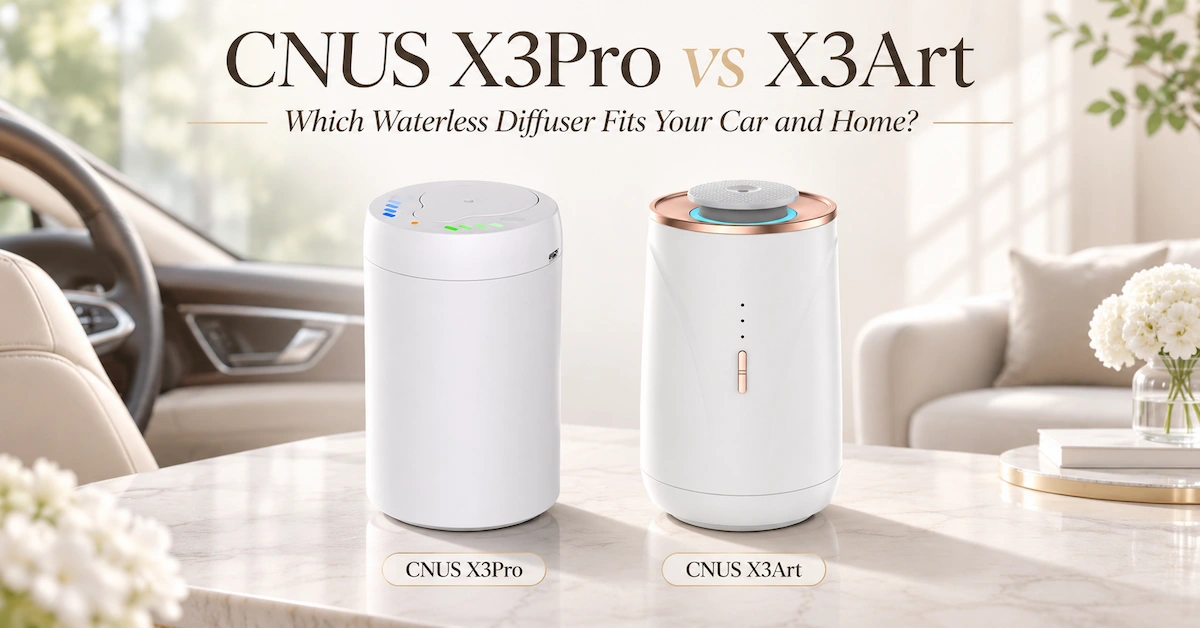
X3Pro vs X3Art at a Glance
The fastest way to understand the comparison is to separate “same” from “different.” Shared specifications tell you that the models belong to the same compact waterless category. The differences tell you which daily routine and physical environment each model is more likely to suit. The table below uses the information published on the current Scentsin product pages. Where one page does not publish a value, the table says so instead of filling the gap with an assumption.
| Decision factor | CNUS X3Pro | CNUS X3Art | Why it matters |
|---|---|---|---|
| Published application | Small car/home use; car mode and indoor mode described. | Home/car air scent diffuser. | X3Pro gives more explicit mode information; X3Art is positioned broadly for both environments. |
| Capacity | 10 ml | 10 ml | Capacity is not a differentiator; do not assume equal runtime. |
| Published coverage | 100 m³ | 100 m³; page also shows about 30 m² / 300 ft². | Both are compact models on paper; room airflow and placement still control the real result. |
| Power and input | 2 W; DC 5 V; Type-C plug-in and quick-charge language; battery version described. | 2 W; DC 5 V; page does not publish the same battery detail. | X3Pro is the clearer choice for buyers prioritizing a portable or rechargeable routine, subject to variant confirmation. |
| Size | Φ70 × 109 mm | Φ75 × 128 mm | X3Pro is 5 mm narrower and 19 mm shorter in the published dimensions. |
| Weight | 0.3 kg | 0.41 kg | X3Pro is 0.11 kg lighter, useful for moving between a car, desk and room. |
| Listed noise | Below 34 dB | Below 32 dB | X3Art has the lower published number, but measurement conditions are not shown. |
| Main material | Aluminum alloy; atomizer also listed as aluminum alloy. | Composite PP | Material affects weight, touch, appearance and buyer questions about heat, corrosion and finish. |
| Oil consumption | 0.3 ml/h ±5% | Not stated on the visible specification. | X3Pro is easier to model for refill planning; X3Art requires a direct question. |
| Colors | White / Black | White / Black | No published color advantage; confirm the exact finish and stock. |
The table gives X3Pro a stronger evidence advantage, not an automatic performance advantage. X3Art's lower listed noise may suit a fixed quiet position, while X3Pro's lighter body and oil data may suit a mobile routine. Choose the difference that matches your actual constraint.
What the Two Models Have in Common
Both products are designed around waterless cold-air diffusion rather than a water reservoir. Both list a 10 ml fragrance capacity, 2 W power, DC 5 V input, white and black color options, and 100 m³ coverage. That shared baseline matters because it rules out several weak reasons for choosing one over the other. If your decision is based only on capacity, basic power draw, or the headline coverage number, the comparison is effectively a tie.
Same category, different decision pressure
Both models belong to the portable car aroma diffuser category, but “portable” can mean different things. For one buyer it means a smaller body that can move from vehicle to desk. For another it means a rechargeable version with no cable during use. The X3Pro page provides more explicit evidence for the first interpretation because it lists 0.3 kg, car and indoor modes, Type-C language and a battery version. The X3Art page confirms home/car use and a 0.41 kg body, but it does not expose the same battery or oil-consumption details.
Same capacity does not mean same operating time
Both pages list 10 ml, but a reservoir size is only one input into runtime. The X3Pro page lists oil consumption at 0.3 ml/h ±5%. A simple continuous-use calculation is 10 ml divided by 0.3 ml/h, or roughly 33 hours before considering the tolerance, cycling, lower output, or residual oil. That is a planning reference, not a promise. X3Art does not publish a comparable consumption rate on the visible page, so a buyer should not infer that its 10 ml will last for the same number of hours.
Same coverage should be read as a reference
A 100 m³ listing helps compare the models, but it does not guarantee uniform scent. Car ventilation, an open doorway, a fan or an HVAC outlet can change the fragrance path. Use coverage as a screening number, then decide from placement and output control.
The Differences That Actually Change the Buying Decision
1. X3Pro is smaller and lighter
The X3Pro page lists Φ70 × 109 mm and 0.3 kg. X3Art lists Φ75 × 128 mm and 0.41 kg. In practical terms, X3Pro is 5 mm narrower, 19 mm shorter and 0.11 kg lighter in the published figures. Those are small numbers until the diffuser has to fit a narrow console, move between a vehicle and a home office, or sit on a lightweight shelf.
For a fixed home position, the extra X3Art size may not matter. For a buyer who carries the unit, keeps it in a door pocket or moves it between rooms, the X3Pro dimensions are easier to justify. Do not translate the smaller size into a claim that it diffuses better or uses less oil; the product page does not establish either conclusion.
2. X3Art has the lower listed noise figure
X3Art lists less than 32 dB, while X3Pro lists less than 34 dB. That gives X3Art the lower published number, which may matter in a quiet bedroom, reading corner or parked vehicle. But the pages do not show the measurement distance, output level, test room, operating cycle or whether vibration from the bottle and surface was included. A two-decibel difference on a specification table should be treated as a reason to test or ask, not as proof that every listener will hear a dramatic change.
If quiet operation is your only deciding factor, ask for a short video or sample test at the intended output and with the intended bottle installed. A diffuser can meet a headline noise figure and still create a rattle when it touches a hard dashboard or shelf. Placement, surface contact and operating mode are part of the real sound experience.
3. The body and atomizer materials are different
X3Pro lists aluminum alloy as the main material and also lists aluminum alloy for the atomizer. X3Art lists composite PP as the main material. This is a real product difference, but it is not a simple “metal is always better” decision. Aluminum alloy may appeal to a buyer who values a more metal-led finish or wants the atomizer material stated clearly. Composite PP may appeal to a buyer who prefers a lighter-feeling polymer housing or a specific surface and color treatment.
The X3Pro product copy also mentions composite PP in a durability paragraph even though the specification table identifies aluminum alloy as the main material. That inconsistency should be resolved before a large purchase. Ask which material applies to the outer housing, nozzle, bottle interface, atomizer and any internal heat-exposed part. Treat the published table as the current reference, but request a sample or technical drawing if material is critical.
4. X3Pro publishes oil consumption; X3Art does not
Oil consumption is one of the most commercially useful differences between the pages. X3Pro publishes 0.3 ml/h ±5%, giving a buyer a starting point for estimating refill demand. X3Art's visible page lists capacity, power, size, weight, noise and material but no consumption rate. That does not mean X3Art consumes more or less. It means the public evidence is incomplete.
For B2C use, the practical question is how often you want to refill. For a small retail test or gift bundle, the question becomes how many refills a customer may need over a month and whether that expectation can be stated honestly on packaging. Ask for the X3Art consumption rate under the intended mode, whether the device cycles automatically, and how much oil remains unusable at the end of a bottle.
5. X3Pro exposes more power and portability information
The X3Pro page describes a Type-C connector for the plug-in version and quick charge language. It also says the battery model can continue working for up to 60 hours once charged. This makes X3Pro the more explicit choice for buyers who need a rechargeable option, but the exact variant still matters. The page does not provide a complete battery capacity, charging time, cycle-life record or included cable specification in the visible text.
X3Art lists DC 5 V and 2 W but does not publish the same battery detail on the visible specification. A buyer should not assume that both models include the same rechargeable hardware just because both use 5 V input. Ask whether the ordered SKU is plug-in, rechargeable, or available in both versions; confirm what is in the box; and confirm whether the device can operate while charging.
Which Model Fits a Car Cabin?
For a car buyer, the best choice is less about the 100 m³ headline and more about movement, mounting, sound and the power routine. A car is a small, enclosed space with changing temperature, strong directional airflow and limited stable surfaces. The unit must remain secure, avoid obstructing controls, and use an approved fragrance container.
Choose X3Pro when your car use is mobile
X3Pro is the stronger starting point for a driver who moves the diffuser between cars, a vehicle and a desk, or a vehicle and a bedroom. The published 0.3 kg weight, smaller dimensions, car and indoor modes, magnetic nozzle-and-bottle language, and battery version description all support a portable-use discussion. Its aluminum-alloy body and atomizer are also more explicitly documented than X3Art's material details.
That recommendation still has conditions. Confirm the exact battery or plug-in version, the included vehicle fixing accessory, and the fragrance bottle format. The visible page describes a magnetic connection for the nozzle and essential-oil bottle; it does not clearly prove that a separate magnetic dashboard mount, vent clip or cup-holder base is included. Do not purchase on the assumption that “magnetic” means “ready to mount anywhere in a car.”
Choose X3Art when quietness and a fixed position matter more
X3Art is a sensible candidate when the diffuser will sit in one stable position and the lower listed noise figure matters more than a published battery or oil-consumption figure. Its home/car description and 100 m³ listing make it relevant to a vehicle, while composite PP and a 0.41 kg weight may suit a buyer who prefers a slightly larger fixed unit.
Ask the same accessory questions before ordering: is there a vent clip, adhesive pad, bracket, cup-holder base or another mounting part? The live page does not show a complete accessory list in its visible specification. If the device will be placed on a dashboard, confirm surface temperature, vibration behavior and safe clearance from controls.
Which Model Fits Home Use?
Both models can be used for a compact home area because both product pages describe home use and 100 m³ coverage. In a home, however, the decision changes from “can it fit in a car?” to “will it fit the room and routine?” A bedroom buyer may care about sound and charging. A home-office buyer may care about cable placement and portability. A living-room buyer may need to understand that 100 m³ is a listed reference, not a promise of even scent across an open floor plan.
Bedroom or reading corner
X3Art has the lower listed noise value, so it is the logical first candidate for a quiet bedroom or reading corner. Test it on the actual table and floor surface, because contact vibration can change the sound. X3Pro remains relevant when you want to remove the charging cable, move the unit away from the bed, or use the same device in a car during the day. In either case, use the manufacturer's approved oil and start with a conservative operating schedule.
Home office or desk
X3Pro's smaller dimensions and lighter weight are useful when a desk is shared with a laptop, notebook or monitor stand. Its published 0.3 ml/h figure also gives a clearer starting point for refill planning. X3Art may suit a buyer who values a slightly larger, fixed body and the lower listed noise number. Decide whether the unit will remain on the desk or move between rooms before choosing a material and power routine.
Living room or open-plan space
Neither model should be selected for an open-plan living area solely because the page says 100 m³. Open doors, ceiling height, fans, air-conditioning and kitchen airflow can make a compact diffuser feel weak or uneven. Use the published coverage to screen the models, then consider placement near the occupied zone, the desired operating schedule and whether a larger home diffuser is a better category fit. X3Pro versus X3Art is most useful when the space is compact enough for a portable model to be realistic.
Review the X3Art Home and Car Model
What the Product Pages Do Not Tell You Yet
A high-quality comparison is clear about evidence gaps. The current pages are useful for a first shortlist, but several purchase-critical fields are not fully published for both models. These are not reasons to reject either product; they are the questions that separate a careful order from a guess.
| Open question | Why it matters | What to ask before purchase |
|---|---|---|
| Exact X3Pro variant | Plug-in and battery descriptions may represent different configurations. | Which SKU is quoted, and what battery, cable, charger and operating-while-charging options are included? |
| X3Art oil consumption | 10 ml capacity alone cannot predict refill frequency. | What is the ml/h rate at each mode, and is the output continuous or cyclical? |
| Mounting accessory | Car use depends on a secure, heat-aware placement. | Is a vent clip, adhesive base, cup-holder insert, bracket or other mount included? |
| Noise test method | A published dB value is not comparable without test conditions. | At what distance, output level, surface and operating mode was noise measured? |
| Material scope | X3Pro's table and product copy mention aluminum alloy and composite PP in different places. | Which material applies to the shell, atomizer, nozzle, bottle interface and internal parts? |
| Included fragrance and compatibility | The wrong oil can affect atomization, residue or seals. | Which oil or fragrance bottle is approved, and is a sample included? |
| Warranty and after-sales | Portable devices may need bottle, nozzle, cable or battery support. | What is covered, for how long, and which parts are replaceable? |
Operating Cost: What You Can and Cannot Calculate
Buyers often ask which model costs less to run. The honest answer is that the current pages support a partial calculation. X3Pro publishes 0.3 ml/h ±5% and 10 ml capacity, so continuous operation at that listed rate would be roughly 33 hours per full 10 ml fill before tolerance and remaining liquid. In normal use, a cycle, timer, lower output or intermittent schedule can extend the period. X3Art lists the same 10 ml capacity but does not publish a matching rate on the visible page, so its runtime must be confirmed.
Do not compare 10 ml to 10 ml as if the bottles will last the same length of time. Ask for consumption at the exact setting, the cost and availability of the approved refill, whether oil is supplied in a separate bottle, and how much residual liquid remains after the device stops atomizing. For a B2C buyer, this prevents surprise refills. For a small retail test, it helps you write accurate usage information on a product card.
Power cost is only one part of total cost
At 2 W and DC 5 V, both models have modest published power requirements. Electricity is unlikely to be the only cost that matters. Include the fragrance refill, cable or charger, battery replacement if applicable, mounting accessory, cleaning, returns, and the time spent maintaining the unit. A portable model that is easy to move may be worth more than a slightly cheaper unit that needs a separate mount or has unknown refill demand.
Material, Heat and Durability Questions
Car and home environments are not identical. A vehicle can become hot when parked, while a home desk may remain stable but receive more frequent handling. The X3Pro page describes aluminum alloy and uses language about temperature and corrosion resistance. X3Art lists composite PP. Those facts are useful starting points, but they do not replace a test under the intended climate, oil and mounting condition.
When material matters, ask for a sample and clarify which component the material description covers. A metal atomizer does not automatically mean the entire exterior is metal, and a composite-PP body does not automatically mean poor durability. Also ask how the fragrance bottle connects, whether seals are replaceable, and whether the surface finish is resistant to the oil used in the project.
For Retail, Gifting and Small B2B Tests
This article is written for B2C decision-making, but the same model comparison can support a small retailer, corporate gift buyer or private-label test. The commercial question is not only which device looks better. It is which specification can be communicated accurately, which variant can be replenished, and which packaging and accessory details are stable enough for a customer promise.
When X3Pro is easier to merchandise
X3Pro has a clearer public story around portability: smaller published dimensions, lower weight, car and indoor modes, a stated oil-consumption figure, and a battery-version description. That can make a compact “move it from car to desk” use case easier to explain. For a retail test, ask whether the quoted unit is the same variant shown on the public page and whether the battery and charger are included in every carton.
When X3Art is easier to position
X3Art has a clear home/car product name, the lower listed noise figure, and a composite-PP main material. That can suit a product line positioned around a quiet, fixed home or vehicle experience. Because oil consumption and battery details are not visible on the page, a retailer should request those fields before printing packaging or a product listing.
What to request for a sample or quotation
- Exact model and variant name, including plug-in or battery configuration.
- Sample unit, approved fragrance bottle and all standard accessories.
- Oil consumption at each operating mode and expected refill interval.
- Noise test method, mounting method and recommended car placement.
- Material scope, color reference, logo options and packaging artwork rules.
- MOQ, sample lead time, bulk production lead time, inspection method and warranty.
How to Choose in Three Steps
- Start with movement. If the diffuser will move between a car, desk and room, prioritize X3Pro's lighter published body, smaller dimensions and more explicit portable-power information. If it will stay in one position, X3Art's lower listed noise figure may matter more.
- Resolve the missing field. For X3Pro, confirm the exact variant, mount and the material wording. For X3Art, request oil consumption, battery availability and accessory details. Do not let a shared 10 ml capacity hide those differences.
- Test the real surface. Place the chosen model on the actual dashboard, console, bedside table or desk. Check noise, vibration, cable reach, bottle fit and fragrance output with the approved oil before making a larger purchase.
If you still cannot decide, use the following rule: choose X3Pro when portability and evidence about oil use are the priority; choose X3Art when the lower listed noise figure and a fixed composite-PP format are the priority. If neither priority is clear, request a side-by-side sample test rather than choosing from the product names alone.
Frequently Asked Questions
1. What is the main difference between CNUS X3Pro and X3Art?
The main published differences are size, weight, noise, material and the amount of operating information. X3Pro lists Φ70 × 109 mm, 0.3 kg, below 34 dB, aluminum alloy, 0.3 ml/h ±5% oil consumption and a battery version described for up to 60 hours. X3Art lists Φ75 × 128 mm, 0.41 kg, below 32 dB and composite PP, but no visible oil-consumption rate or equivalent battery detail.
2. Is X3Pro or X3Art better for a car?
Choose X3Pro if you need a lighter, smaller unit that may move between a car and home and you value more explicit power and oil data. Choose X3Art if a fixed position and the lower listed noise figure are more important. Confirm the actual mounting accessory for either model because the visible product pages do not clearly list every car mount option.
3. Is X3Pro or X3Art better for a bedroom?
X3Art is the first candidate on the published numbers because its page lists below 32 dB versus below 34 dB for X3Pro. X3Pro may still be better if a rechargeable routine, portability or published consumption planning matters. Test the unit on the exact bedside or desk surface because placement vibration can change the perceived sound.
4. Do X3Pro and X3Art have the same coverage?
Both product pages list 100 m³ coverage. X3Art also shows an approximate 30 m² / 300 ft² reference. Treat these as published comparison values, not a promise of uniform scent in every car, bedroom or open-plan room. Airflow, room shape, temperature and output schedule still matter.
5. Do both models hold 10 ml?
Yes, both visible product specifications list 10 ml capacity. That does not prove equal runtime because X3Pro lists 0.3 ml/h ±5% oil consumption while X3Art's visible page does not state a comparable rate. Ask for X3Art's consumption before planning refills.
6. Is X3Pro rechargeable?
The X3Pro page describes a Type-C connector for a plug-in version and says the battery model can work for up to 60 hours after one charge. Confirm the exact quoted variant, battery capacity, charging time, cable, charger and operating-while-charging behavior before purchase.
7. Is X3Art rechargeable?
The visible X3Art specification lists DC 5 V and 2 W but does not publish the same battery information shown for X3Pro. Do not assume a rechargeable battery is included. Ask the supplier which variants are available and what is included in the box.
8. Which model is quieter?
X3Art has the lower listed specification, below 32 dB, compared with below 34 dB for X3Pro. The pages do not show test conditions, so the difference should be verified in the intended mode and on the intended surface. A lower number is a useful screening signal, not an independent acoustic test.
9. Which model has the better material?
There is no universal winner. X3Pro lists aluminum alloy for the main material and atomizer, while X3Art lists composite PP for the main material. Choose based on the finish, weight, heat environment, oil compatibility and sample result. Ask CNUS to clarify the X3Pro product-copy reference to composite PP before a bulk order.
10. Can I use any essential oil in X3Pro or X3Art?
No. Use the fragrance or essential-oil format approved for the exact model and bottle connection. Viscosity, ingredients and concentration can affect the atomizer, seals, residue and output. If the product page does not identify an oil clearly, request compatibility information before filling the unit.
11. Which model is easier to budget for refills?
X3Pro is easier to model because its page publishes 0.3 ml/h ±5% oil consumption. X3Art's visible page does not publish a matching figure, so a buyer needs a direct quote or test result. In both cases, actual runtime changes with cycling, output level, temperature and fragrance formula.
12. Where can I verify the two models?
Review the CNUS X3Pro product page and the CNUS X3Art product page for the current specification, then use the CNUS contact page for variant, sample, accessory and technical questions.
Conclusion
CNUS X3Pro vs X3Art is not a choice between two unrelated technologies. Both are compact waterless diffusers with 10 ml capacity, 2 W power, DC 5 V input and a published 100 m³ coverage figure. The decision comes from the details around that shared platform. X3Pro is the more defensible choice when you want the smaller, lighter body, explicit car and indoor modes, aluminum-alloy documentation, oil-consumption planning and a battery-version option that still needs confirmation. X3Art is the more defensible choice when the lower listed noise figure, composite-PP body and a slightly larger fixed format fit your routine better.
Before ordering, do not stop at the model name. Confirm the exact variant, included mount, approved fragrance, oil consumption, noise test method, material scope, charging behavior, warranty and current availability. For a home buyer, those questions prevent a poor fit. For a retailer or small B2B test, they prevent an inaccurate product promise. Review the two official product pages, then request a sample or technical answer when the missing field could change the decision.